Get in touch: +1 888 904 4161



Every aspect of the bar exam is intense. You need to memorize and apply hundreds of legal rules, answer each question in less than two minutes, and sit for the exam for 12 hours over two days.
As grueling as that sounds, you can absolutely still pass on your first try if you remain disciplined, stick to a good study schedule, and know how to review your practice questions effectively. You need to be able to understand why you got questions wrong, identify patterns in your mistakes, and know how to adjust your approach to avoid making the same mistakes on test day.
To help you do that, I worked with some of our bar exam tutors. Together, we created practice questions with detailed answer explanations. I’ve also included their top strategies for reviewing your answers properly, diagnosing your weaknesses, and improving your overall score.
I worked with the bar exam tutors on my team to write the following sample Uniform Bar Examination (UBE) questions on the major subjects you’ll be tested on. They aren’t official National Conference of Bar Examiners (NCBE) questions, but they follow the same structure and require the same reasoning.
You can use them to test your rule recognition and reasoning and compare your thought process to ours using the answer explanations.
Question:
Dana runs a red light while driving and hits Leo, a cyclist. Leo has a rare bone condition that makes him unusually vulnerable to fractures. The collision causes injuries that would have produced only minor bruising in most people but leaves Leo with several serious fractures. Can Leo recover for the full extent of his injuries?
A. No. Dana only owes damages for injuries that an average person would have suffered.
B. Yes. Dana can face liability for the full extent of Leo’s injuries.
C. No. Leo’s medical condition caused the serious injuries, so Dana did not legally cause them.
D. Yes, but only if Dana knew about Leo’s condition before the collision.
Question: Maya opens a closed but unlocked window at night and enters her neighbor’s house to retrieve a laptop she left there earlier that day. Maya honestly believes her neighbor would let her retrieve it, and she has no plan to commit a crime inside the house. Has Maya committed common-law burglary?
A. Yes, because she entered another person’s home at night.
B. Yes, because opening the closed window counts as breaking.
C. No, because she lacked the intent to commit a felony when she entered.
D. No, because an unlocked window cannot satisfy the breaking requirement.
Question: A city passes an ordinance that prohibits people from displaying signs that criticize the mayor in public parks. The city still allows signs that praise the mayor. A resident challenges the ordinance. Which result is most likely?
A. A court will uphold the ordinance because cities control their public parks.
B. A court will uphold the ordinance as long as people can criticize the mayor somewhere else.
C. A court will likely strike down the ordinance because it discriminates based on viewpoint.
D. A court will strike down every restriction on signs in public parks.
Question: A contractor offers to renovate a homeowner’s kitchen for $20,000 and says, “I’ll keep this offer open until Friday.” The homeowner gives the contractor nothing in exchange for that promise. On Wednesday, the contractor calls the homeowner and withdraws the offer. On Thursday, the homeowner tries to accept it. Did the parties form a contract?
A. Yes, because the contractor promised to keep the offer open until Friday.
B. Yes, because the homeowner accepted before Friday.
C. No, because renovation agreements cannot create binding contracts until work begins.
D. No, because the contractor revoked the offer before the homeowner accepted it.
Question: For the full statutory period, Nina openly fences off a strip of her neighbor’s unused land, maintains it as a garden, and excludes everyone else from it. Her neighbor never gives Nina permission to use the land. Nina’s use remains continuous throughout the period. Which statement best describes Nina’s potential claim?
A. Nina can never acquire title because she knew the land belonged to someone else.
B. Nina may acquire title through adverse possession if she satisfies all requirements in the jurisdiction.
C. Nina automatically becomes the owner as soon as she installs the fence.
D. Nina cannot claim adverse possession because she improved the property instead of living on it.
Question: Paula, a citizen of Ohio, sues Delta Corp. for $90,000 under state negligence law in federal district court. Delta Corp. is incorporated in Delaware and maintains its principal place of business in Illinois. Does the federal court have diversity jurisdiction?
A. No, because the lawsuit raises only a state-law claim.
B. No, because a corporation can have citizenship in only one state.
C. Yes, because the amount in controversy exceeds $75,000 and the parties have complete diversity.
D. Yes, but only if Delta Corp. agrees to litigate in federal court.
Question: Seconds after a serious car crash, a passenger climbs out of one of the vehicles while shaking and crying. She immediately tells a nearby pedestrian, “That truck ran the red light.” At a later civil trial, one party asks the pedestrian to repeat the passenger’s statement to prove that the truck ran the light. Does the hearsay rule necessarily exclude the statement?
A. Yes, because the passenger made the statement outside court.
B. Yes, unless the passenger also testifies at trial.
C. No, because the statement may qualify as an excited utterance.
D. No, because every statement made immediately after an accident falls outside the hearsay rule.
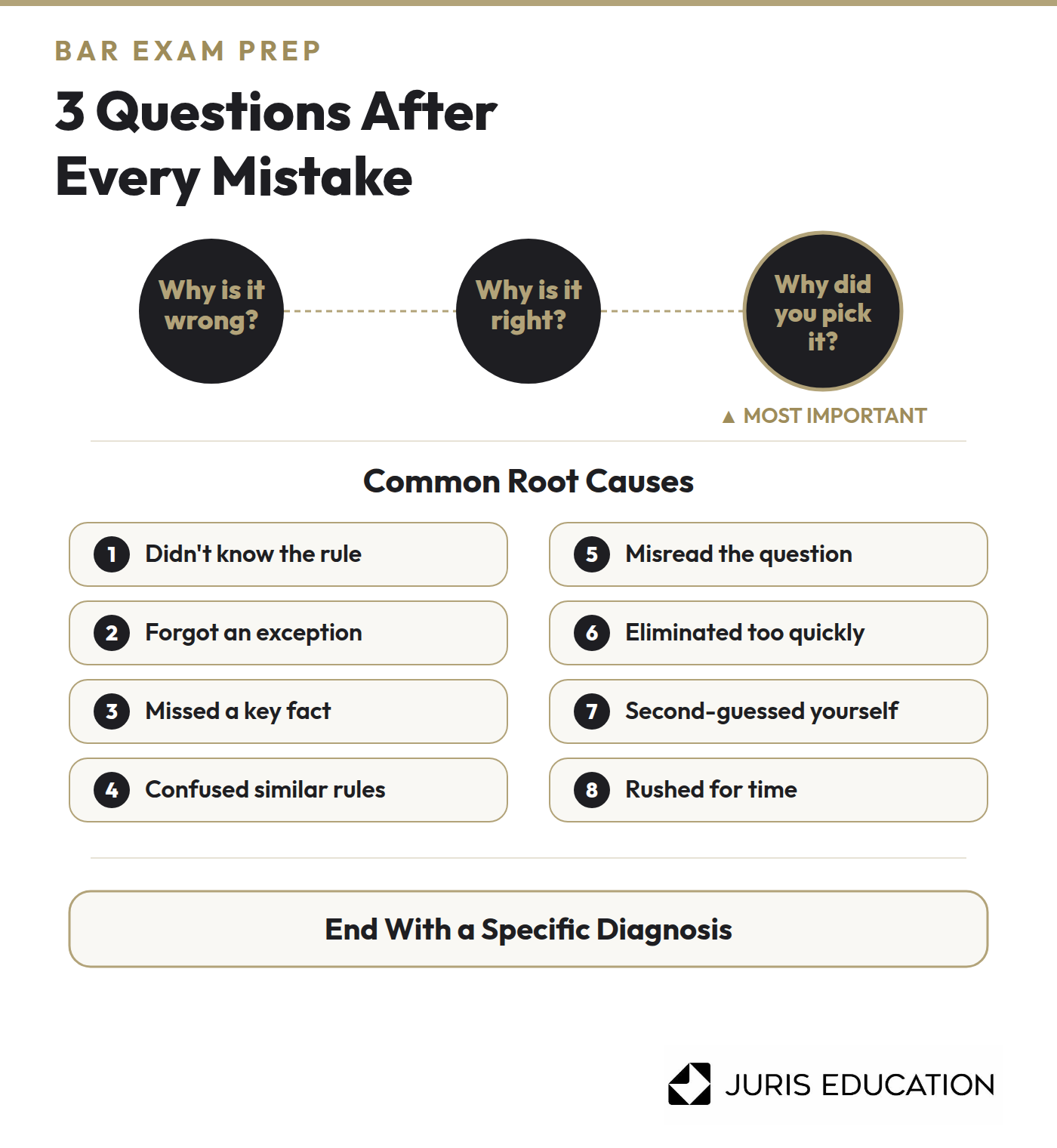
One of the experts I spoke to shared three specific questions you should ask yourself after every missed question: "Why is the answer you chose incorrect? Why is the correct answer correct? And why did you pick the incorrect answer?”
That third question matters most. An answer explanation can tell you why C was correct, but only you can figure out why you chose B instead.
Maybe you:
Each answer review should end with a specific diagnosis. For example, instead of just saying you got an Evidence question wrong and moving on, you should be able to pinpoint that you knew the hearsay rule but forgot that an excited utterance can still be admitted in court under certain conditions. That gives you something concrete to fix.
One wrong answer won’t tell you how to adjust your prep. But 10 wrong questions with the same type of mistake tell you exactly where you need to spend more time.
Create an error log for the questions you miss and sort each mistake into one of four categories:
Then add the subject and specific doctrine that was involved in the question scenario. Here’s an example of what your log might look like:
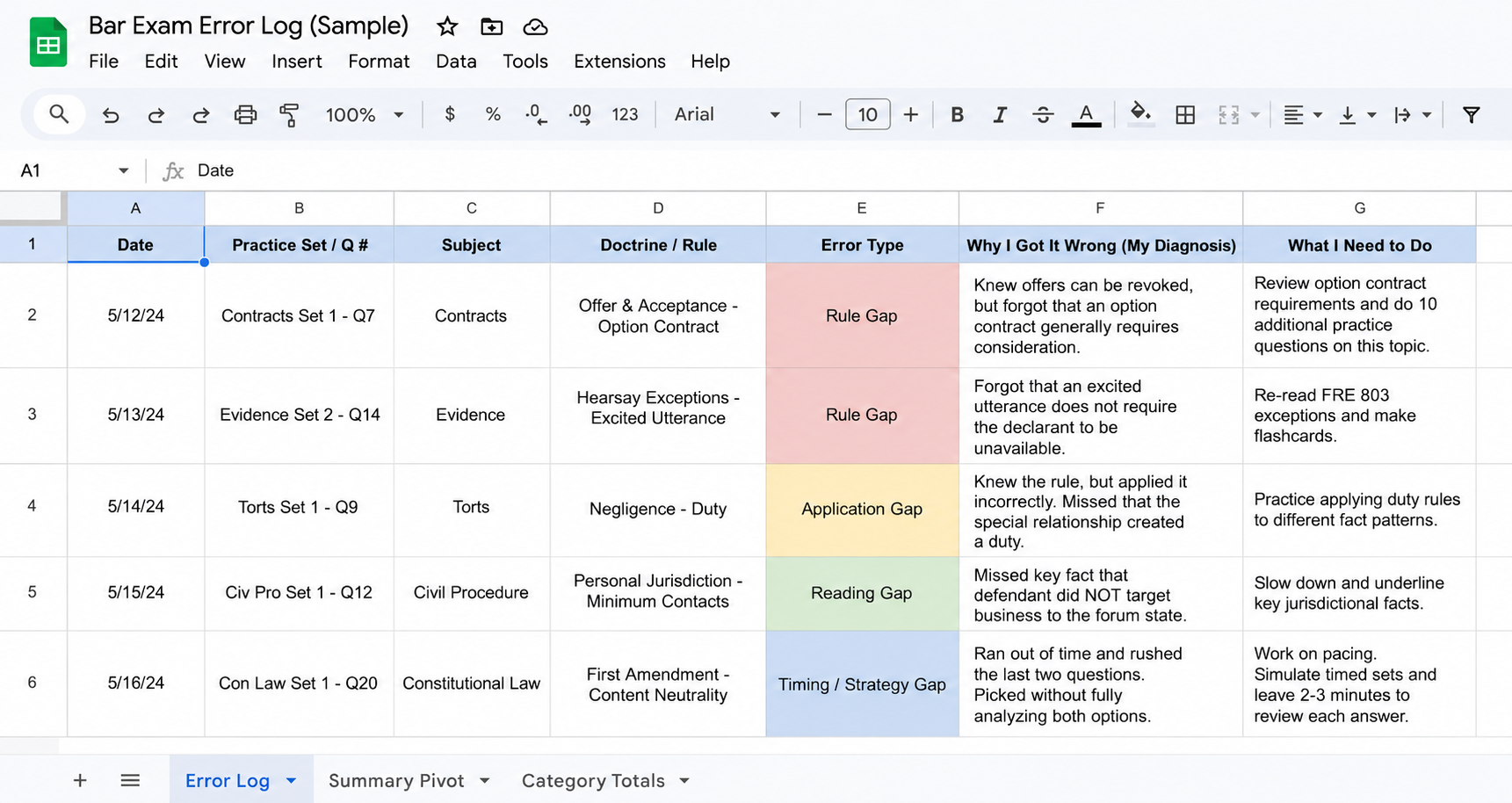
After finishing a few practice sets, look at which categories appear in your log most often. If most of your errors are rule gaps, you should probably spend more time learning and memorizing the law.
If your rules are solid but application gaps keep appearing, you need more practice applying those rules to the facts.
If you have a lot of reading errors, simply slowing down and using the process of elimination can help you gain more points. If it’s a combination of two or three, then you need to adjust your studying approach or study schedule altogether.
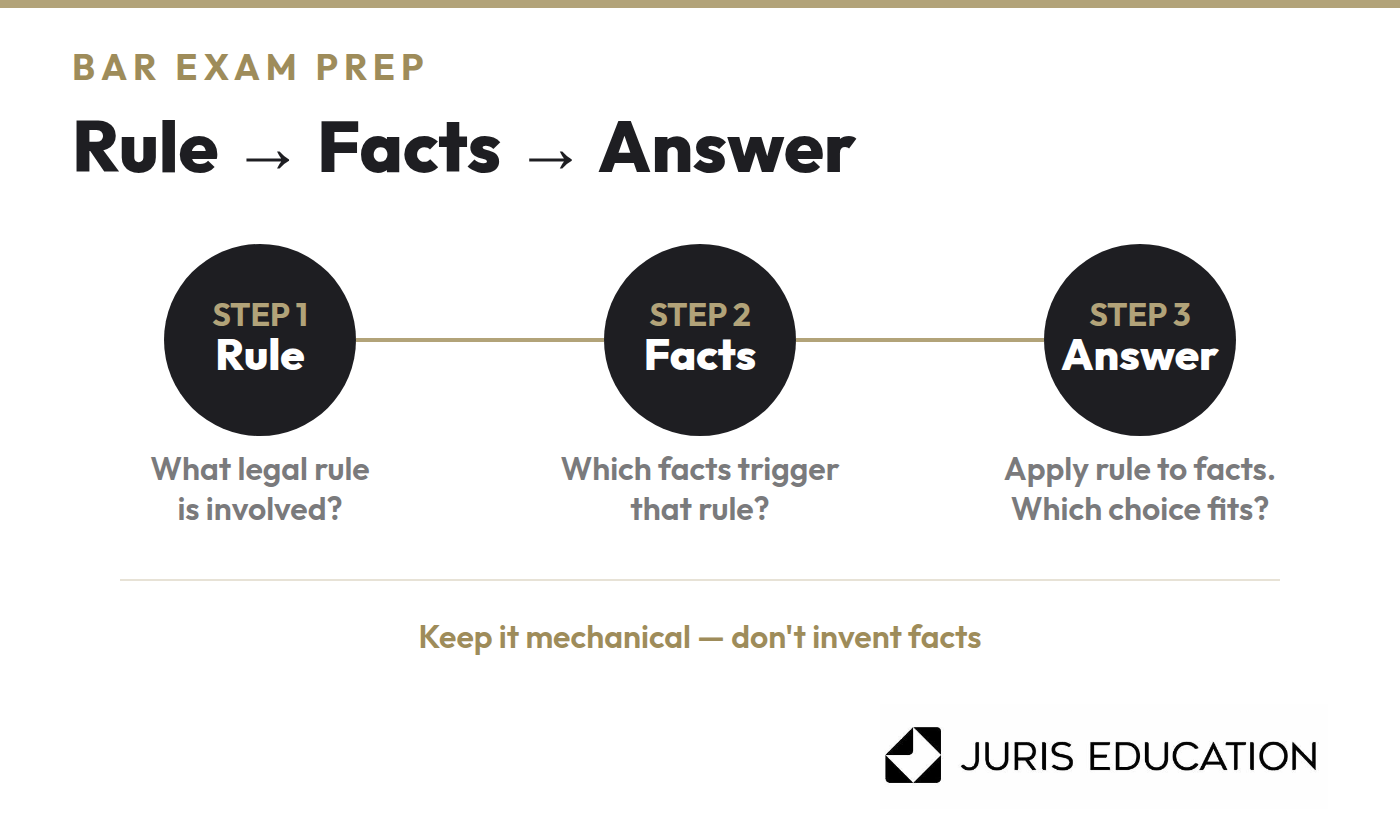
When you review a question, you should always break it down into three parts:
1. Rule: What legal rule is involved in this question?
2. Facts: Which facts trigger that rule, exception, or defense?
3. Answer: Which choice makes sense when you apply that rule to those facts?
One of the experts I spoke to emphasized rule number two in particular. She said to keep this process mechanical and not to invent facts that aren’t in the fact pattern.
Take an Evidence question about an excited utterance, for example. When you break it down, it should look something like this:
Rule: The Federal Rule of Evidence 803(2) says a statement about a startling event can be considered in court only if the speaker makes it while under the stress of the event.
Facts: The passenger makes the statement seconds after a serious crash and is shaking and crying while saying it.
Answer: Those facts support the excited utterance exception, so the statement may be considered and isn’t automatically hearsay.
This approach keeps you focused on the facts presented in the question. It also makes it easier to spot where you went wrong on incorrect answers.
The legacy Uniform Bar Examination uses the 200-question Multistate Bar Examination alongside essay and performance-test components. The MBE tests Civil Procedure, Constitutional Law, Contracts, Criminal Law and Procedure, Evidence, Real Property, and Torts. The NextGen UBE uses standalone multiple-choice questions, integrated question sets, and performance tasks.
Yes, the bar exam is notoriously difficult. It requires you to memorize all of the specific elements of hundreds of legal rules, spot issues quickly, read carefully, and perform well under pressure. Some jurisdictions, like California and New York. also have reputations for having particularly difficult bar exams.
Start practicing for the bar exam with a structured study plan that combines rule review with active practice. Most students require at least 300-400 hours of dedicated prep time to succeed on this exam. Work through multiple-choice questions, essays, or written exercises, and performance tasks that match your jurisdiction’s current format. Review every missed question and any question you answered correctly for the wrong reason. NCBE currently provides official study aids for both legacy exams and the NextGen UBE.
Jurisdictions that continue to use legacy exam components may use Multistate Essay Examination (MEE) questions or locally written essays. MEE questions require you to analyze a fact pattern and apply relevant legal rules.
The NextGen UBE doesn’t include a true essay section. Instead, it uses short-answer questions, medium-length written responses, and longer legal writing assignments.
You should complete at least 1,000 practice questions before writing your bar exam. This is a general benchmark to aim for, so you may need less depending on your performance. Regardless of how many practice questions you do, carefully review each of them to actually improve your score.
Official practice questions are better because they give you the most realistic picture of what the exam questions will look like and how hard they’ll be. NCBE specifically says its study aids are created by real exam authors and aligned with the test you will take. Third-party questions are still good to use, though, since they can give you more practice volume, explain rules in more depth, and help you drill weak areas. Use both for the most comprehensive prep.
The Baby Bar Exam, formally called the First-Year Law Students’ Examination (FYLSX), is a California exam covering Contracts, Criminal Law, and Torts. It consists of 100 multiple-choice questions, has no essay section, and requires a scaled score of 560 to pass.
You generally only need to take it if you attend an unaccredited registered law school, participate in California’s Law Office Study Program, or entered law study without completing at least 60 semester or 90 quarter units of undergraduate coursework.
Co-Founder of Juris Education, Dartmouth College


.svg)
