Get in touch: +1 888 904 4161



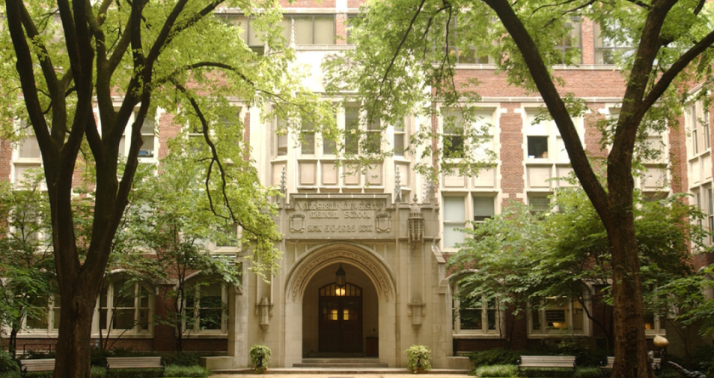
Vanderbilt Law School hit its lowest acceptance rate in five years last cycle, and the margin between accepted and rejected at Vanderbilt Law often comes down to whether the admissions committee believes you'll strengthen the community or just occupy a seat in it.
I spoke with several of the former law school admissions officers on my team to understand what students need to do to stand out to the admissions committee, and I’ve incorporated their advice into this guide. I also cover which scores make you competitive, what Vanderbilt Law's admissions criteria demonstrate about its priorities, and how to build an application that focuses on the collaborative instincts the school values most.
If you’re just here for the requirements, click here.
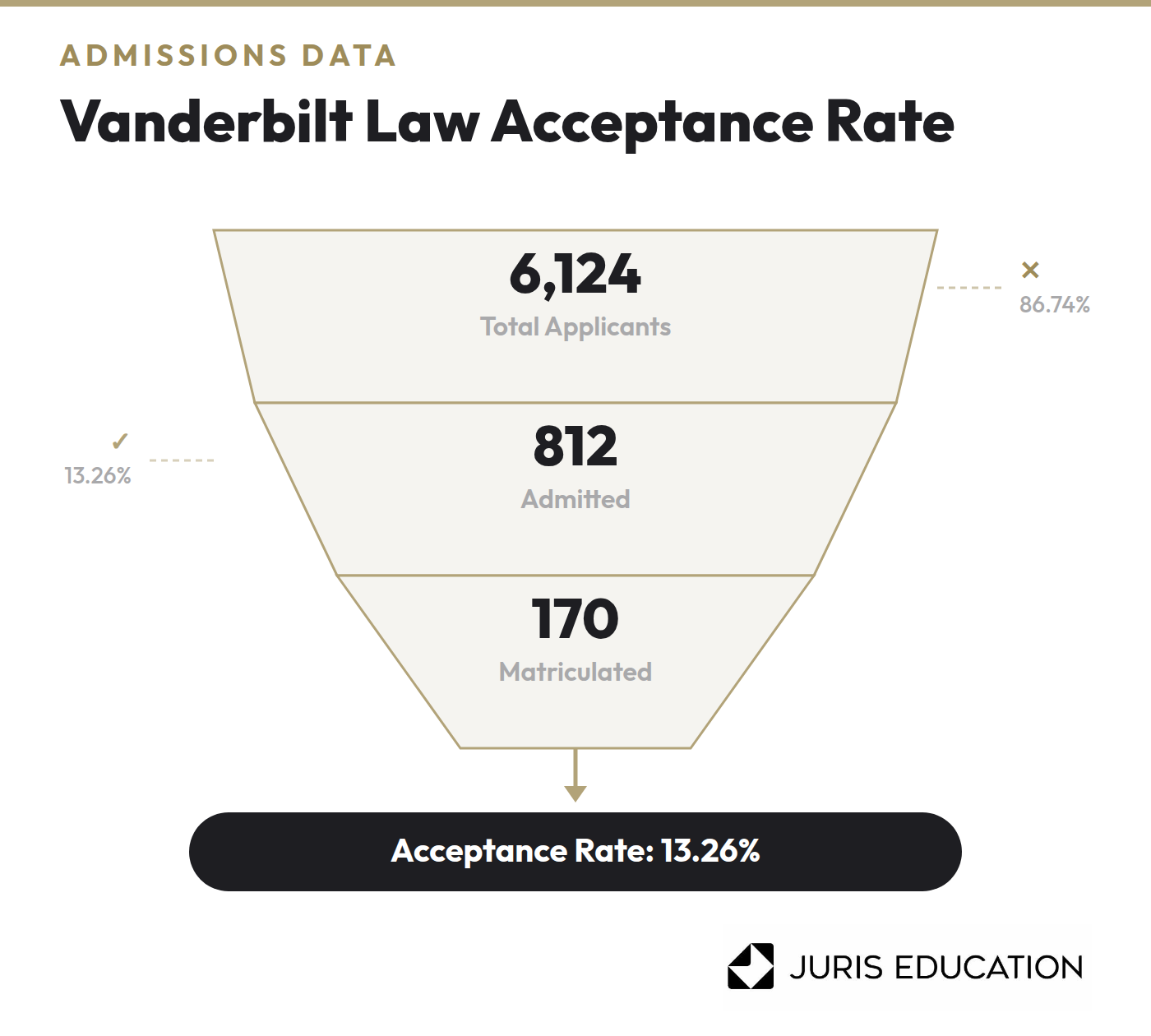
The acceptance rate at Vanderbilt Law School in the 2025-2026 admissions cycle was 13.26%, according to data from the American Bar Association (ABA). In this admissions cycle, Vanderbilt Law School received 6,124 total applicants, offered 812 admissions, and 170 students matriculated.
Here’s a look at Vanderbilt Law School’s admissions statistics from the past five admissions cycles:
It’s very difficult to gain admission to Vanderbilt Law School, as just over 1 in 10 students got accepted in the 2025-2026 admissions cycle. Over the last five years, Vanderbilt Law School has averaged only a 15.45% acceptance rate, meaning most students aren’t accepted. You need an exceptional application to stand out at Vanderbilt Law School, with specific reasons why studying law at their school is the only path toward your legal future.
In the 2025-2026 admissions cycle, Vanderbilt Law School's median LSAT score was 170. You don’t need a minimum score to be considered for admission, but you do need a competitive score to stand out.
Use the tool below to see how your score compares with previous matriculants in the 2025-2026 admissions cycle:
The national median LSAT score among all law school applicants was 159 in the 2025-2026 admissions cycle, according to the Law School Admissions Council (LSAC). That means most students at Vanderbilt Law School score 6.92% higher on the LSAT than all law school applicants.
Vanderbilt Law School’s median GPA of all matriculants in the 2025-2026 admissions cycle was 3.91. There’s no minimum GPA to be considered for admission.
Enter your GPA into the tool below to assess its competitiveness compared with the recent matriculating class:
In the same admissions cycle, the national median GPA among all law school applicants was 3.68, according to the LSAC. That means most students at Vanderbilt Law School have a GPA 6.25% higher than the national median.
Vanderbilt Law School doesn’t accept the GRE as part of its admissions process. If you don’t plan on taking the LSAT, you can submit the JD-Next. However, most applicants submit the LSAT when applying to Vanderbilt Law School.
Write the Lived Experience Statement with the same care and specificity you give your personal statement. Vanderbilt Law School is one of the few T-14 law schools that requires a separate essay about what you’d contribute to the educational environment.
The admissions page frames the Lived Experience Statement around "a broad mix of individual backgrounds, experiences, skills, knowledge, and interests," and the FAQ page reinforces that readers want "a glimpse of who you are and the unique background and life experiences that have brought you to the point of applying to law school at Vanderbilt."

Find something specific about your background that would contribute meaningfully to a class conversation. For example, if you grew up in a military family and moved every two years, explain how that gave you a framework for thinking about federalism or jurisdictional conflicts. If you worked in healthcare before law school, describe how patient consent questions shaped your interest in legal reasoning.
Treat the personal statement as your answer to the “Why law?” and “Why law now?” questions and the Lived Experience Statement as your answer to the “What unique perspective will you contribute to Vanderbilt Law School?” question.
Take a look at the video below to learn how to craft your application narrative:
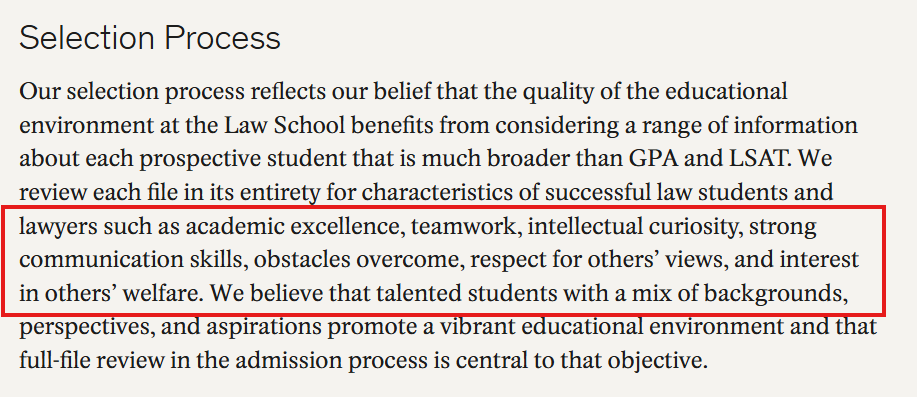
Frame your application around moments when you made others better, not just yourself. Vanderbilt Law School describes its culture as "highly collaborative" on its About page, "collegial" in its LSAC profile, and "close-knit" on the Why Vanderbilt page. The Binding Early Decision selection criteria list "teamwork" and "respect for others' views" alongside academic excellence.

The school runs a house system that organizes students into small communities designed to build the kind of cooperative relationships it screens for in admissions. An application that only describes individual accomplishments misses what Vanderbilt Law School says it values most.
Use your resume and recommendation letters to highlight team-oriented work. A recommender who writes about how you elevated a group project or mentored a struggling colleague speaks directly to Vanderbilt's stated culture. In your interviews, describe a situation where you navigated disagreement productively rather than one where you won an argument.
To learn more about letters of recommendation, watch the video below:
Find the specific Vanderbilt Law School academic program that aligns with your goals and reference it in one of your essays. Vanderbilt Law School offers 11 programs for a class of roughly 173 students, which means the school has invested heavily in specialized pathways such as:
Naming a program shows you’ve researched what makes Vanderbilt Law School different from other law schools. A pre-med applicant interested in health law, for example, would stand out by explaining how the Weaver Program's intersection of neuroscience and legal decision-making connects to their clinical research background.
An applicant with a startup or tech background would stand out by referencing the Law & Innovation Program rather than writing generically about studying "emerging technology law."
Record your Video Essay with the same preparation you’d give a job interview. Vanderbilt Law School's Binding Early Decision (ED) track requires applicants to complete a recorded Video Essay through the applicant portal.
The ED selection criteria explicitly list "strong communication skills" and "intellectual curiosity" as traits the committee evaluates.
Most applicants underestimate the video component, treating it as a casual introduction. At Vanderbilt Law School, the Video Essay is one of the few opportunities where the admissions committee can evaluate how you think and communicate in real time.
Prepare by practicing your answer to a broad question about your interest in law, but don’t follow an internal script word for word. Your goal should be to sound casual, but confident.
Speak to the camera the way you’d talk to a professor during office hours at a school that prides itself on "open-door" faculty access. If you’re not applying ED, you lose access to this particular tool, which makes every other written component of your Regular Decision application more important to help you prove these skills.
Document specific instances where you worked to improve someone else's circumstances. Vanderbilt Law School's Binding Early Decision selection criteria list "interest in others' welfare" as a characteristic the committee evaluates in prospective students. Even if you’re not applying to the ED program, it’s very evident that Vanderbilt Law School looks for students who’ve helped others.
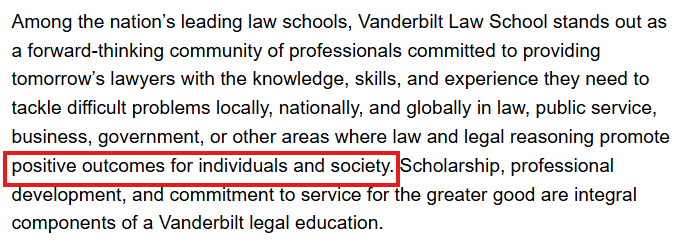
According to the LSAC, Vanderbilt Law School aims to produce lawyers who "promote positive outcomes for individuals and society." Vanderbilt Law School also has a dedicated Office of Culture & Community, which is committed to "belonging, community, and growth for all."
On your resume, quantify the impact of your responsibilities wherever possible. If you volunteered at a legal aid clinic, specify how many clients you helped intake or how many hours you contributed.
In your personal statement, ground your motivation for law in a real person or community you served rather than an abstract commitment to justice. Vanderbilt Law School's admissions committee reads thousands of essays about "wanting to make a difference." The applicants who stand out are the ones who write about how they already have.
Work with a Juris Education consultant to help you get into Vanderbilt Law School. Our experts know what a winning Vanderbilt Law School application looks like, and they know how to get you accepted.
A competitive candidate at Vanderbilt Law School pairs a 171+ LSAT score with a 3.97+ GPA and brings collaborative experience that demonstrates they can work in a team-oriented environment. Those numbers align with the 75th percentile of the most recent entering class, and hitting both puts you ahead of the majority of admitted students in the initial screening phase.
According to Vanderbilt Law School's Class of 2028 profile:
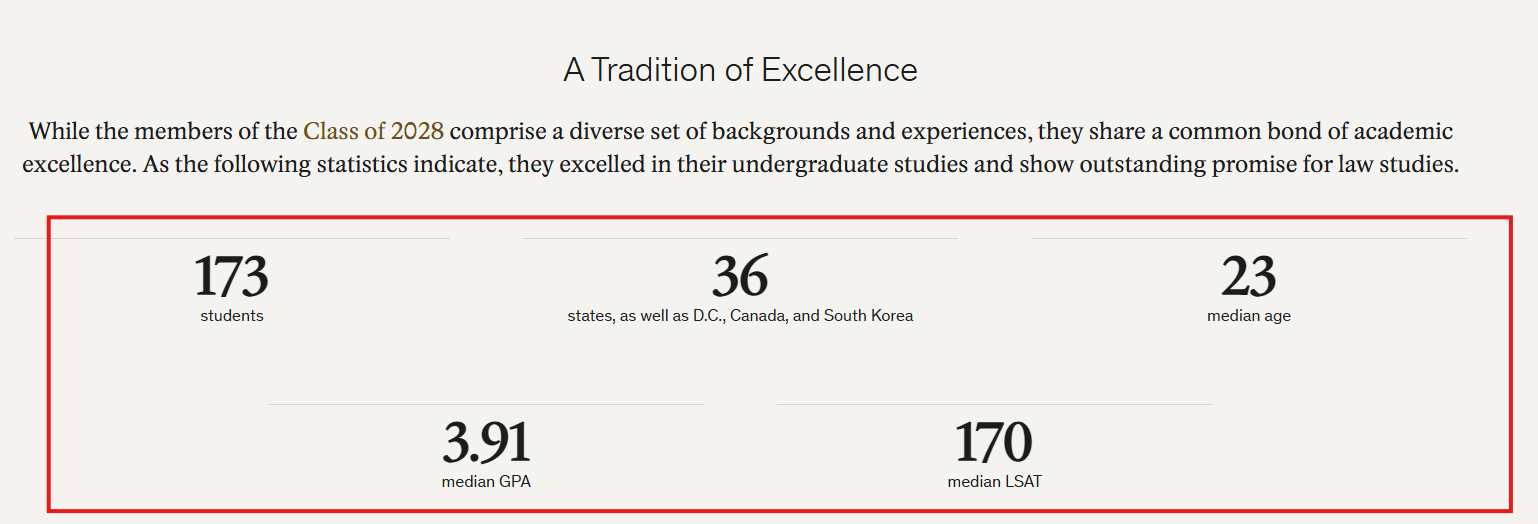
These statistics show that Vanderbilt Law School admissions officers look for real-world depth and a range of professional perspectives that feed into collaborative classroom discussion. The entering class included students who had worked at:
Your strongest application will combine top-tier academics with hands-on professional experience and a Lived Experience Statement that explains what specific perspective only your background can contribute to Vanderbilt Law's close-knit community.
Submit all application materials through the LSAC and its Credential Assembly Service (CAS). Vanderbilt Law School uses a rolling admissions process and won’t review your application until it receives all required materials. Here’s everything you need to submit:
The application opens September 1. The Binding Early Decision deadline is November 1, and the Regular Decision deadline is April 1.
Watch the video below for a comprehensive law school application checklist:
We ranked Vanderbilt Law School as the 20th best law school in the nation. The school consistently places among the top programs for employment outcomes, with 98.2% of the most recent graduating class securing employment within 10 months of graduation and 9.0% landing federal clerkships.
Vanderbilt Law School's first-time bar passage rate is 94.64% for the class of 2025, based on the most recent ABA bar passage data. That rate has remained remarkably stable over the past three years, with the class of 2024 passing at 94.51% and the class of 2023 passing at 96.97%. In individual jurisdictions, Vanderbilt's class of 2025 posted a 100% first-time pass rate in both California and Illinois, a 95.00% rate in Tennessee, and a 93.10% rate in New York.
Vanderbilt Law School offers optional alumni interviews as part of the admissions process. Applicants can request an interview by completing the interview request section of the application and submitting it by December 1. More than 800 Vanderbilt Law alumni across the United States and in several foreign locations conduct interviews on behalf of the admissions office. Most interviews take place outside Nashville with an alumni interviewer near the applicant, though on-campus interviews are available for applicants visiting Nashville. Applicants who participate in an interview receive priority review, meaning their applications move to the front of the review queue once they receive the interview report.
Vanderbilt Law School offers 10 academic programs within the JD curriculum, covering areas from business law to neuroscience. Beyond the JD, Vanderbilt offers an LLM for internationally trained lawyers, a Master of Legal Studies, and a PhD in Law and Economics. Dual-degree options include the JD/MBA, JD/MS in Finance (doable in three years), JD/MD, JD/Master of Public Policy, JD/PhD in Neuroscience, and JD/Master of Divinity or Master of Theological Studies through Vanderbilt Divinity School. The school also runs Vanderbilt in Venice, a summer study-abroad program.
David Merson was the original author of this article. Snippets of his work may remain.
Co-Founder of Juris Education, Dartmouth College


.svg)
