Get in touch: +1 888 904 4161





Every year, our team works with pre-law students who don’t know what it looks like to pursue a legal career. They know law school is intense and that they have to take difficult tests, but they aren’t aware of the requirements for both law school and any additional specialties.
That lack of clarity costs applicants time and money. I've seen students choose the wrong undergraduate major just because they thought law schools required one. I've seen applicants waste years of core resume-building experience because no one told them admissions committees prioritize meaningful work experience. I've watched students realize too late that the specialty they wanted requires additional credentials they could’ve started planning for way earlier.
The process of becoming a lawyer might sound straightforward, but you have to make many decisions that depend entirely on the kind of law you eventually want to practice.
I created a complete, step-by-step guide to help you on your journey to starting a career in law, along with the specialty-specific requirements you need to consider now.
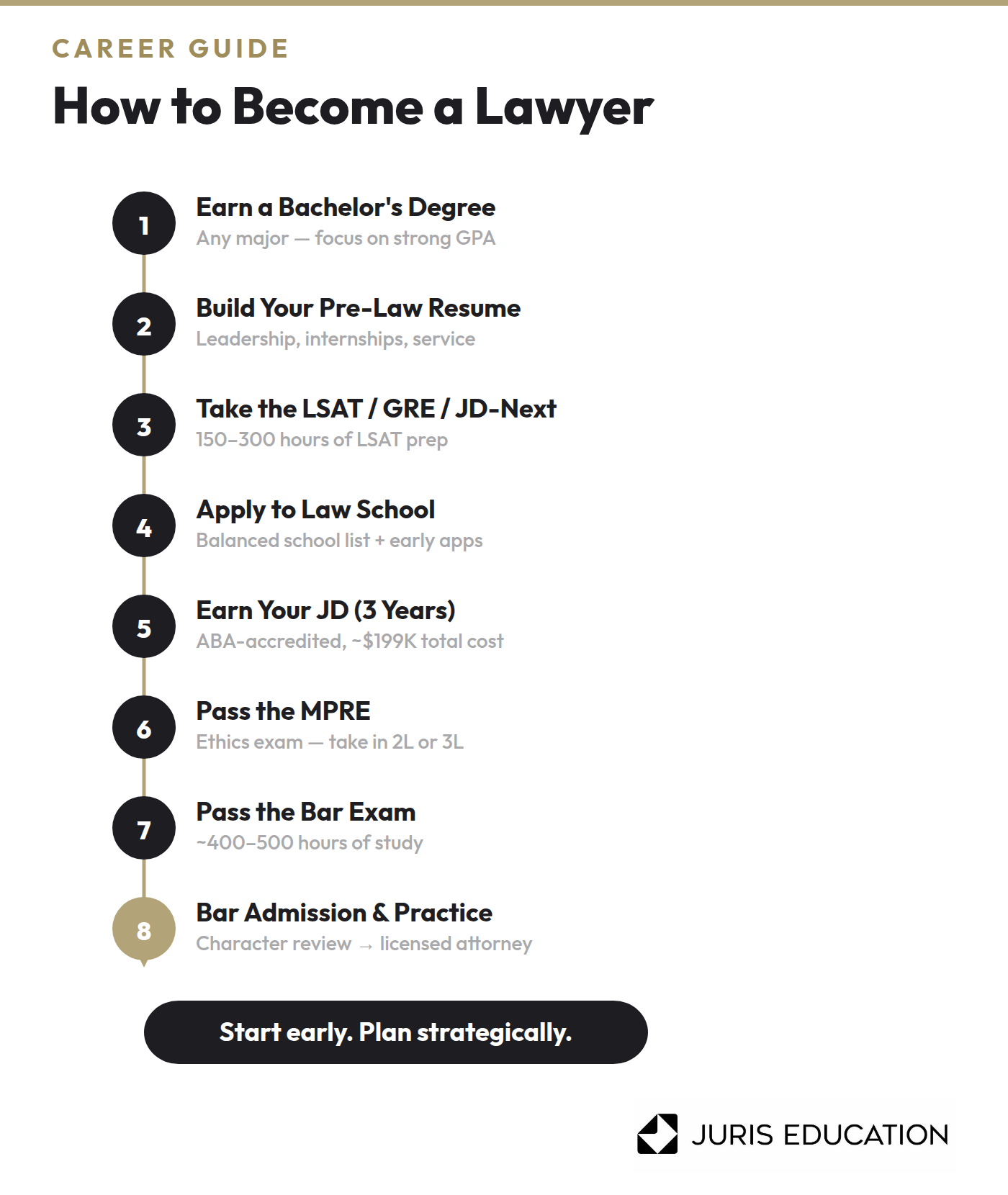
You need a bachelor's degree to apply to law school. You don’t need a specific major because law schools don’t favor one over another. Political science, English, philosophy, and history are excellent choices, but admissions committees care far more about your GPA than your major.
Pick a major that interests you and that you can earn strong grades in. A high GPA will factor into your competitiveness for law school admissions, and choosing a subject you find interesting makes that more attainable.
In our law school application webinar, Jesse Wang, a Juris Education consultant and graduate of USC Gould School of Law, shares his insights on choosing the right major.
"Having a STEM major can be a great launching point for a career in patent law,” he says. “People don't want to keep looking at the cookie-cutter political science graduate ... if you’re a biology major, by all means you can go to law school and you could be great at it, too."
If you already know which area of law interests you, enroll in early coursework that builds the foundation of that knowledge. For example, future patent attorneys benefit from degrees in engineering or hard sciences. Students interested in corporate law can learn a lot from economics or accounting courses. This is also your chance to explore different courses to see which area of law interests you most.
Start thinking about law school early in your undergraduate career. Research the prerequisites and admissions expectations of your target schools so you can plan your transcript well in advance.
Law school admissions committees evaluate more than grades and test scores. Your resume needs to show meaningful involvement in extracurriculars, work experience, volunteer service, and leadership roles.
The strongest applicants build a track record of sustained commitment rather than a long list of one-off activities. Mock trial, debate, student government, legal aid volunteering, and pre-law organizations all give you impressive experiences for your resume. Internships at law firms, government offices, or nonprofits show admissions committees that you understand what legal work entails before committing three years and six figures to a degree.
Stay involved in your activities throughout your undergraduate career. Show up to each event, earn a leadership position, and show that you worked towards a goal over a long period of time. Large gaps on your resume indicate that you were disengaged, lazy, or uninterested, and admissions officers might question your readiness for law school.
The LSAT is the standard admissions test for law school, and your score is one of the two most important numbers in your application alongside your GPA. LSAT registration costs $253 for the 2026-2027 testing year, with additional fees for the Credential Assembly Service (CAS) and score reports sent to schools.
A growing number of law schools also accept the GRE in place of the LSAT. Check whether your target schools accept GRE scores before committing to either test.
You can also take the JD-Next, an eight-week online program that culminates in a law school admissions assessment. Unlike the LSAT, JD-Next teaches foundational 1L skills such as case law analysis, legal reasoning, and analytical writing, and then measures your proficiency in those areas.
Over 60 law schools can currently accept JD-Next in place of the LSAT for the 2025-2026 admissions cycle, and that number is growing. Registration ranges from $399 to $499 depending on when you sign up.
JD-Next works well for applicants who demonstrate their abilities more effectively through coursework than timed standardized tests, but confirm with each target school whether they accept it as a primary admissions test or only as a supplemental addendum.
Regardless of which test you take, aim to complete it in the summer or early fall of the year you plan to apply. Most law schools use rolling admissions, so submitting your application early gives you access to more seats and more scholarship money.
If your first LSAT score falls below your target range, you can retake the exam. Plan for 150 to 300 hours of dedicated LSAT preparation to give yourself the best chance of hitting a competitive score on the first attempt.
Once you have your bachelor’s degree and LSAT, GRE, or JD Next, put your application materials together. A complete law school application typically requires:
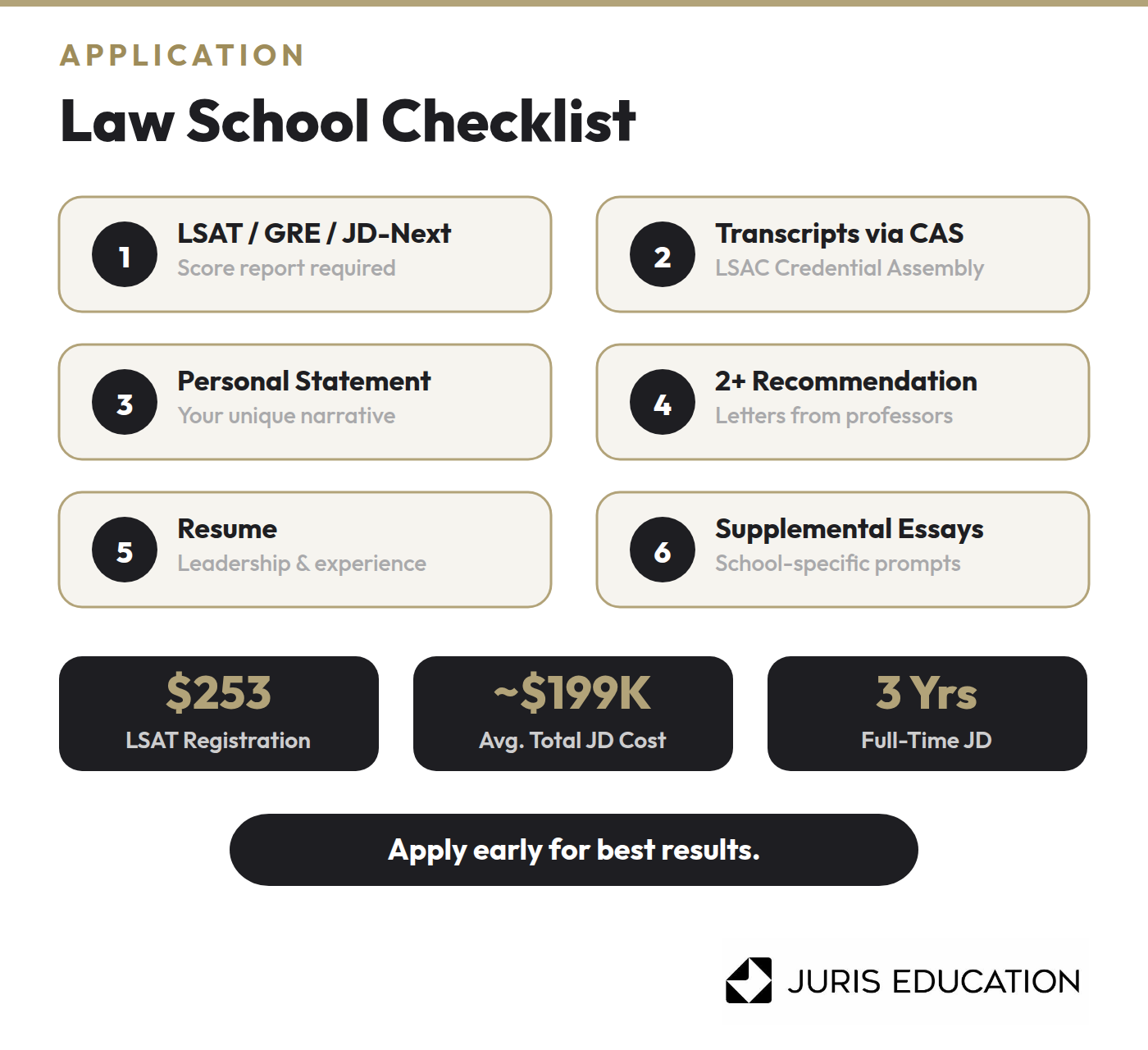
Research each school's average LSAT and GPA to build a balanced list of schools. Review each program's strengths in the practice areas that interest you, as well as bar passage rates, employment outcomes, and scholarship availability.
Working with an experienced admissions consultant like Juris Education can help you build a school list that maximizes your chances of acceptance and financial aid.
Take a look at the video below for a comprehensive breakdown of the law school application checklist.
You need a JD from an ABA-accredited law school to sit for the bar exam and practice law in the United States. Full-time JD programs take three years to complete, whereas part-time programs at some schools extend that to four years.
The first year (1L) covers foundational courses that are largely standardized across law schools:
Your second and third years offer opportunities for electives, clinics, externships, and seminars to begin building knowledge in your areas of interest.
Your 1L grades determine your eligibility for law review, moot court, and many of the summer associate positions that lead to post-graduation job offers. Treat your first year as the highest-stakes academic period of your career.
Average law school tuition runs approximately $32,000 per year at public schools for in-state students and roughly $57,000 to $60,000 per year at private institutions. The total cost of a JD (including tuition, fees, and living expenses) averaged approximately $199,000 for the Class of 2026.
A JD is the foundational law degree in the United States, so you need it to take the bar exam and practice law. An LLM (Master of Laws) is a one-year graduate degree that builds on top of an existing JD or its foreign equivalent.
You can’t practice law in the U.S. with only an LLM unless you hold a qualifying law degree from another country and your state allows it.
In our primary application webinar, Wang also provides his insights on LLM programs.
"Some people will actually go to law school, get their JD, work a little bit, and then get their LLM in tax law,” he says. “That's actually quite common, and there are certain schools that have really desirable LLM programs."
Most aspiring lawyers need only a JD. Pursue an LLM if you want to specialize in a field like tax law, intellectual property, or international law, or if you hold a law degree from another country and want to practice in the U.S. Some specialties (such as tax) view an LLM favorably during hiring, but the degree is never required to practice.
The MPRE tests your understanding of the ethical rules that govern the legal profession. Nearly every U.S. jurisdiction requires a passing MPRE score for bar admission, with the exceptions of Wisconsin and Puerto Rico.
The MPRE is a two-hour, 60-question multiple-choice exam administered three times per year (March, August, and November). The exam costs $185, and most students take it during their second or third year of law school. Passing scores vary by state, typically falling between 75 and 86 on a scaled score range of 50 to 150.
Build a dedicated study schedule, even though the exam is less difficult than the bar exam. The questions require you to apply ethical rules to complex scenarios rather than simply recall them, and underestimating the MPRE is a common mistake.
The bar exam is the final licensing barrier between law school and the practice of law. You must pass the bar in the state(s) where you intend to practice.
Most states currently administer the Uniform Bar Exam (UBE), which consists of:
The exam takes two full days to complete and covers core legal subjects including contracts, torts, constitutional law, criminal law, civil procedure, evidence, and real property.
The NextGen UBE launched in July 2026 in 10 jurisdictions including Connecticut, Maryland, Missouri, Oregon, and Washington. The NextGen format reduces the exam from 12 hours to 9 hours over 1.5 days, shifts toward skills-based assessment rather than memorization, and runs on your personal laptop.
All remaining UBE jurisdictions are expected to transition to the NextGen UBE by July 2028. Check your target jurisdiction's adoption timeline on the NCBE's NextGen page to prepare for the correct exam format.
Bar exam fees range from roughly $250 to over $1,000 depending on the state. Most graduates also invest $2,000 to $4,000 in a bar prep course. Plan for approximately 400-500 hours of dedicated study.
Passing the bar exam doesn’t automatically make you a licensed attorney. Each state has its own admissions process that includes a character and fitness review, in which the bar examines your background for issues such as criminal history, academic dishonesty, or financial irresponsibility. The review is very thorough, so disclose everything beforehand.
Once your state grants you admission to the bar, you can begin practicing law. New attorneys typically enter the profession through:
Your law school's career services office and the relationships you build during internships, clinics, and summer positions will lead your early job search.
Every lawyer follows a similar path, but the journey diverges in the additional credentials, coursework, exams, and experience required by each specialty.
Some specialties require specific graduate degrees or licensing exams in addition to a JD. Other specialties don’t have additional requirements, but applicants benefit from specific elective coursework, clinics, or certifications that demonstrate credibility with employers and clients.
Board certification for lawyers exists in more than a dozen states, where state bar associations or supreme courts certify attorneys as specialists after they meet practice-hour minimums, pass a specialty exam, and undergo peer review.
The table below breaks down what each major specialty requires or recommends beyond the standard JD and bar admission:
The core path to becoming a lawyer in California is the same, but it differs in a few ways. The State Bar of California allows candidates to qualify for the bar without attending an ABA-accredited law school through its Law Office Study Program, which requires four years of supervised study under a practicing attorney or judge.
California has also historically administered its own bar exam rather than the UBE, though the state is now transitioning to the NextGen UBE for July 2028. California also runs its own board certification program through the State Bar's Board of Legal Specialization, which certifies attorneys in areas including appellate law, criminal law, immigration and nationality law, taxation, and intellectual property after a minimum of five years in practice, a specialty exam, and peer review.
The term "lawyer" refers to anyone who has completed law school and earned a JD. The term “attorney” specifically refers to someone who has also passed the bar exam, been admitted to a state bar, and holds an active license to represent clients in court. By this definition, all attorneys are lawyers, but not all lawyers are attorneys. A JD graduate who works in compliance, policy, legal consulting, or academia without bar admission is a lawyer but not an attorney.
Becoming a lawyer takes a minimum of seven years after high school, including four years for a bachelor's degree and three years for a JD. Add two to three months of full-time bar exam preparation after graduation before you can begin practicing.
Yes, you can become a lawyer without attending law school, but only in four states: California, Vermont, Virginia, and Washington. Each offers a legal apprenticeship program that allows candidates to qualify for the bar exam without earning a JD.
Co-Founder of Juris Education, Dartmouth College


.svg)

