Get in touch: +1 888 904 4161




I often see students who don’t think too much about their extracurricular activities for law school. They don’t treat them with the same level of complexity as work experience or academics. After speaking with our top consultants, I know that’s a big mistake.
Extracurricular activities provide evidence of your character, passion, and reason for applying to law school. They give admissions readers further insight into who you are beyond the numbers. Your activities don’t necessarily need to relate to law, since not everyone eats, sleeps, and breathes law school. However, you should include at least some experiences that can directly speak to why you want to become a lawyer.
Below, I’ll outline the best extracurricular activities to include on your application and how to address them.
Extracurricular activities won’t necessarily make or break your application, but they can help differentiate you from other candidates. The following are the most effective extracurricular pursuits and what they tell an admissions committee about your candidacy:
Law schools read your extracurricular activities as further evidence of your character. Your LSAT and GPA answer whether you can handle the requirements. Your activities answer what you’ll do with a law degree, and whether you’ll contribute to the class or just occupy a seat in it.
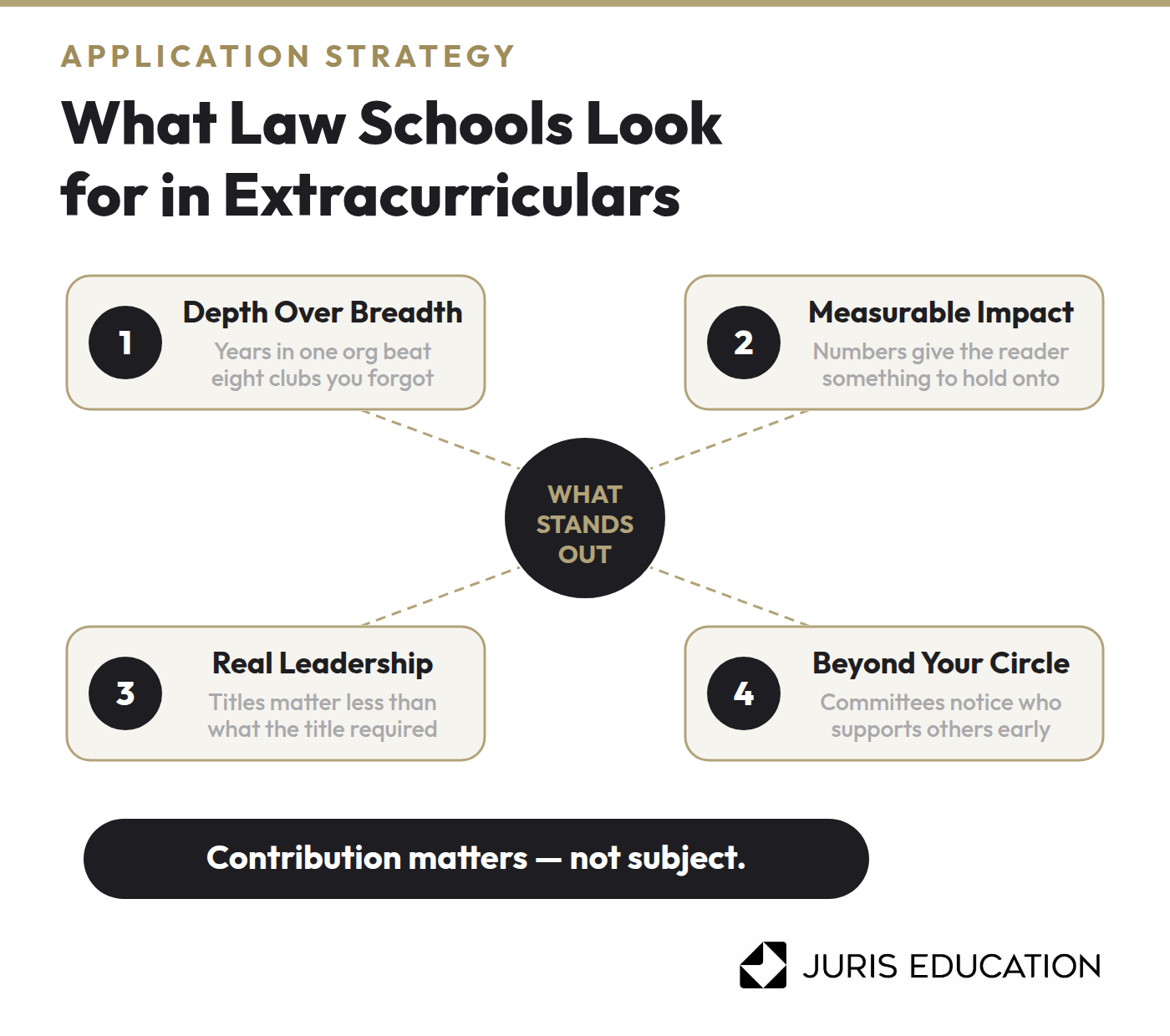
Admissions committees look for four things in your extracurriculars:
In our pre-law webinar, Marcelius Braxton, a Juris Education consultant and graduate of the University of North Carolina School of Law, shares his insights on extracurriculars.
"Any activity can be valuable as long as you show law schools that it can be valuable ... law schools are going to know if you're just taking something just to take it ... they'd much rather see that it’s something you really care about."
Your activities don't have to be law-related. A varsity athlete who captained a team or a musician who built a youth program demonstrates the same discipline and leadership as a pre-law society president. What matters is the record of contribution, not the subject matter.
Extracurriculars are very important for law school admissions. Your GPA and LSAT scores will help you clear the initial screening phase, but your extracurriculars help provide more weight to your application.
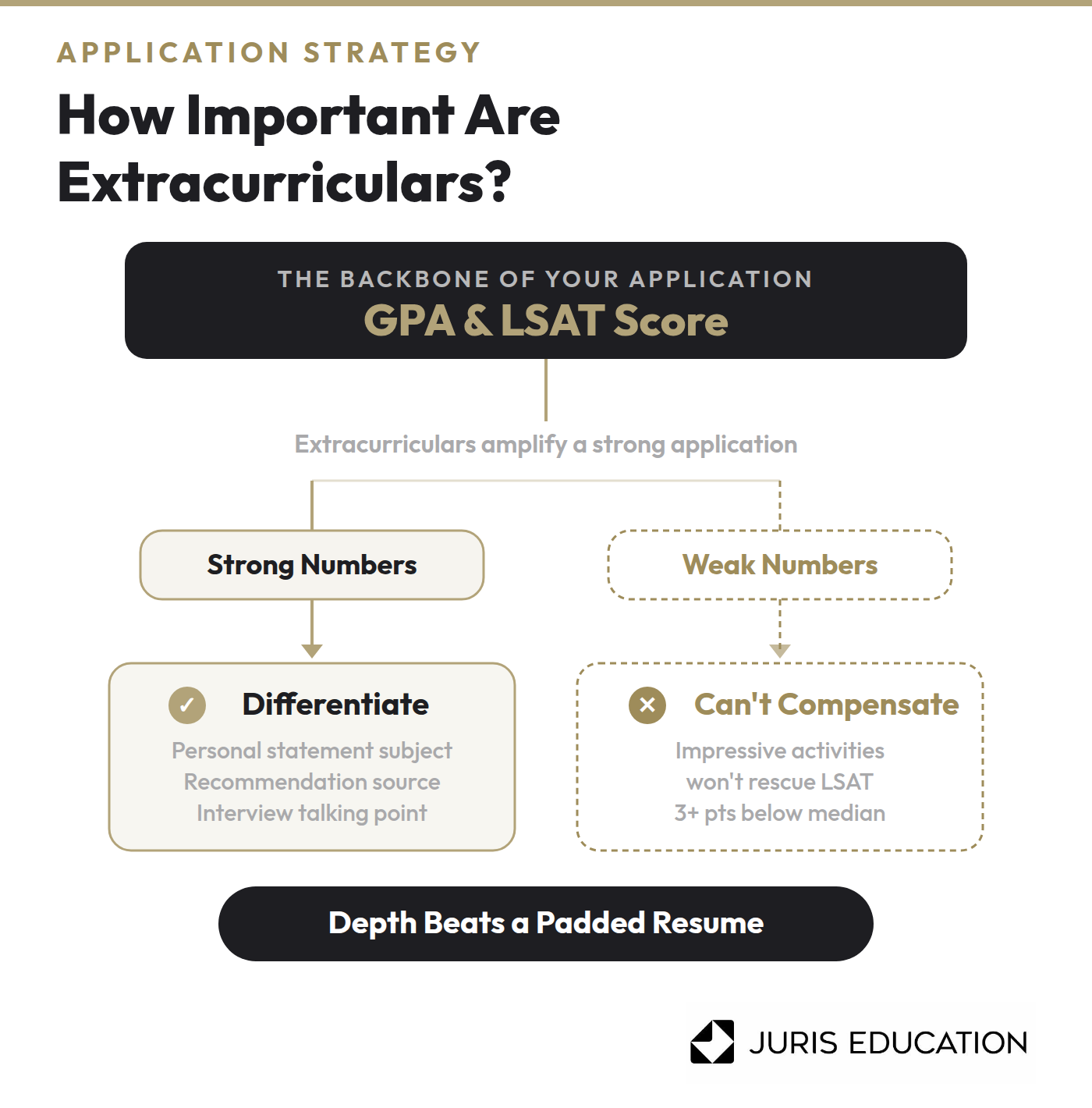
However, even the best extracurriculars can’t save a weak application. All other aspects of your application must be competitive for your extracurriculars to matter. They can help you differentiate yourself from thousands of other candidates.
In our law school webinar, Jesse Wang, an expert advisor at Juris Education and graduate of the University of Southern California Gould School of Law, shares his opinion on the value of extracurriculars.
"You want to get as high of a GPA as possible while also doing as many extra extracurricular activities as possible,” he says. “But if you have to sacrifice one, sacrifice some of your extracurriculars. Your GPA and your LSAT score are the backbone of your application."
In our experience advising law school applicants, students tend to overestimate how much a great extracurricular list can compensate for below-median numbers. It can't.
We've seen applicants with genuinely impressive activity records get waitlisted or turned down at schools where their LSAT fell three or more points below the median. The hard truth is that extracurriculars amplify a strong application. They don't rescue a weak one.
Admissions committees will most appreciate extracurriculars that demonstrate passion, leadership, civic engagement, and significant time commitments.
Your strongest activity usually becomes your personal statement subject, your best recommendation letter source, and your interview talking point. One long-term commitment gives you three pieces of your application puzzle, which is why depth always beats a padded resume.
Here are the best ways to choose the right extracurriculars for you:
Think about something you’re already passionate about. Maybe it’s saving the environment, helping animals, or assisting the elderly. Think about what you genuinely want to see change in the world and how you can help support that.
That lays the groundwork for choosing the right extracurricular activity. If you figure out that you’re passionate about the environment, look at joining your university’s environmental club. Even though it’s not directly related to law, you can still show transferable skills.
None of your activities need to be related to law or the specialty you want to eventually pursue. What matters more is how long you’re able to commit to a project and what you learned from it.
One pattern we see often is applicants panicking during junior year and suddenly joining three law-related clubs at once, thinking it’ll show their commitment. Admissions officers read right through that.
We've watched far more compelling applications come from students who spent two years coaching a youth soccer league or running a campus food pantry than from someone who speed-ran a pre-law society membership in their final semester.
The activity itself is almost irrelevant. The duration and depth of your involvement are the whole story.
Even if you don’t have your application materials ready yet, look at the full picture. Think about whom you’ll ask for recommendations, what personal statement angle you want to take, and what your core application narrative will eventually become. It doesn’t have to be final right now, but just think about the foundation.
Ask yourself whether any part of your application clearly lacks certain skills. For example, if all you have to talk about is your participation in an environmental club, you probably need another activity that exemplifies your active listening or risk assessment skills. If other activities already cover those skills, look for other weaknesses.
Extracurricular activities should fill gaps in your application, so look for holes and cover them with transferable skills. This helps you choose the right activities, tailored to your future application.
The type of extracurricular you participate in matters far less than any verifiable outcomes you can report. Thankfully, outcomes exist in virtually all extracurricular activities.
When highlighting these activities, focus on results. What did you do in that activity and how did it impact the organization? For example, maybe you recruited 20 additional students to your pre-law society, which led to a 150% increase in efficiency. Admissions officers really like to see when you own your impact and highlight how your presence helped others.
Here's something most applicants get wrong: They describe what the organization does instead of what they did.
We review personal statements and resumes in which the student spends 80% of the space explaining the nonprofit's mission and 20% on their own role. Flip that ratio.
The committee already knows what Habitat for Humanity does. They want to know you managed a crew of 12 volunteers and completed three builds ahead of schedule.
When looking for the right extracurricular activities, choose ones you can commit to over the long term. If your school is offering a single-semester club, you’re probably best investing your time elsewhere.
Aim for an extracurricular you can stay in for at least two years. This is especially important for showing growth within a role. If you started as a volunteer in your first year and worked your way up to a leadership role, that shows transferable skills admissions officers love to see.
If you’re still unsure of your extracurricular activities list for law school, here are some last-minute activities you can participate in:
Contact the legal aid office or courthouse in your area to ask about summer volunteer positions. Nonprofit legal aid groups often need an extra hand with client intake, assembling case files, or filing paperwork. There’s no requirement for prior legal training to be of service, and you can generally expect to be up and running with an organization in as little as a week.
That kind of experience on your resume shows law schools you understand the service side of the profession. It’ll provide material for your personal statement and a supervisor willing to vouch for your work ethic in a letter of recommendation.
Look into the mediation programs operating in your community. They put volunteers through their paces to handle disputes among small-claims parties, neighbors, or landlord-tenant issues. A 20- to 40-hour certification is usually available at no cost and can be completed over a couple of weekends.
This type of training is worth pursuing. You’ll come away with negotiation and conflict resolution skills that are directly applicable to what law schools look for in testing. On top of that, it’s a formal credential for your resume that many other candidates will lack.
We recommend mediation training to almost every pre-law student we work with, yet most have never heard of it. That's exactly why it works.
In a pile of applications where half the candidates list "mock trial" and "debate" on their resumes, a formal mediation certification stands out. It also happens to teach the exact skill set that alternative dispute resolution courses will test in law school, so you're getting a head start on a curriculum you haven't even seen yet.
Find a legal subject you’re well-versed in and begin to write. Whether it’s state legislation, a new local policy, or the latest from the Supreme Court, put your analysis down in words on a WordPress page, Substack, or Medium. Try to publish a post every week, and keep it analytical rather than opinionated.
Admissions committees place a premium on strong communication and analytical ability, and regular writing demonstrates that you have both. Your published work also makes for a solid portfolio, a writing sample that says more than a personal statement alone could.
Get involved with a ballot initiative or political campaign in your vicinity. Volunteer for canvassing, phone banking, or a voter registration drive; these are all forms of genuine civic engagement.
If you have the aptitude to take on a coordination role and put some volunteers to work, even better. There’s a correlation between the persuasion and hard deadlines of a political campaign and the realities of legal practice. A summer of this sort provides a leadership narrative grounded in action that law schools will appreciate.
Put in some time at a formal public speaking or debate workshop. Check for university-hosted programs, Toastmasters clubs, or summer debate institutes in your area; they tend to be intensive affairs lasting two to four weeks.
The National Speech & Debate Association also offers online options, if you can’t find anything local. Law school will assume you’re unversed in oral advocacy, but coming in with that kind of training gives you an advantage over peers who’ve never had to make their case before a critical audience. It’ll serve you well in moot court tryouts.
Reach out to a couple of professors whose work aligns with your own and offer your services as a research assistant for the summer. You might find common ground with faculty in the political science or criminal justice departments.
Be clear about what you can contribute to the project and what you hope to gain from it. An assistantship gives a really good recommendation letter, especially if it’s written by someone who’s seen you parse case law or compile data over the course of the summer. That’s the sort of intellectual output admissions want to see.
Students who land these positions send targeted, specific emails. "I'd like to be your research assistant" gets ignored. "I read your article on Fourth Amendment search doctrine in digital spaces and would like to help compile case law for your follow-up project" usually gets a response.
Professors receive dozens of generic requests every semester. Show them you've actually engaged with their work and you'll stand out immediately.
Enroll in a paralegal or legal studies class at a community college or university for the session. You can cover the basics of contract law or civil procedure and get a head start on the 1L vocabulary.
When you arrive at law school, you’ll already know how to brief a case or handle citation format, sparing you the learning curve that trips up most first years and showing the admissions committee some initiative.
Call the county or municipal courthouse to inquire about observer or aide positions. Whether you’re helping with administration or sitting in on hearings to document proceedings, you get to see how arguments play out in the real world, not just in a book.
It’s a good way to round out your personal statement and prove you’ve given some thought to the profession before you sign on for three years of study.
We've had students tell us that a single afternoon spent watching arraignments at a county courthouse changed the direction of their entire personal statements.
There's something about seeing the gap between how law works in a textbook and how it plays out in a courtroom that reframes why you want to do this. If you're struggling to articulate your "why law" answer, spend a week observing before you write another draft. The material will come to you.
You could also identify a local issue and build a project around it. Launch a voter-education effort on campus or organize know-your-rights workshops for immigrants in the community. Make sure it’s measurable.
Starting something from the ground up is different from joining an existing cause; it speaks to your service ethic and project management skills. Just be prepared to cite concrete results when you apply.
Look into internships with a law firm, the district attorney’s office, or a nonprofit. Six or eight weeks, even without pay, will help you become familiar with the regular schedule.
Seek out a place where you work with attorneys, not relegated to a back room with a scanner. It’s the best way to show the reader of your application that you’re serious. And it puts your interest to the test before you’ve spent six figures on a degree. If you like it, you’ll know you made the right choice. If not, you’ve just avoided an expensive error.
We always tell students that if this is going to be your last summer before applications go out, make it count in one direction, not three. Pick one activity from this list that fills the biggest gap in your profile, commit fully, and let the results speak for themselves.
Scattering your time across four different summer projects gives you four mediocre bullet points. Going deep on one gives you a personal statement, a recommendation letter, and a skillset you can talk about in any interview.
Yes, you can get into law school without any extracurriculars, but it’s much easier with them. Your LSAT and GPA help you clear the initial screening phase, but the way you describe your activities provides more insight into your character.
Pursue four extracurricular activities that you can write about on your application. However, focus on long-term involvement in an activity rather than the number of activities you list. One long-term activity will outweigh five short activities, because you won’t be able to write specific enough details.
Yes, work experience can be an extracurricular activity for law school, especially if it involved leadership, problem-solving, or client-facing responsibilities. Managing a retail team, coordinating logistics at a nonprofit, or supervising interns at a government office can provide the same insight as a traditional extracurricular activity. Frame the experience around the skills you gained and the impact you delivered.
Your extracurricular experiences should ideally fall within the last two to four years of your application timeline. Admissions committees want to see what you're doing now, not what you did as a high school sophomore. If your strongest activity happened several years ago, pair it with something current to show the committee you've maintained that same level of engagement.
Online or virtual extracurriculars can strengthen your application when they produce real, verifiable outcomes. Publishing a legal commentary blog, completing a remote research assistantship, or earning an online mediation certification all carry weight because they provide tangible evidence of your skills.
David Merson was the original author of this article. Snippets of his work may remain.
Co-Founder of Juris Education, Dartmouth College


.svg)
