Get in touch: +1 888 904 4161




The University of Chicago Law School (UChicago Law) is one of the most selective law schools in the country, with an acceptance rate below 10%. Strong numbers matter, but most applicants already know that.
What separates admitted students is how well the rest of their application fits UChicago Law's specific culture, and most applicants never learn what that actually looks like.
I sat down with several admissions experts on my team who have served on UChicago Law's admissions committee or helped students earn admission there, and I asked them for the details most guides leave out. Your academic record carries real weight at a school this competitive, but that's the baseline, not the differentiator.
The real signal UChicago Law looks for is whether you treat ideas as worth examining, questioning, and debating. That quality can sound abstract until you see it in practice. Show the admissions committee how you think, how you respond to competing viewpoints, and what you'd bring to an intellectually demanding classroom.
Weave that thread through your essays, recommendations, resume, and interview, and you separate yourself from every other applicant with numbers just like yours.
In this guide, you'll get UChicago Law's latest acceptance rate, LSAT and GPA statistics, and application requirements, plus the school-specific strategies that turn a competitive profile into an admitted one.
If you just need the application requirements, skip to the checklist.
UChicago Law accepted 9.74% of applicants to its most recent entering class. The American Bar Association (ABA) Standard 509 Report shows 6,581 applications, 641 offers of admission, and 191 students who ultimately matriculated.
Here’s a closer look at UChicago Law’s acceptance rates over the last few years:
Applications surged 22.6% year-over-year (from 5,366 to 6,581), while offers actually dropped from 683 to 641. The school didn't just passively become harder to get into; it actively tightened selectivity in the face of rising application volume.
Another major takeaway from this year-by-year breakdown is the applicant-to-seat ratio. Only 191 of 641 admitted students enrolled, a yield rate of roughly 29.8%, meaning UChicago Law extends more than three offers for every seat it fills.

UChicago Law is one of the hardest law schools in the country to get into. At 9.74%, its acceptance rate is the seventh lowest of all ABA-accredited law schools. In other words, 189 of the 196 schools admitted a larger share of applicants than UChicago Law did. More than 9 out of every 10 applicants don’t receive an offer to this law school.
Curious where you stand? Try our admissions chances quiz:
The median LSAT score for UChicago Law's most recent entering class was 174, with the 25th percentile at 171 and the 75th percentile at 176.
Use the tool below to compare your score against the recent entering class:
Arush's Advice
You should aim for 176 or above to be the most competitive. Scoring at UChicago Law's 174 median, you're not standing out; you're blending in. Two points may not sound like much on a 120-to-180 scale, but the LSAT doesn't work that way at the top. Going from 174 to 176 means getting roughly two to three more questions right across the entire exam while making essentially zero careless mistakes on everything else."
You're already outperforming 98% of test takers nationwide at 174. To hit 176, you need to be sharper, faster, and more consistent than almost everyone in the room, including the people who are already scoring at elite levels. That's why a 174-to-176 jump is so much harder than, say, a 160-to-162 jump, even though both are two points.
The higher you go, the more each point costs you in preparation and precision, and the admissions committee knows that. When they see a 176, they're not thinking it's 'just two points above the median'; they're thinking, 'This person performed under pressure with almost no margin for error.' That kind of impression carries real weight.
The median undergraduate GPA for UChicago Law's most recent entering class was 3.97, with the 25th percentile at 3.87 and the 75th percentile at 4.00.
Use the tool below to see where your GPA falls relative to the 2025-2026 entering class:
UChicago Law has the highest GPA composite out of all 196 ABA-approved law schools, according to the Internet Legal Research Group (ILRG)'s 2026 analysis of ABA 509 data. ILRG calculates the composite by averaging each school's 25th, 50th, and 75th percentile GPAs into a single number.
For UChicago Law, that’s (3.87 + 3.97 + 4.00) / 3 = 3.95. No other law school in the country produces a higher average across all three percentile bands, which means UChicago Law's entering class is not just strong at the median but uniformly strong from the bottom quarter to the top quarter.
To add more perspective, the national median GPA for all ABA law school matriculants is 3.68, meaning a student in the bottom 25% of UChicago Law's entering class still outperforms roughly half of all law school enrollees nationwide on GPA alone.
Arush’s Advice
At a school where the median GPA is 3.97, and the 75th percentile is 4.00, your grades actually have very limited room to differentiate you. Think about what that gap actually means in practice: a 3.97 over a typical 120-credit degree is almost all As with maybe one or two A-minus grades across four years. A 4.00 is straight As, no exceptions.
To put that into perspective, the difference between the middle and the top quarter of UChicago Law's entering class comes down to one or two grades over an entire undergraduate career.
A student with a 3.97 and a student with a 4.00 performed at essentially the same level. The admissions committee knows that, and so should you. A 3.97 isn’t a weakness to compensate for. It’s an outstanding academic record that places you squarely in the middle of one of the most credentialed entering classes in the country.
If your GPA is already near the median, focus your remaining preparation time on the LSAT. That’s where meaningful differentiation actually happens.
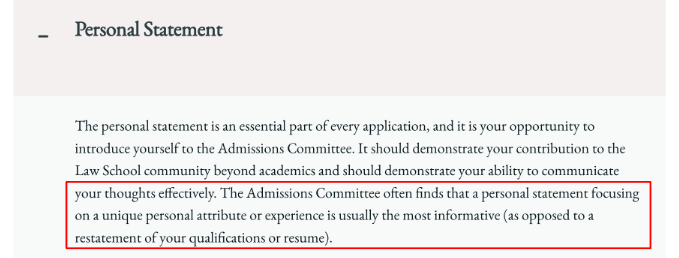
UChicago Law says your personal statement should show what you would contribute beyond academics, and it finds essays about a personal attribute or experience more informative than essays that repeat the resume.
The school also seeks students who are “intellectually curious, lively, collegial, and rigorous.” Its educational mission rests on the belief that ideas matter and deserve serious discussion, while its dean emphasizes the ability to understand and engage with opposing views.
Dean Adam Chilton also describes the law school as a place where ideas matter, no single viewpoint should dominate, and students must learn to understand, engage with, and respond to opposing views. He also says discussion becomes more rigorous when it includes different perspectives.
That makes intellectual engagement a strong lens for your essay. Frame your essay around a moment that shows how you engage with complexity. Write about an assumption you reconsidered, an idea you initially resisted, or a problem that forced you to change your approach. Show what challenged your original thinking and what you did with that tension.
UChicago’s examples of real, successful personal statements model this well. One applicant used piano to explain her shift from technical precision to interpretation. Another showed how he replaced brute effort with strategy in football. A third described learning to weigh competing ideas before accepting or rejecting them.
The topics differ, but each essay reveals a mind questioning, adapting, and forming judgment. Your personal statement should, too.
Our experts go into more depth about what makes a strong personal statement in this webinar:
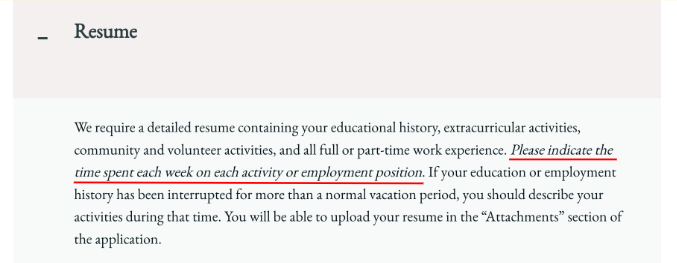
UChicago Law asks for a detailed resume that covers your education, all full- and part-time work, extracurricular activities, community service, and volunteer experience. It also asks you to list the approximate number of hours you spent on each commitment every week.
The school welcomes resumes longer than one page and specifically encourages applicants to include non-legal work and interests.
Show where you invested your time, how your responsibilities grew, and what you became genuinely good at, even when it had nothing to do with law.
The Class of 2028’s profile proves you don’t need law experience to be admitted. This class included 104 research assistants, 58 published authors, 27 musicians, two professional ballerinas, two video game creators, a U.S. rowing coach, and a YouTuber who runs a channel about the Supreme Court. More than 30% of the class also knew at least one coding language.
The common thread here is depth. These students didn’t simply collect interesting hobbies. They pursued their interests until they developed real skill, produced something meaningful, earned recognition, or took on greater responsibility.
They weren’t just writers; they became published authors. They weren’t simply rowing teammates; one became a U.S. rowing coach. They didn’t only play video games; some learned how to create them.
Apply that same standard to your resume. Show that you took your interests seriously. Dean Chilton describes UChicago Law through its “unabashed enthusiasm for the life of the mind.” Let your resume show your version of that. Be specific about what makes you different; then show how far you took it.
An interview invitation means something in your application “piqued” the admission committee’s curiosity, so review your entire file before the 20-minute Zoom call. Be ready to expand on your thesis, research, unusual work experience, or even the interests section of your resume.
Most importantly, in an admissions video, UChicago Law’s Associate Director of Admissions, Meg Bingle, says to prepare strong answers to the two questions the school says it asks consistently: Why law, and why UChicago Law? Bingle explains that a thoughtful, well-researched answer that still seems very natural stands out during the cycle.
Prepare talking points, not a script. For each answer, identify the experience that shaped your interest, what you’ve done since then to explore it, and why UChicago Law offers the right next step.
Instead of listing clinics and courses, connect one specific UChicago Law opportunity to research, work, or an extracurricular already visible in your application. Then explain what you hope to contribute or examine there.
For example, if you spent a summer at a legal aid clinic helping tenants fight eviction. Don't just say you're interested in "housing law" and list the Kirkland & Ellis Housing Initiative Clinic as proof.
Say the eviction cases you worked left you convinced that most housing law fights get lost on procedure, not merits, and that you want the Housing Initiative Clinic specifically because it partners with Chicago's Legal Aid Society on the same kind of procedural defense work you saw fail for your clients.
Then name what you want to examine there: whether early procedural intervention changes case outcomes and how that data could inform tenant advocacy strategy elsewhere.
Practice answering the same question in different words so you know your ideas without memorizing exact sentences. That will help you stay focused while still responding naturally to follow-up questions.
You will also likely be asked a creative question with no correct answer. You can take a moment before responding when needed. Bingle says applicants who ask for time to think show maturity and thoughtfulness, not weakness.
The strongest UChicago Law applicants share a set of characteristics that go beyond meeting numerical thresholds.
No applicant is perfect across every dimension. The applications that succeed at UChicago Law are the ones where each piece reinforces the same narrative: You’re someone who takes ideas seriously, engages with complexity willingly, and would make the 200-person class more interesting by being in it.
To ensure you submit the most competitive law school application, book a consultation with one of our expert counselors.
All JD applications go through the LSAC Flexible Application (entirely paperless; UChicago Law discards any paper materials it receives). Here’s the complete list of required components:
There are no prerequisite courses and no preferred major. UChicago Law explicitly welcomes applicants from every academic discipline, and its entering classes reflect that policy: The Class of 2028 represented 35 different undergraduate majors, with the most common being business, computer science, economics, history, finance, government, international relations, philosophy, and political science. More than 25% majored in a STEM field.
Rather than checking off specific courses, focus on taking rigorous, challenging coursework that develops your writing, analytical reasoning, and capacity for sustained intellectual work. The committee reads transcripts for academic difficulty and performance trajectory, not for compliance with a pre-law checklist.
UChicago Law runs three admissions tracks, each with a December 1, 2026, or March 1, 2027, deadline:
UChicago Law is the fourth-best law school in the nation, according to our rankings. This positioning reflects its elite employment outcomes, faculty, and student resources.
UChicago Law's first-time bar passage rate for 2025 graduates was 96.73% (207 of 214 first-time takers passed). The aggregate first-time pass rate across all ABA-accredited schools in 2025 was approximately 83.77%, putting UChicago Law almost 13 percentage points above the national average.
UChicago Law offers four degree programs and a suite of dual degrees and certificates:
Co-Founder of Juris Education, Dartmouth College


.svg)
