Get in touch: +1 888 904 4161




Getting into Pepperdine Caruso School of Law is more competitive than it has been in the past five years. Its acceptance rate recently fell to a five-year low of 23.36%, while the number of applicants reached a record high. With more students competing for fewer offers of admission, securing a spot at Pepperdine Law has become increasingly difficult.
I spoke with our admissions counselors about what makes a successful Pepperdine Law application, and I learned just how much importance the school places on its mission. This law program is committed to preparing students for lives of purpose, service, and leadership. When the committee reviews applications, it looks for applicants who already live that way, regardless of the faith they bring to campus.
I put together this guide that covers what a competitive Pepperdine Law application looks like beyond your test scores, and how to show the admissions committee the record of service and leadership it wants to see.
If you’re just here to see the requirements, click here.
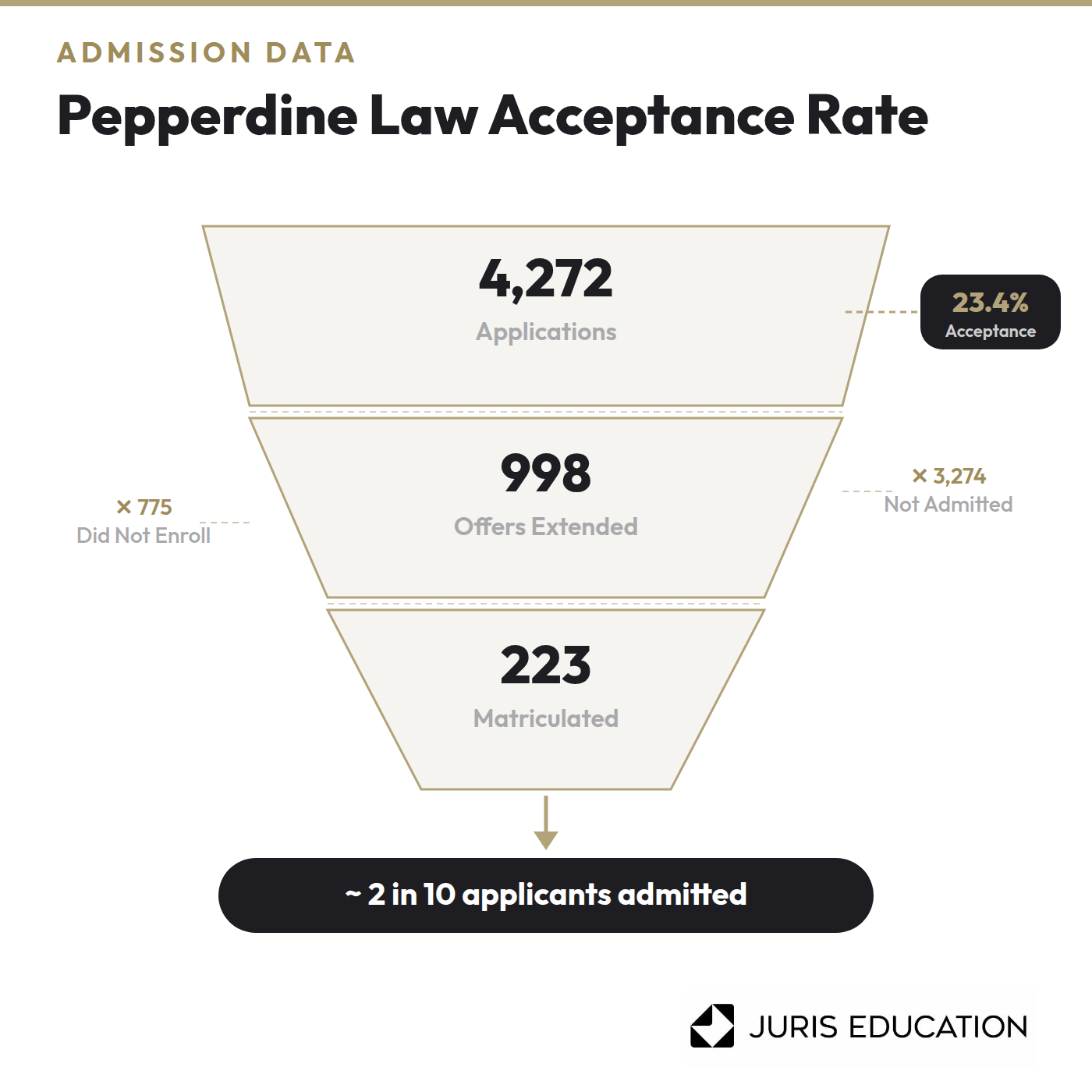
In the most recent admissions cycle, Pepperdine Law's acceptance rate was 23.36%. A total of 4,272 students applied, the school extended 998 offers, and 223 students matriculated.
Its acceptance rate fell 5.08 percentage points from the previous cycle, from 28.44% to 23.36%. Applications increased 10.13%, from 3,879 to 4,272, while offers declined 9.52%, from 1,103 to 998. In other words, Pepperdine received more applications while extending fewer admission offers.
Despite making fewer offers, Pepperdine enrolled more students from its applicant pool: 223, up from 181 the previous year. Its enrollment rate increased from 16.41% to 22.34%, meaning a larger share of admitted students ultimately enrolled.
Here's a look at Pepperdine Caruso School of Law's admissions statistics from the past five admissions cycles:
At a 23.36% acceptance rate, roughly 8 out of 10 applicants got rejected, making Pepperdine Law School difficult to get into. Over the last five years, the school has averaged a 26.53% acceptance rate, with the most recent admissions cycle being the most selective in that period.
Pepperdine Caruso School of Law's median LSAT score was 164 in the 2025-2026 admissions cycle. The 25th percentile LSAT score was 161, and the 75th percentile was 167. The school reports no minimum score for admission.
Enter your LSAT into the tool below to assess its competitiveness compared with the recent matriculating class:
According to the Law School Admission Council (LSAC), the median LSAT score among 2025 matriculants at U.S. ABA-approved law schools was 159. Pepperdine Law’s 2025 entering class had a median LSAT score of 164, five points higher than the national matriculant median.
In the 2025-2026 admissions cycle, the median undergraduate GPA at Pepperdine Law was 3.85, with the 25th percentile at 3.61 and the 75th percentile at 3.94. There's no minimum GPA to be considered for admission.
Enter your GPA into the tool below to assess its competitiveness compared with the recent matriculating class:
According to LSAC, the median undergraduate GPA among 2025 matriculants at U.S. ABA-approved law schools was 3.68. Pepperdine Law’s median GPA was 3.85, 0.17 GPA points higher than the national matriculant median.
Pepperdine Caruso School of Law accepts the GRE, but almost no one uses it. Only two of the 227 students in the 2025-2026 entering class enrolled with a GRE score, down from five in each of the two prior cycles.
Most law schools limit personal statements to two pages. Pepperdine Law, by contrast, asks for two to four double-spaced pages.

The prompt asks for four things:
Address all four points in your personal statement. You can even structure your statement in that same order:
One thing I tell all our students is that a clear narrative gives your personal statement structure, but your authentic voice keeps a reader interested. After you write the first draft, set it aside for a day or two before reading it again out loud. If it doesn’t sound like a statement that truly represents you and your motivation to go to Pepperdine, go back and revise until it does.
Pepperdine Law offers two optional statements of one to two double-spaced pages each. Most applicants pick one. If you want to stand out, write both, since each prompt asks for different things. The first asks what you would contribute to the Pepperdine Law community. The second asks what shaped you. Answering both gives the admissions committee a much fuller picture of who you are.
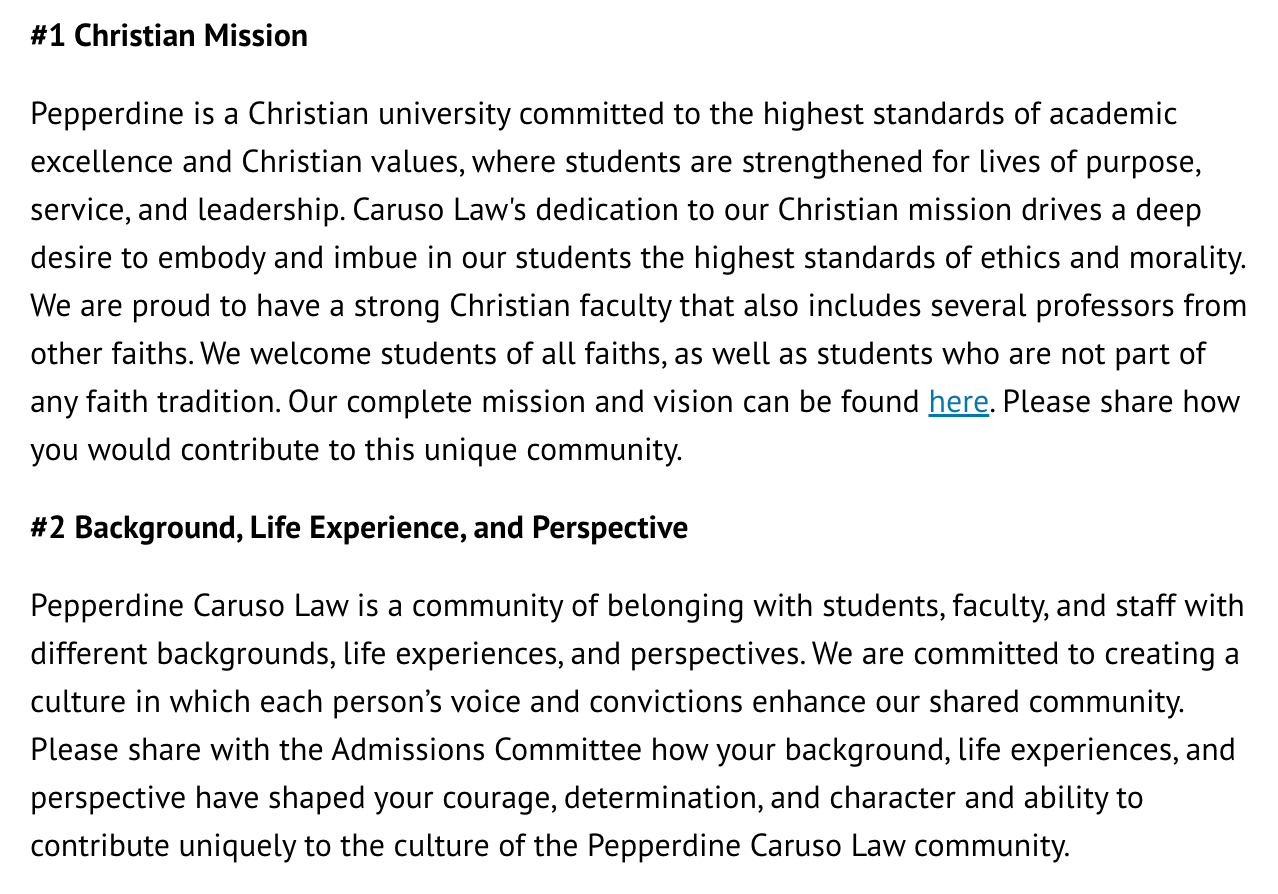
The first prompt covers the Christian mission and asks how you would contribute to the Pepperdine community. It clearly states it welcomes students of all faiths, including those with no faith tradition, so be authentic in your response. If you are Christian, name the principles you live by and the practice behind them. If you hold different beliefs, explain the perspective you bring to a classroom debate and what your classmates would learn from it.
The second prompt asks how your background, life experiences, and perspective shaped your courage, determination, and character. This is your chance to show the admissions committee what unique perspective you can bring to the classroom. Every applicant has a unique quality to them that makes them a great candidate for law school. Do some self-reflection to find what sets you apart from the run-of-the-mill applicant, and apply it to this second optional statement.
Lastly, make sure your essays don’t overlap. When you complete your drafts, try laying them side by side and check that each one tells a story the others don't.
If you need help writing the different statements in your application, watch our webinar Perfecting Your Personal Statement below. In this guide, Ebehi Izoku, a Stanford Law graduate and Juris admissions coach, discusses exactly how applicants can keep each statement distinct by choosing different aspects of their life experiences:
Taking a gap year helps you gain valuable work experience that sets you apart from other applicants. The average age in the most recent incoming class at Pepperdine Law is 24, and ages range from 19 to 42, meaning most matriculants bring work and life experience after undergrad.
Pepperdine Law evaluates applications on "employment experience, extracurricular activities, community involvement." It states that the admissions committee "consider the whole person, shaped by faith, adversities overcome, lessons learned." If your resume feels thin because it consists mainly of coursework and a few internships, adding a year of relevant experience will do more for your application than another round of LSAT exams.
If you decide to take a gap year, choose work that aligns with the school’s mission, like spending a year helping people in need. Consider volunteering at a nonprofit that provides free legal representation to families who can’t afford an attorney. Join an organization that helps refugees and asylum seekers, or go on a mission trip abroad to an under-resourced country. Doing meaningful work broadens your horizons and equips you with the kinds of experiences you want to highlight in your application.
As a bonus tip, if you decide to do non-profit or volunteer work abroad, you can show interest in Pepperdine Law’s Sudreau Global Justice Institute in your application. This organization sends Pepperdine Law students across the globe to “defend the defenseless.” Students clerk with national judiciaries across Africa through its Global Summer Internships, and they work real cases inside correctional facilities through its Prison Project. If your gap year takes you into this kind of service, tell the committee the Institute is what draws you to Pepperdine Law.
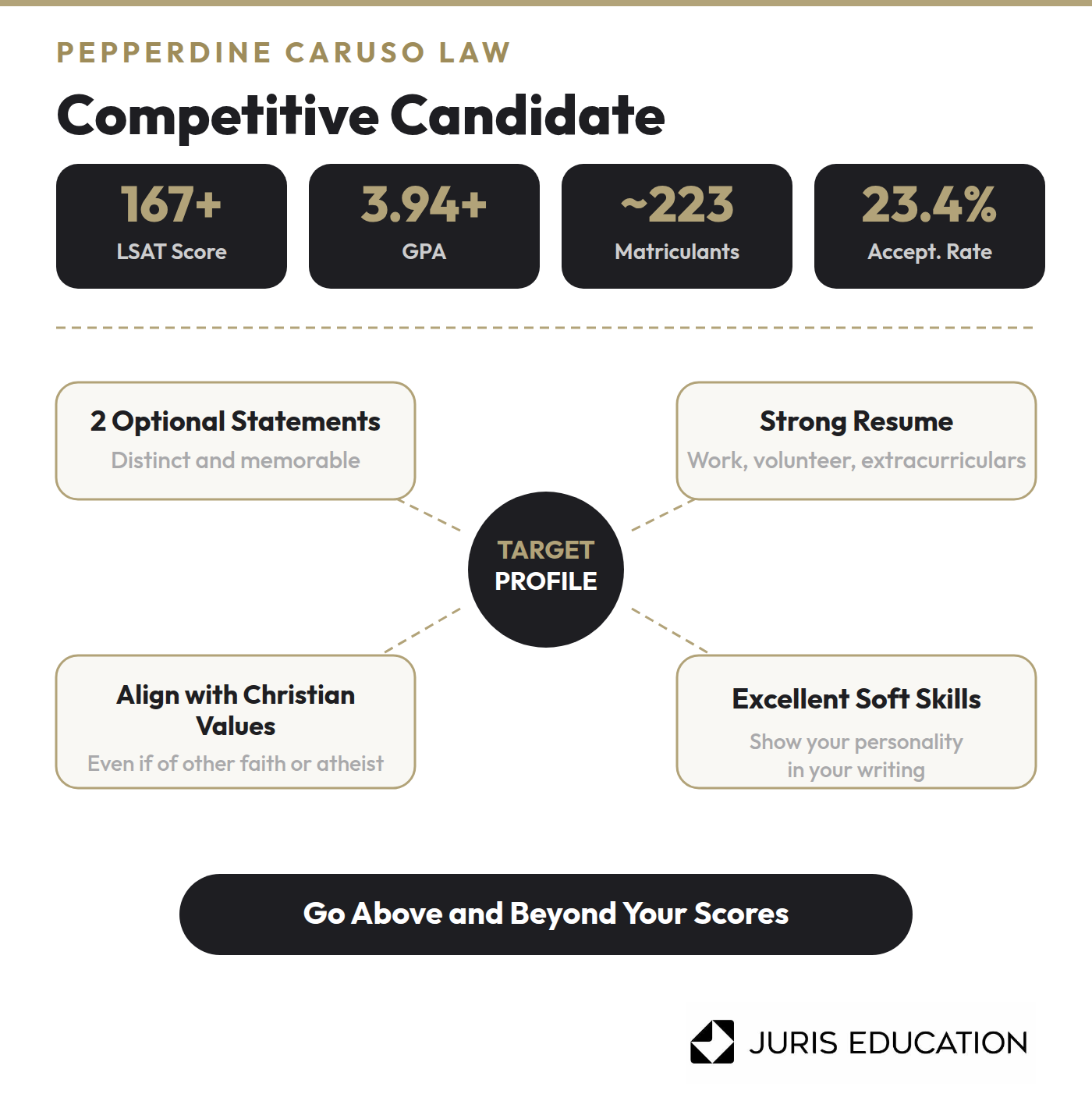
A competitive Pepperdine Law candidate has at least a 167 LSAT, a 3.94 GPA, strong extracurriculars or work experience, and a specific reason for choosing this school. Pepperdine Law turns away roughly 3 of every 4 applicants, so a competitive application demonstrates both elite scores and compelling soft skills.
Here's what that looks like on paper:
Numbers move you past the first cut. With applications in 2025 at a record high of 4,272 and fewer offers than in previous years, the admissions committee reads thousands of applications that look very similar on paper. Everything after the LSAT and GPA decides which of those applications gets an offer.
Get help with your law school application to stand out from thousands of other candidates. Juris Education admissions consultants have helped thousands of students gain admission to their dream schools. Through 1:1 application support, our admissions experts give you personalized help every step of the way.
Every Pepperdine Caruso Law application goes through LSAC's electronic system. Here's every requirement to submit a complete application:
Watch the video below for a comprehensive law school application checklist:
Pepperdine Caruso Law School ranks 52nd according to our rankings.
Pepperdine Caruso Law's bar passage rate was 90.7% on the July 2025 California bar exam, with 136 of 150 first-time takers passing the exam.
Pepperdine Caruso Law's final application deadline is April 1, with a priority deadline of February 1. The school admits on a rolling basis and issues most decisions between December and June.
Pepperdine Caruso Law doesn’t offer a binding early decision option for JD applicants. The closest equivalent is the December 15 Faculty Scholars Award deadline, which requires a completed application months ahead of the regular timeline.
Pepperdine Caruso Law does not include interviews in its JD admissions process. The committee only evaluates your grades, test scores, and your written materials.
Pepperdine Caruso Law offers a traditional three-year JD alongside accelerated, extended, and joint-degree paths:
Co-Founder of Juris Education, Dartmouth College


.svg)
