Get in touch: +1 888 904 4161




In the 2025 admissions cycle, Emory Law School received nearly 25% more applications than the previous year, rising from 3153 to 3891. However, its acceptance rate dropped from 40.12% to 38.68%, and its enrollment rate is higher than it has been in the last 5 years. These numbers tell you that this school is becoming more selective as more and more students want to attend.
What Emory Law actually evaluates is narrower than most applicants realize. The law program doesn’t conduct admission interviews, only requires one letter of recommendation, and doesn’t offer optional statements. Instead, it places significant emphasis on the written portions of your application to help you stand out among hundreds of other applicants beyond just your LSAT and GPA.
I asked the former admissions officers on my team what separates successful applications from waitlists and rejections at Emory Law, and put together this guide. I'll cover everything from what scores make you competitive to what Emory admissions counselors are looking for in your application.
If you’re just here for the requirements, click here.
Emory Law School's acceptance rate dropped to 38.68% in 2025, down from 40.12% in the previous academic cycle, according to the ABA's 509 reports. It wasn't that Emory Law admitted fewer students; in fact, it was quite the opposite. During the 2025 admission cycle, 3891 students applied, Emory Law sent out 1,505 offer letters, and enrolled exactly 391 students, both the highest numbers in the last six years.
Here’s a look at Emory Law School’s admissions statistics from the past five admissions cycles:

It’s moderately difficult to get into Emory Law School, as the acceptance rate is 38.64%. This means roughly 4 out of every 10 applicants are admitted. However, if you can put together a strong application with a high GPA and a good LSAT score, you’ll have a good chance of competing with the other qualified applicants.
The median LSAT score at Emory Law in the most recent admission cycle was 166, with the 25th percentile at 162 and the 75th percentile at 168.
According to the Law School Admissions Council (LSAC), in the 2025-2026 admissions cycle, the national median LSAT score among all law school applicants was 159. That means most students at Emory Law School score 4.4% higher on the LSAT than all law school applicants in general.
In the 2025-2026 admissions cycle, the median undergraduate GPA for Emory Law was 3.82, with the 25th percentile at 3.68 and the 75th percentile at 3.87. There’s no official minimum GPA required for admission.
According to the LSAC, in the 2025-2026 admissions cycle, the national median GPA among all law school applicants was 3.68. That means competitive students at Emory Law have a GPA that’s 0.14 points higher than all law school applicants.
On its admissions page, Emory Law states its strong preference for LSAT scores over the GRE. Its law program only allows students to apply using a GRE score under two circumstances:
However, on its admissions page, Emory Law still recommends that all applicants submit an LSAT score. They believe “the evidence of the GRE's correlation with law school performance is questionable at best.”
For reference, in the most recent class of 2025, which welcomed 391 students, eight students were admitted using GRE scores.
Emory Law does not officially publish GRE percentiles.
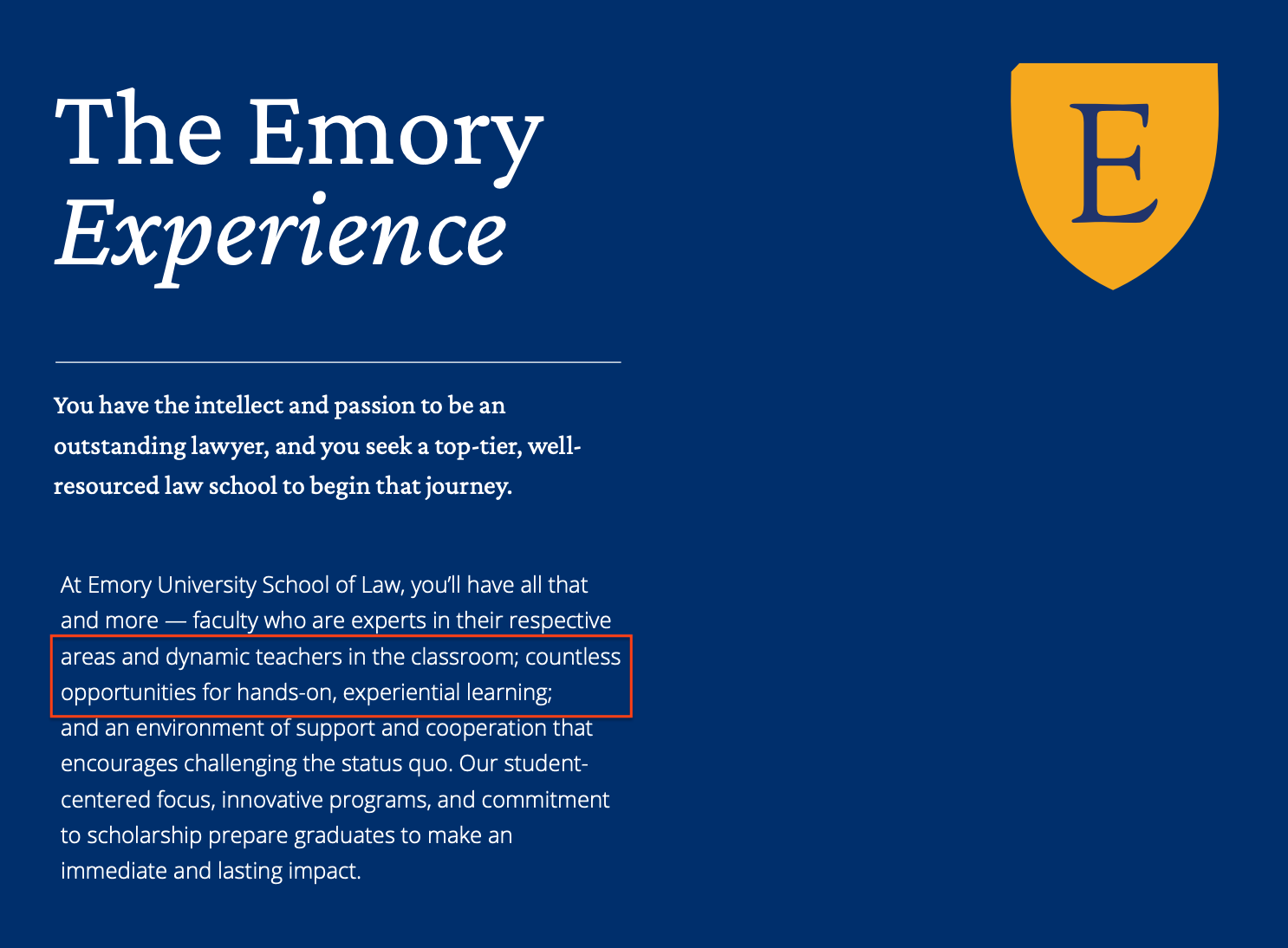
If you look at Emory Law’s admissions brochure, the first page emphasizes “countless opportunities for hands-on experiential learning.” Because this law school highlights its wide variety of “learn by doing” programs, it clearly values students who learn best through applied practice. Tailor your personal statement to demonstrate how you thrive as an action-oriented learner.
Demonstrate this in your personal statement by making sure you show, not just tell, the specific experiences where you learned by doing.
For example, let’s compare these two sentences:
Notice how the first sentence only states what you learned but leaves out how you learned it. In the second sentence, you put the reader in the room with you, and that kind of action-specific writing is what helps the Emory Law admissions committee understand that you have already excelled in other hands-on learning programs.
An extra tip: Strategically choose an anecdote that directly ties in with one of Emory Law’s existing programs or clinics. For example, as part of its mandatory curriculum, Emory Law offers 2L students the Kessler-Eidson Program for Trial Techniques, the largest trial advocacy program in the country and a two-time winner of the American College of Trial Lawyers' Emil Gumpert Award for excellence in teaching trial advocacy. By highlighting an experience like the mock trial example above, you are indirectly telling the admissions committee you’d be a great fit for that specific program.
If mock trial isn't part of your background, the same strategy works with any of Emory Law's centers and clinics. If you have experience with environmental fieldwork, this can point to the Turner Environmental Law Clinic, or if you’ve worked with veterans, it can point to the Volunteer Clinic for Veterans.
Take a look at the video below to learn how to craft your personal statement around your application narrative:
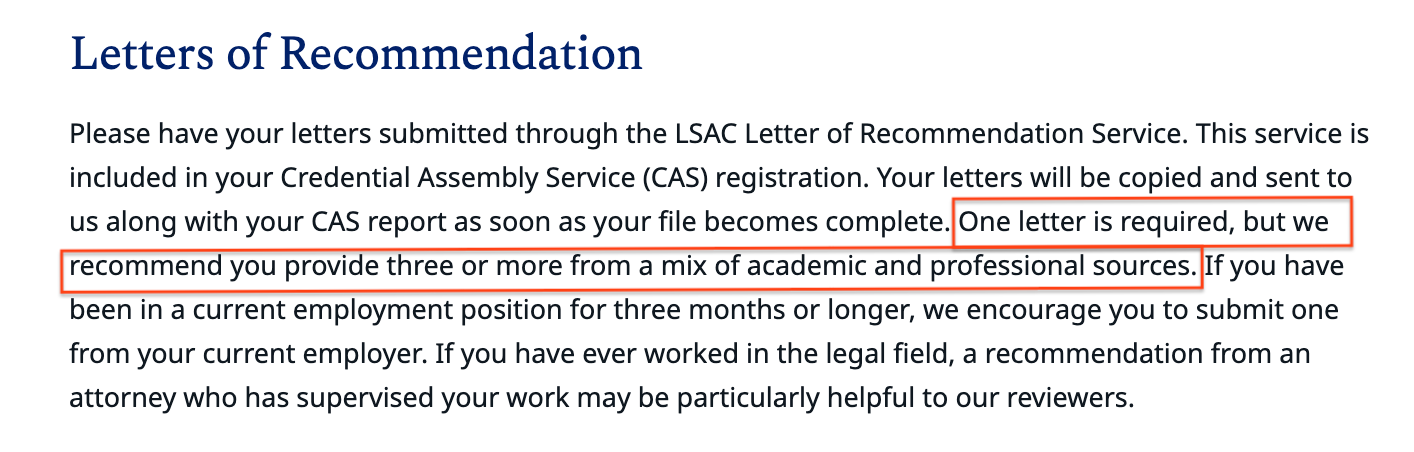
Emory Law states on its JD application requirements page that one letter of recommendation is required, but recommends submitting “three or more from a mix of academic and professional sources.” Going above and beyond this requirement gives the admissions committee a more complete picture of who you are, since one letter alone can’t speak in-depth about your academic performance, professionalism, and readiness for law school at the same time.
The best approach is to have one letter focus on your academics, the second on your work ethic, and the third on your readiness for law school. By splitting your letters this way, you can deliver the exact mix of academic and professional sources Emory Law asks for.
When picking a professor for a recommendation, I always tell our students to ask someone who knows them well enough to speak highly of their academic abilities. In other words, I wouldn’t recommend asking a professor who doesn’t know you very well just because you got an A in their class. They might not know much about you apart from your grade, so they won’t be able to write a strong letter for you. I recommend asking a professor who has seen you participate actively in class or during an activity, even if you didn’t get an A.
If you have work experience, ask the employer to write you a letter of recommendation vouching for your work ethic. It doesn’t have to be from a law-related job. It should just be from an employer who can speak to your ability to commit to a job, work diligently, and see a task through to the end. If you don’t have work experience, certain extracurriculars, such as being an RA or a teaching assistant, can still speak to your work ethic.
This letter should speak to your potential as a law student and your readiness to take on the demands that come with it. It should be from someone who has seen firsthand how you handle real legal work and can attest to your abilities to problem-solve or think critically. If you participated in an internship, clerkship, mock trial, or legal aid organization, ask a supervisor who was present to write this letter.
If you don't have any legal experience, try to think of other activities or extracurriculars you took part in where you demonstrated skills that law schools value, like leadership, critical thinking, or persuasive communication. This can be anyone — a coach, an advisor, or a supervisor from a leadership role you held, for instance.
To learn more about letters of recommendation, watch the video below:
Emory Law asks for a detailed resume covering:
It specifically asks for you to indicate the month and year of each activity, along with the weekly hours of each.

This is your space to show in detail how you invested your time, the responsibilities you took on, and how these experiences developed your skill set. Use it to your full advantage.
Treat your resume as a tool to tell your story, not just as a checklist of activities. As you go through each activity description, I recommend using action verbs to demonstrate your critical thinking skills. Take a look at this example:
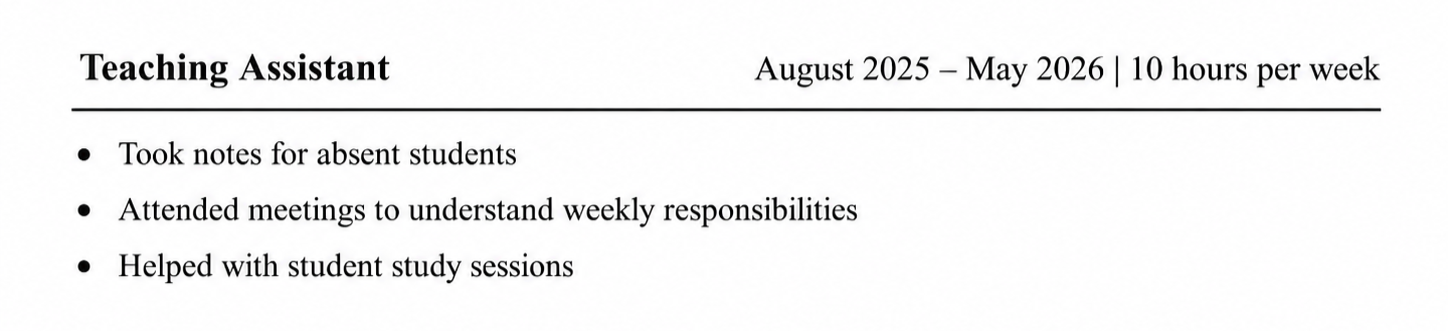
This resume would make anyone sound like a bystander instead of a leader. If you use lackluster verbs like “attended meetings” or “helped,” you won't highlight your initiative or your critical thinking skills. Instead, I recommend swapping them out for action verbs that let your abilities shine, and get specific with what you did. Take a look at this revised example:
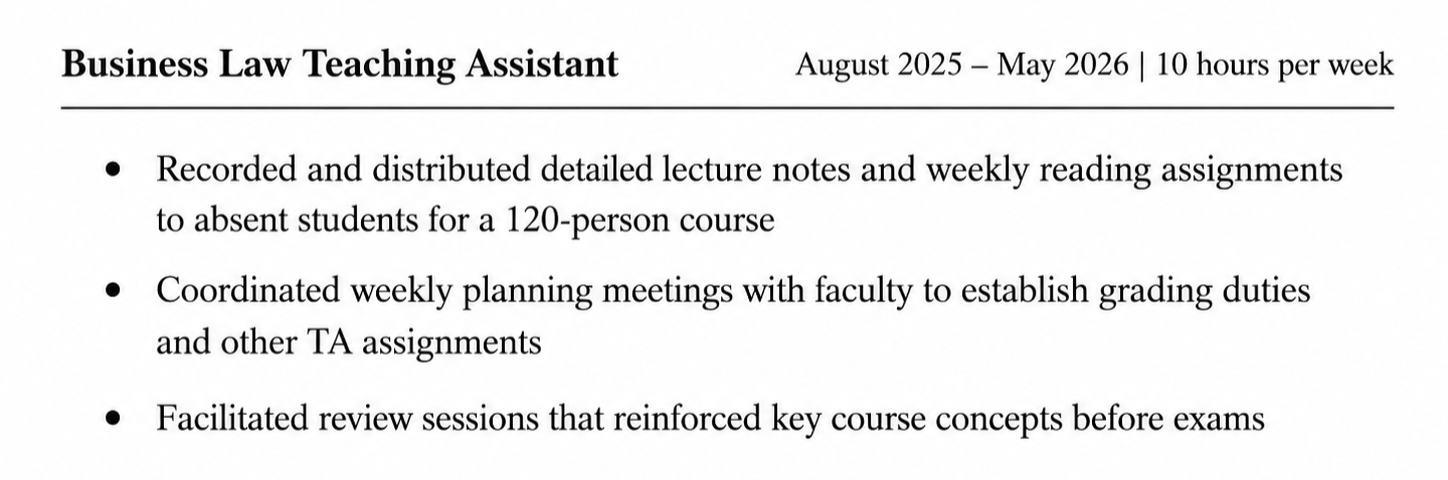
Notice how the latter is much more descriptive of your responsibilities, which highlights your leadership skills. One caution I give our students as they revise: Only claim a verb you can back up. Weak bullets usually undersell the work you actually did, so dig into your real contributions instead of inflating them. Write “coordinated” only if you helped plan those meetings. If you didn’t help plan them, writing “engaged in meetings” is still stronger than simply attending one.
If applicable, include a quantifiable number in your descriptions. For example:
When you include tangible metrics like these, you give the admissions committee a fuller picture of the real impact you had. It proves that you didn’t just show up; you made a difference.
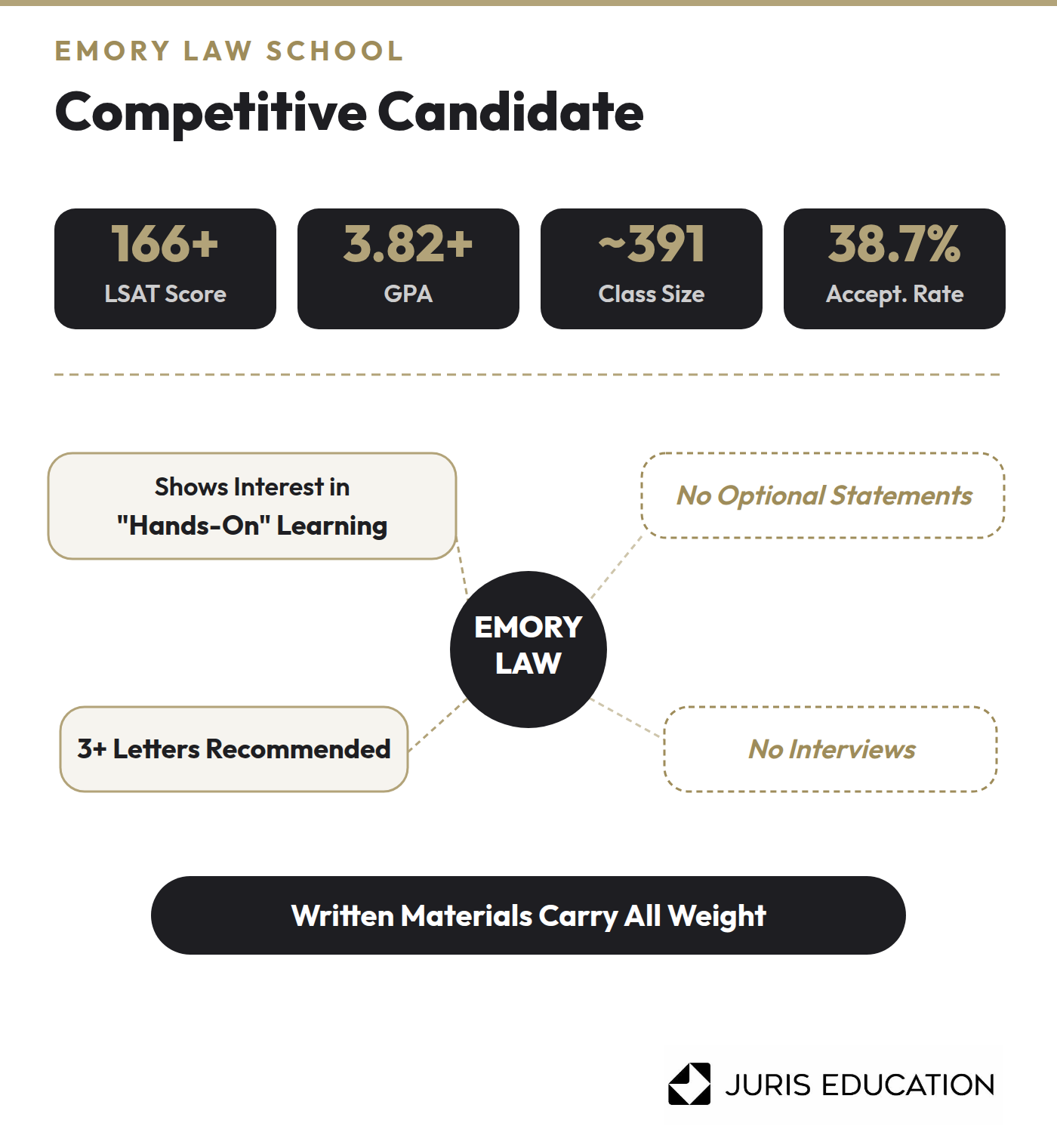
The strongest Emory Law applicants go above and beyond just meeting the school's medians. These are the characteristics your Emory Law application should have to be a competitive candidate:
If you need help with any of these components, Juris Education admissions advising can help you get into your dream school. Work with our counselors to refine your personal statement, find the perfect letters of recommendation, and write a standout resume.
Every Emory Law application goes through LSAC's electronic system. Here's every requirement to submit a complete application:
Watch the video below for a comprehensive law school application checklist:
Emory Law School ranks 36th among the top law schools in the United States, according to our ranking. Emory Law School’s programs and clinics are among the highest regarded in the country, and its alumni network includes a former SEC commissioner, a former Georgia attorney general, and multiple sitting federal appellate judges.
Emory Law School's bar passage rate was 86.34% in 2025 (196 of 227 first-time takers passed). The ABA weighted average pass rate across the jurisdictions where Emory Law graduates sat for the exam was 80.47%, putting Emory Law nearly 6 percentage points above that benchmark.
Emory Law's final application deadline is March 15. This is the regular decision deadline for all JD applicants, though submitting earlier in the cycle works in your favor since Emory Law admit on a rolling basis.
Emory Law's early decision deadline is November 15. This option is binding, meaning if you're admitted, you're committing to enroll and must withdraw any applications you've submitted to other law schools.
Emory Law doesn’t conduct interviews as part of its JD admissions process. Instead of an interview, the admissions committee relies entirely on your written materials, your personal statement, resume, and letters of recommendation to evaluate qualities like leadership, communication, and critical thinking.
Emory Law School offers seven JD program options, including a standalone Juris Doctor and six joint-degree tracks:
Co-Founder of Juris Education, Dartmouth College


.svg)
