Our Black Friday Sale Is Here
Ends In:
00
D
00
H
00
M





A question aspiring pre-laws ask me all the time is whether the degree is worth what they’ll put into it. The answer is never a simple yes or no.
I asked several admissions experts on my team for their take. They all agreed that law school is the right choice if you know how you want to use your degree and have a realistic plan to manage the cost. If you don’t, it’s worth reconsidering.
Below, I dive deeper into exactly what to consider, share these experts’ insights, and break down the latest data to help you decide.
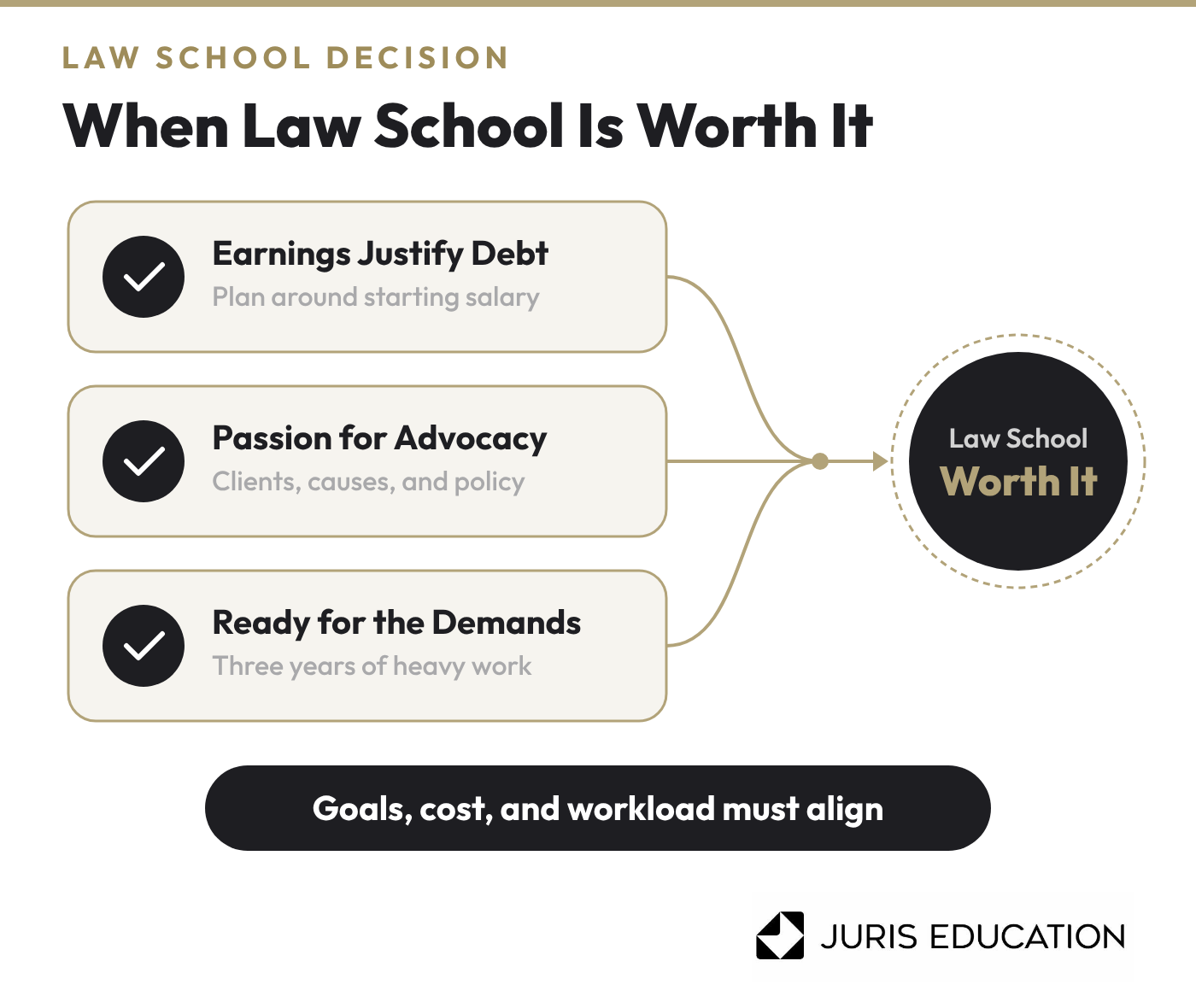
Law school is worth it when a JD supports your career goals, and you can manage the cost and workload. Consider whether the following circumstances apply to you:
Law school can be worth the financial investment if the realistic earnings in your chosen field will support your debt payments and living expenses.
A major draw to the legal field is its earning potential. The median annual wage for lawyers is $159,670, according to the U.S. Bureau of Labor Statistics. But keep in mind that that's the median for all lawyers, not a typical starting salary.
You won’t necessarily make this much when you first start, so carefully consider how much debt will be sustainable for you in the short and long term.
This is especially important following the July 2026 changes to federal student loans, which cap borrowing for new law students and end Grad PLUS access. If federal loans don’t cover your costs, you may need private loans, which have higher interest rates and stricter repayment terms.
Compare each school's graduate employment and salary outcomes to better gauge if a law degree is worth the investment for you.
Law school can be the right path for you if you want to use the law to advocate for people or causes you care about. As a lawyer, you'll be able to represent clients and may have opportunities to influence policy-making and change.
If you’re passionate about advocating for the environment, animals, or children, you can make a big impact in the relevant legal specialty.
Getting into law school is only the first challenge. A full-time JD means three years of heavy courseloads, reading, analyzing complex cases, preparing for on-the-spot class discussions, and studying for high-stakes exams.
Law school challenges your preconceptions and pushes you to think in new ways. If you understand these demands and still want to study law, the personal satisfaction of completing your JD can add to its value.

Law school isn’t worth it if you don’t have a clear career goal in mind, can’t reasonably manage the debt, or can’t commit the time and energy it takes to succeed.
Here are some circumstances to consider:
The most important question to ask yourself is why you want to go to law school, and you’ll be expected to answer it clearly and persuasively to be admitted. If you're primarily interested in the prestige of a JD or aren't sure how you'll use your degree, it may be worth taking a step back.
You can take a gap year to work in a related field, gain experience, and explore your options before making such a significant investment.
Law school may not be worth pursuing right now if you can’t make room for the workload or aren’t sure you can handle the stress and commitment. Law school is a very competitive environment.
As the experts on my team have shared, competition for top grades and jobs can sometimes create a “me vs. you” atmosphere that not everyone is cut out for.
The law school path will also take up a lot of your time, from preparing your application to the three-year JD commitment itself.
Law school is a true grind. It’s a new way of thinking, and that alone can be stressful, especially in the beginning when you’re trying to grasp the material. You have to adjust to the demands of constant reading, preparing for class, and learning to think on your feet.
Students face a heavy course load and a fast-paced, high-stress environment. Law school can be challenging if your heart's not fully in it, especially when you have work, family, or other obligations.
In addition to tuition, you'll need to consider living expenses, textbooks, course materials, application fees, and bar preparation. While there are ways to subsidize these costs, students who borrow can graduate with substantial debt. Don’t assume a high salary will automatically follow your degree.
The median starting salary for employed graduates in full-time, long-term jobs who reported salaries was $100,000 for the Class of 2025, according to the National Association for Law Placement (NALP). This was up from $95,000 for the Class of 2024.
That figure is more useful for estimating your first years after law school than the median salary for all practicing lawyers.
While law school skills can be beneficial in many professions, a JD isn't necessary for every legal-adjacent role or career in business, politics, and communications.
If you're planning to work in a field that doesn't actually require a law degree, the cost of earning one likely isn’t worth it.
Law school can be worth it financially in 2027, but only if your expected earnings justify what you'll actually pay. A strong scholarship, affordable public law school, or clear path to a well-paying legal job can make the investment easier to manage. Borrowing heavily for a career with a lower starting salary can make it much harder.
The best way to decide is to compare your total cost after scholarships with the employment and salary outcomes of each school, not just its ranking or sticker price.
According to LawHub's latest published tuition series, average annual tuition in 2025 was $59,759 at private law schools and $32,051 for in-state students at public law schools. These figures are tuition only, not the full cost of attendance. The full cost of attendance per year can range from $40,000 for the cheapest schools to over $125,000 for the most expensive, depending on the school and location.
The ABA's latest published (2024) student debt survey found that respondents who borrowed for law school reported a median of $112,500 in JD loans and $137,500 in total education loans at graduation. These figures describe survey respondents who borrowed, not every recent graduate. This was also before the loan changes, so I expect these figures to be even higher in the years to come.
With such high loan payments, earning a high salary doesn't automatically mean you'll pay off your debt quickly. Before choosing a school, estimate your monthly payments and compare them with realistic starting salaries in your intended field.
Here's the latest BLS breakdown for lawyers in selected industries:
These are median wages for lawyers across career stages in each industry, not starting salaries or guaranteed pay for a specialty.
You should look at both your debt and anticipated salary after law school to understand how manageable your loan payments may be. One way to compare schools is through a debt-to-income ratio, which divides the median amount borrowed by median annual earnings for a school’s graduates. Lower ratios mean grads borrowed less compared to what they earned.
I looked at every law school with borrowing and earnings data in the Department of Education’s recent 2026 release and found the 10 with the lowest debt-to-income ratios:
These are the latest figures available from the U.S. Department of Education. Borrowing figures cover students who graduated in the 2022-23 and 2023-24 academic years. Income figures cover students who graduated in 2020-21 and 2021-22 and show what they earned one year after graduation. The Department adjusted those earnings for inflation to show their equivalent value in 2024.
Andrew Post, a master tutor at Juris Education and a Georgetown University Law alum, suggests you openly ask about expected debt and salaries during your conversations with law schools.

Debt-to-income ratios are only one factor to consider when choosing a law school. Juris Education’s admissions experts can help you compare schools based on your career goals, budget, and admissions profile to find the best fit for you.
Law school can be right for you if you’ve considered all of the necessary factors like debt, family obligations, and your intended career, and you still want to pursue it. Law school isn't necessary unless you want to become a lawyer or pursue a profession that requires a JD. Ensure you make a choice that benefits you in the long run.
The most common and best use of a law degree is becoming a lawyer, law professor, or judge. Law graduates may also pursue other careers in compliance, business, government, mediation, policy, journalism, or academia, but pursuing a law degree for these roles isn’t necessary or suggested, considering the cost of a JD.
No, AI will not make lawyers obsolete. AI is definitely changing how lawyers work, particularly in tasks like document review, research, and drafting. However, legal work also depends on judgment, client relationships, advocacy, and professional responsibility that AI can’t replicate.
Co-Founder of Juris Education, Dartmouth College