Get in touch: +1 888 904 4161



In the most recent admissions cycle, Northeastern University School of Law was the most competitive it’s been in five years. Applicants who still think it’s easy to get in because it's not in the T14 are most likely to submit a weak application.
Some students apply to Northeastern Law with a recycled personal statement about wanting to "pursue justice," a resume full of academic credentials, and no professional experience. Those students have missed the point entirely and are extremely unlikely to be accepted.
Northeastern Law built its entire educational model around the idea that you learn law by practicing it, not just studying it. The admissions committee looks for evidence that you've already tested your interest in the legal profession through real work, not just coursework, in every application they read.
The guide below covers which scores make you competitive, what the admissions committee evaluates beyond your numbers, and how to write an application that aligns with the way Northeastern Law educates future lawyers.
If you’re just here for the requirements, click here.
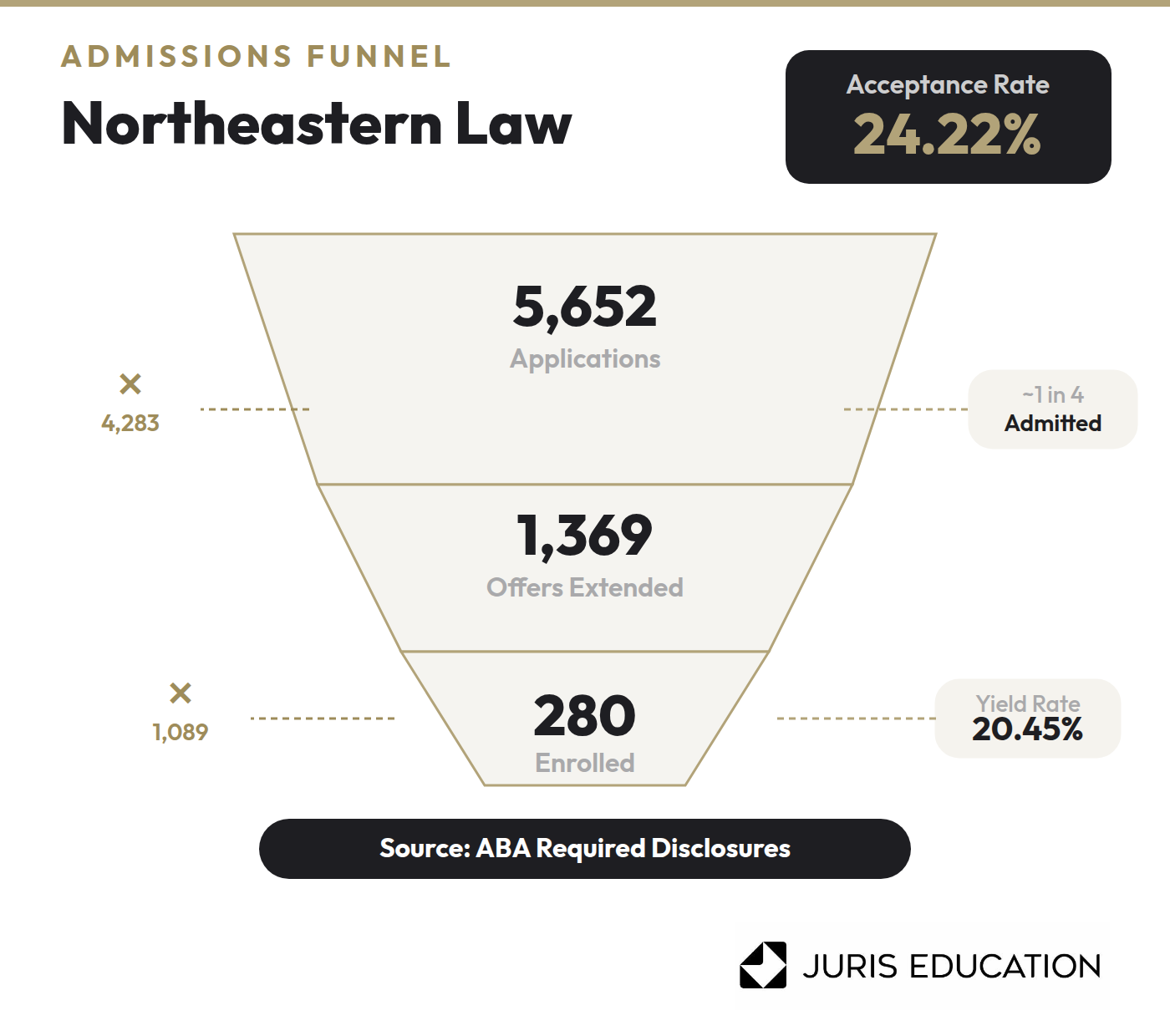
The 2025-2025 acceptance rate at Northeastern University School of Law is 24.22%. According to the American Bar Association, in the most recent admissions cycle, Northeastern University School of Law received 5,652 applications, extended offers of admission to 1,369, and 280 students enrolled. That means about 1 in 4 applicants receives an offer of admission.
The visual below shows exactly how much the school’s admissions statistics have fluctuated over the past five admissions cycles:
Getting accepted to Northeastern University School of Law is challenging, but not impossible. Compared to some T14 schools, it’s relatively more forgiving based on the acceptance rate alone. However, no law school is easy to get into because you still need exceptional academics, a compelling application narrative, and impressive experiences to stand out.
Over the last five admissions cycles, Northeastern University School of Law has averaged a 30.63% acceptance rate, meaning roughly 3 in 10 applicants gain admission. You still need to stand out to get accepted, but it’s easier to get into Northeastern University School of Law than any T14 law school in the country.
The median LSAT score of matriculants in the 2025-2026 admissions cycle was 164 at Northeastern University School of Law. You don’t need a minimum LSAT score, so you can apply with any score. However, you should still aim for a competitive score to stand out.
Take a look at the visual below to see how competitive your LSAT score is compared with matriculants in the 2025-2026 admissions cycle:
According to the Law School Admissions Council (LSAC), in the same admissions cycle, the national median LSAT score among all law school applicants was 159. That means the typical matriculant at Northeastern University School of Law scores 3.14% higher on the LSAT than all law school applicants in general.
The median GPA at Northeastern University School of Law in the 2025-2026 admissions cycle was 3.77. There’s no minimum GPA to be considered for admissions, but you should still submit a competitive one.
Here’s how your GPA compares with that of previous matriculants in the 2025-2026 admissions cycle. Enter it below to estimate your chances of clearing the initial application screening phase:
According to the LSAC, in the 2025-2026 admissions cycle, the national median GPA among all law school applicants was 3.68. That means most Northeastern University School of Law matriculants submit a GPA that’s 2.44% higher than that of all law school applicants.
There isn’t enough data on GRE submissions to separate them into percentiles, as only one matriculant submitted it in the 2025-2025 admissions cycle, compared to the 282 matriculants who submitted the LSAT. Submit a high LSAT score instead of the GRE, unless it’s an extremely high score that will help you stand out.
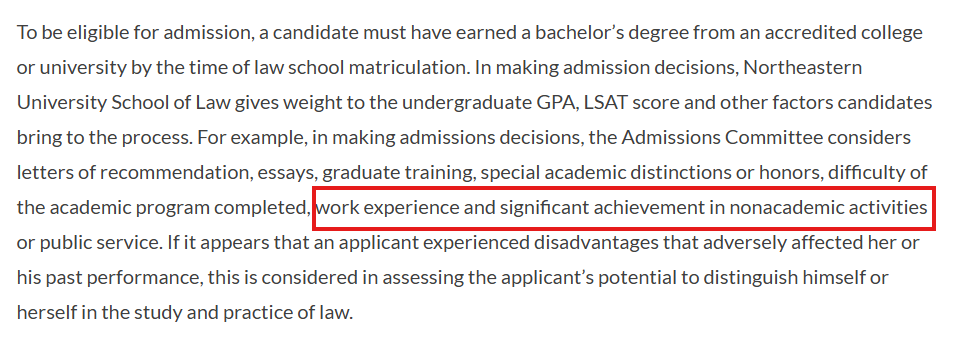
The primary focus of your resume should be your full-time professional experience, not your academic background. Northeastern Law’s Cooperative Legal Education Program requires every JD student to complete three full-time legal work placements before graduation. The phrases "experiential," "real world," and "real clients" appear on nearly every page of the school's website. The admissions policy page explicitly evaluates "work experience and significant achievement in nonacademic activities" alongside your GPA and LSAT.
If you've worked full-time at a legal aid office, government agency, or advocacy organization, give those entries more space in your resume than your coursework. Pinpoint the actual responsibilities you held and the outcomes you contributed to with specific verbs.
Northeastern Law's admissions committee wants proof that you've already tested your interest in law through action, not just study. An applicant who spent a year doing intake at an immigration nonprofit carries more weight here than someone with a perfect GPA and no professional exposure.
Write your personal statement around a specific experience where you confronted injustice and felt compelled to act upon it. Northeastern Law's mission statement identifies social justice as a core institutional purpose, and the school's six core values dedicate an entire section to its pursuit.

Core Value III states the school strives to ensure law serves as a vehicle for advancing the public good. Additionally, the required first-year Legal Skills in Social Context (LSSC) course pairs each incoming student with a nonprofit or government partner to produce real legal work products to advance social justice objectives. Public interest law has its own section in the main website navigation, its own full-tuition scholarship, and its own dedicated center (CPIAC).
You don't need to pledge your career to public interest law. But your personal statement should make it clear that you view law as a mechanism for addressing real problems faced by real people.
Write about the specific community you worked with, the structural barrier you observed, and the moment you realized legal tools could change the outcome. Northeastern Law's admissions committee looks for a sense of purpose that goes beyond career advancement.
If you need more personal statement tips, watch the video below:
Focus your resume and personal narrative on collaborative projects rather than individual accomplishments. Northeastern Law's Legal Skills in Social Context (LSSC) program requires every first-year student to conduct legal research in teams on behalf of a public-service partner organization. Students produce work products such as practitioner manuals and impact reports for clients who lack the resources to complete these projects. The school has run LSSC for over 20 years, and it remains one of the few required 1L programs in the country that combine legal writing instruction with live, community-based project work.
Admissions readers at Northeastern Law are looking for evidence that you can excel in that environment from day one. If you led a research team at an advocacy nonprofit, co-authored a policy brief with community partners, or coordinated a group legal project during undergrad, describe the collaborative dynamic specifically.
Mention who you worked with, how you divided responsibilities, and what the partner organization received. Solo honors and individual awards matter less at a school that replaced traditional grades with written evaluations and eliminated class rank specifically to encourage students to collaborate instead of compete.
Learn how to build a unique application narrative with the video below:
Ask for letters of recommendation from supervisors or professors who watched you work alongside others. Northeastern Law's About page calls "experiential" and "collaborative" the school's foundational principles. Core Value VI commits the school to promoting cooperation, collaboration, and mutual respect across the community.

Students receive written evaluations from professors and co-op employers instead of letter grades. Without a rank to strive for, the school fosters an environment in which students take intellectual risks and support each other's development.
Your recommender needs to describe you the way Northeastern Law describes its students. A letter that focuses on your GPA or individual test performance misses the mark here. The strongest letters will describe a specific situation where you contributed to a group effort, navigated disagreement constructively, or elevated the work of people around you.
A professor who can describe how you operated in a seminar with competing viewpoints, or a supervisor who can describe how you collaborated on a case with a team, tells the admissions committee that you’re prepared to study law at Northeastern University School of Law.
The school's admissions policy considers whether candidates can "reflect on competing viewpoints" and "advance arguments persuasively in a variety of forums." Your recommender should demonstrate you've already done both.
Juris Education can help you build a competitive application for Northeastern University School of Law. Work with our admissions experts and former admissions officers to submit a successful application.
A competitive Northeastern Law applicant has a 166 LSAT score and a 3.86 GPA, brings real professional experience, and shows an actionable commitment to social justice or public service in their application materials. You can be competitive here without elite-level scores, but the difference between "qualified" and "admitted" at Northeastern Law almost always comes down to everything outside the transcript.
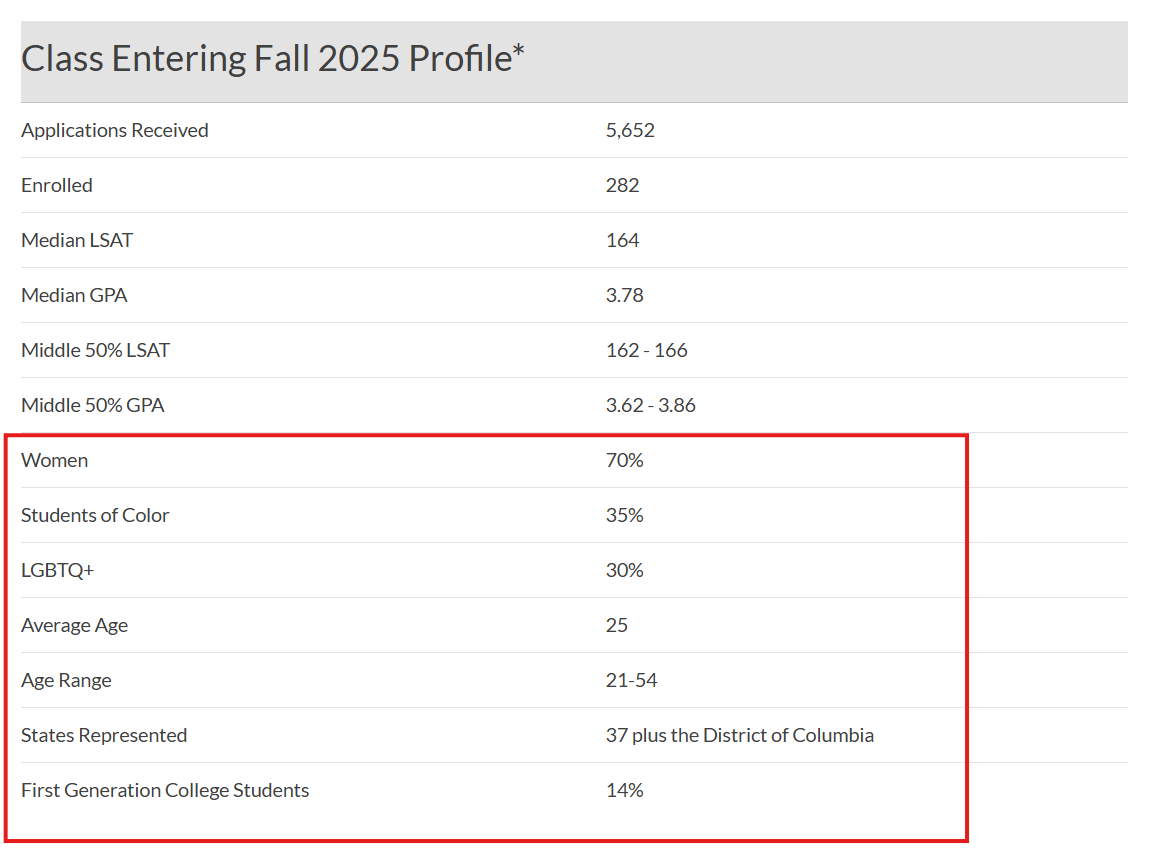
According to the class profile, Northeastern Law is built for people who did something before law school. The entering class invited students from more than 140 undergraduate institutions across 37 states and the District of Columbia. Students brought 63 different undergraduate majors, and several arrived with advanced degrees ranging from MPH and MBA to a PhD in Chemistry and a Master of Letters in Shakespeare and Performance.
You don’t need a political science degree to be competitive. The admissions committee actively looks for non-traditional academic backgrounds because the Cooperative Legal Education Program places students into three full-time legal work rotations, and a co-op cohort that thinks the same way produces narrow outcomes.
The average age of entering students was 25, with a range spanning 21 to 54. Prior careers included:
If you’re considering a career change into law, Northeastern Law is one of the strongest fits in the country because the co-op model assumes you already bring professional instincts into your first placement.
Take a look at the video below if you want to get into law school as a non-traditional applicant:
Here are all the admissions requirements for Northeastern University School of Law:
The first-time bar passage rate at Northeastern University School of Law is 90.52% for the class of 2025, based on 211 first-time takers across all jurisdictions. Northeastern Law graduates exceeded the council-weighted average bar passage rate by 6.25 percentage points that year. The two-year ultimate bar admission rate is also strong: 94.06% of 2023 graduates passed within two years of graduation.
Northeastern University School of Law doesn’t conduct admissions interviews as part of the JD application process. Your personal statement, resume, and single letter of recommendation carry the full weight of demonstrating your fit. Focus your time on making those three written components as strong as possible rather than preparing for an interview that won’t happen.
Northeastern University School of Law offers a full-time JD program, a part-time FlexJD program (which combines remote coursework with required in-person sessions in Boston), an on-campus LLM, an online LLM, a Master of Legal Studies, a Master of Science in Media Advocacy, graduate certificate programs, and a Data Privacy Fundamentals program. The school also offers several dual-degree options for JD students.
David Merson was the original author of this article. Snippets of his work may remain.
Co-Founder of Juris Education, Dartmouth College


.svg)
