Get in touch: +1 888 904 4161




I've looked at five years of Cornell Law admissions data, and the 2025-2026 admissions cycle was exponentially more difficult than the previous 2024-2025 admissions cycle. More applicants competed for fewer seats, resulting in a considerably lower acceptance rate.
That means your application strategy matters more than you think. Submitting a median GPA and LSAT score isn’t enough to stand out. The admissions committee also looks at how you collaborate with others.
The breakdown below covers which scores make you competitive, what Cornell Law's admissions committee specifically looks for, and how to position your application around the qualities that demonstrate your competitiveness.
If you’re just here for the requirements, click here.
Cornell Law School’s acceptance rate in the 2025-2026 admissions cycle was 18.19%, according to the 509 American Bar Association (ABA) Report. Cornell Law School saw 4,608 total applications, and 838 offers were extended. Ultimately, 210 students enrolled.
Take a look at how the acceptance rate has fluctuated over the last five admissions cycles:
The 2024-2025 admissions cycle saw a 23.11% acceptance rate on just 3,722 applications, the lowest applicant volume in this five-year window. One year later, applications increased by nearly 24% while offers barely changed, reducing the acceptance rate back to 18.19%.
The more interesting number is enrollment. Cornell Law has consistently landed between 187 and 210 students each year, regardless of how many applications come in or go out. When application volume rises, you're not competing for more seats. You're competing against more people for the same seats.
Cornell Law is very difficult to get into. Over the last five admissions cycles, the school has averaged an 18.69% acceptance rate, meaning fewer than 1 in 5 applicants receive an offer.
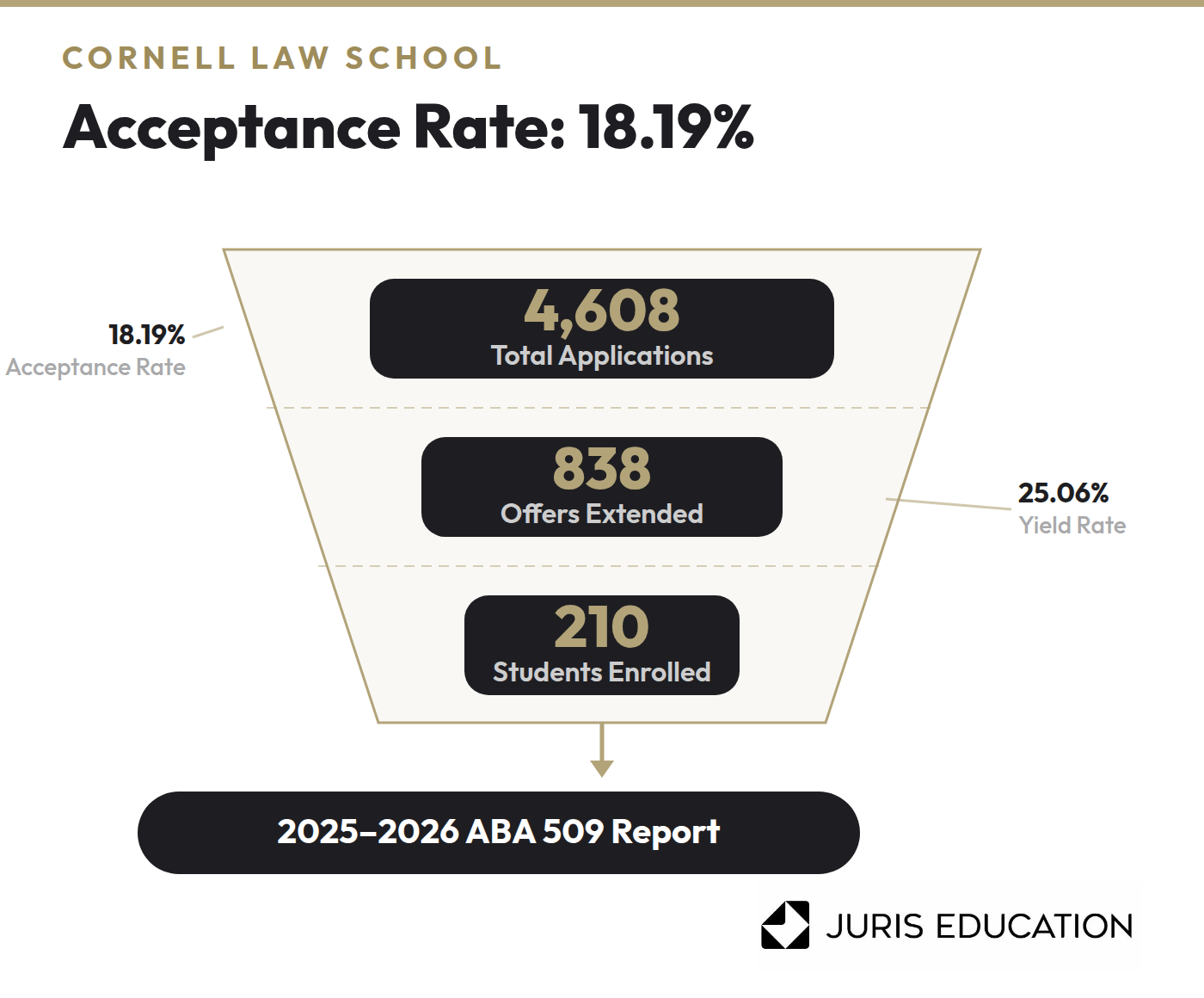
In the most competitive cycle (2021-2022), the acceptance rate dropped to 15.41% with nearly 6,000 applicants vying for just 190 seats. Four admissions cycles later, the school had about 1,300 fewer total applicants, yet an increase in the acceptance rate of only about 3%.
Get an estimate on your Cornell Law School admissions odds with this free quiz:
The median LSAT score of all Cornell Law matriculants was 173 in the 2025-2026 admissions cycle. Cornell Law doesn’t have a minimum LSAT requirement for admission.
Add your LSAT score below to see how it compares to first-year matriculants in the 2025-2026 admissions cycle:
Here’s a look at the range of LSAT scores for the 2025-2026 matriculants:
According to the Law School Admissions Council (LSAC), in the 2025-2026 admissions cycle, the national median LSAT score among all law school applicants was 159. That means most students at Cornell Law score 8.81% higher on the LSAT than all law school applicants in general.
The median GPA of Cornell Law School first-year students was 3.92 in the 2025-2026 admissions cycle. Cornell Law School doesn’t require a minimum GPA to be considered for admission.
Try entering your GPA into the tool below to see how it compares with previous matriculants:
The table below shows the GPA percentile ranges for Cornell Law School’s first-year class:
According to the LSAC, in the 2025-2026 admissions cycle, the national median GPA among all law school applicants was 3.68. That means competitive students at Cornell Law have a GPA that’s 0.24 points higher than all law school applicants.
Cornell Law doesn't publish a median GRE score. Only six matriculated applicants (2.86% of the first-year class) submitted GRE scores, which is too small a sample for the school to report meaningful percentiles. Cornell Law does accept the GRE (and GMAT) in lieu of the LSAT, but the vast majority of applicants still submit LSAT scores.
Cornell Law uses the phrase "close-knit collegial community" on nearly every major page of its website. The About page explicitly states that students at Cornell Law view one another as "colleagues, rather than competitors."
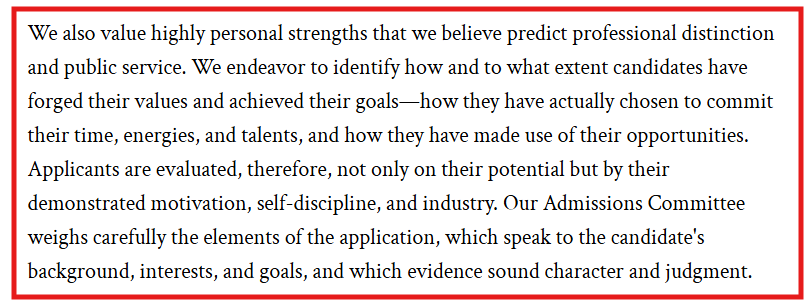
With roughly 600 J.D. students and a 5:1 student-to-faculty ratio, Cornell Law has built its identity around an intimate, cooperative learning model. The admissions committee looks for people who will strengthen that culture rather than simply survive it.
You need to prove you have done collaborative work rather than just claiming you value teamwork. In your personal statement or resume, highlight a specific instance in which you improved someone else's outcome alongside your own.
Maybe you co-led a research team, built a student organization from the ground up, or mentored peers through a difficult academic stretch. Cornell Law's admissions readers are looking for applicants who will stay up late helping a classmate study for a tough exam. Demonstrate that you’re that type of person at your core.
Take a look at the video below to learn how to craft your application narrative:
Choose personal statement Prompt #3 if you want to help underrepresented or vulnerable communities. Cornell Law's guiding principles trace back to President Andrew Dickson White's challenge to produce a select group of "well trained, large minded, morally based lawyers in the best sense," not large numbers of hastily trained lawyers.
That phrase still defines Cornell Law's self-concept today. It appears on the history page, in admissions event recaps, and directly in Prompt #3, which asks you to explain how your career goals connect to the pursuit of justice.
Prompt #3 stands apart from the other three options because it uses the language that the admissions committee encounters every day. If you have a credible public interest narrative, use it.
In our personal statement webinar, Tiffanie Alexander, an expert Juris Education consultant and an attorney who graduated from Wayne State University Law School, shares her insights on the personal statement.
"Ensure that what you're sharing intertwines not only with your reasons for going to law school but why you’ll be successful,” she says. “Often, people talk about why they want to be there or they'll talk about why they want to be an attorney but they don't hit on why it is they're actually going to succeed."
Write about the specific population you want to serve and connect it to a concrete experience. For example, representing tenants in a housing dispute, advocating for immigrant families at a legal aid office, or supporting survivors through a victim services program.
Cornell Law backs up this mission with what they describe as the most generous Loan Repayment Assistance Program in the nation, so the committee wants to see applicants who’ll actually use it, and use it well.
The video below explores how to perfect your personal statement in greater detail:
Reference at least one Cornell Law Center or program in your application. Cornell Law has a ton of space on its website for the Clarke Center for International and Comparative Legal Studies, the Clarke Program in East Asian Law and Culture, and the Clarke Initiative for Law and Development in the Middle East and Africa.
On the experiential learning side, 85% of the Class of 2024 participated in one of Cornell's 27+ clinics or practicums. Among those clinics, the 1L Immigration Law and Advocacy Clinic stands out for offering first-year students direct client representation, a rare opportunity at any T14 school.
Naming a specific program shows that you’ve researched beyond the rankings and understand what’s unique to Cornell Law School:
Be as specific as possible. The admissions committee reads thousands of applications from candidates who say they want "clinical opportunities." Those who name the Gender Justice Clinic or the Death Penalty Program and explain exactly why they want to pursue these programs stand out among thousands of generic essays.
Write and submit the optional "Why Cornell" statement even though Cornell Law doesn’t require it. At Cornell Law, roughly 4,500 candidates compete for around 215 seats, so leaving any component blank means giving up space to make your compelling case for studying law.
A "Why Cornell" statement is the best way to show your interest in the program. Use it to connect a specific element of Cornell Law's programming to your goals:
Keep it to one page, and make every sentence do something specific that shows your interest in Cornell Law rather than other schools.
Pursue academic breadth and depth rather than a "pre-law" checklist. Cornell's FAQ page states directly that there is no preferred major and warns that pursuing a particular major solely for an admissions advantage "is an exercise in futility."
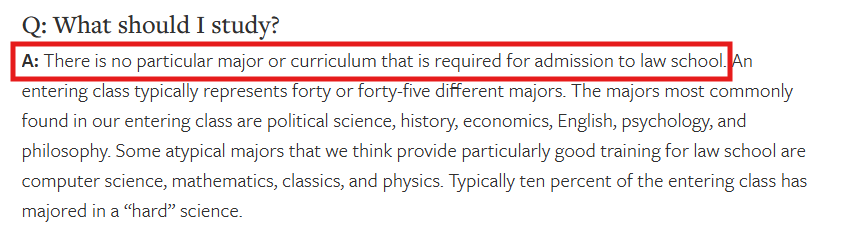
Instead, the admissions committee emphasizes that it looks for curricula that are "both broad and deep," and recommends courses involving close reading of texts, detailed analysis, logical reasoning, and extensive writing.
The committee also reviews transcript trends, grading curves, and course rigor rather than just the cumulative GPA number.
A school that calls itself "serious but not stuffy" and "elite but not elitist" wants students who bring genuine curiosity rather than just a great resume. If you majored in computer science or physics, the FAQ specifically notes that those are "atypical majors that we think provide particularly good training for law school."
Show that you challenged yourself across disciplines. And on the extracurricular side, the committee explicitly values quality of involvement and leadership over quantity of memberships. One deeply held commitment where you drove real results will carry more weight than a resume filled with unnecessary activities.
For personalized feedback on your application, work with a counselor at Juris Education. Our experts have years of experience helping students perfect their Cornell Law School applications.
A competitive Cornell Law candidate has an LSAT score of 175, a 3.97 GPA, and a resume built on depth rather than volume. Both numbers align with the 75th percentile of the current first-year class. And hitting either one puts your academics ahead of most admitted students.
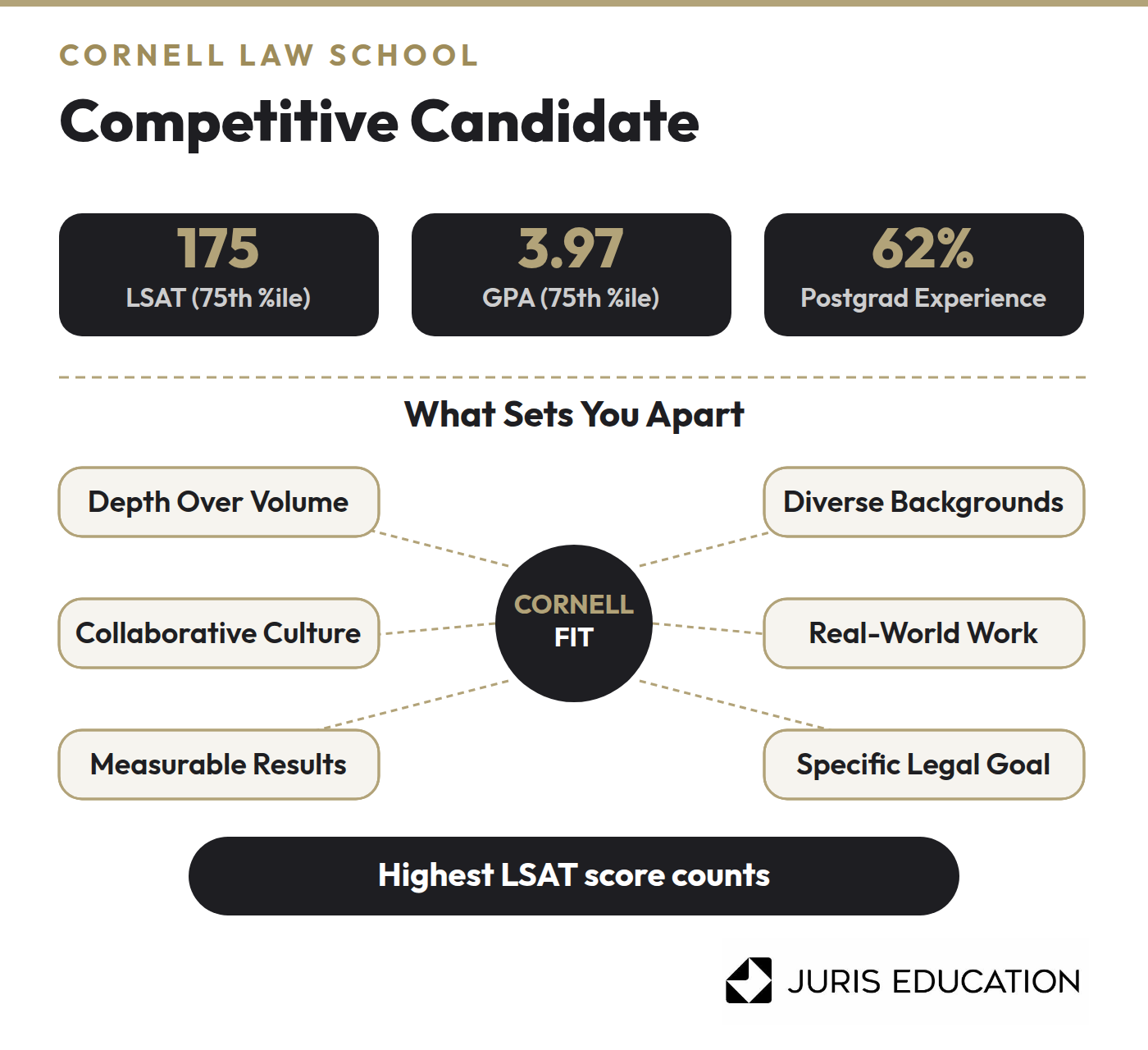
If you're below the 25th percentile LSAT score of 168, retaking the test is the best move you can make, since Cornell Law considers only your highest score.
Numbers get you considered, but the rest of the class profile tells you what actually earns an offer:
Your extracurriculars should show sustained commitment to one or two pursuits where you produced measurable results, ideally in a collaborative setting that reflects Cornell Law's colleagues-not-competitors culture. Pair that record with a personal statement that connects your experience to a specific legal goal, and you look like someone Cornell Law built its class profile around.
Here’s a comprehensive list of admissions requirements for Cornell Law School:
We ranked Cornell Law School as the 11th-best law school in the U.S. It’s ranked so highly due to its excellent job placement rate at large law firms. In 2025, Cornell had a legal employment rate of 99.49%, which was the highest among U.S. law schools in the latest ABA figures.
Cornell Law School's bar passage rate is 96.41% among first-time test takers, outperforming New York's overall bar passage rate of 84.7% by 11.7 percentage points. Graduates pass at a rate that makes the bar exam a less serious concern, which is exactly what you want from a school charging T14 tuition.
Cornell Law School interviews applicants by invitation only through the Kira Online Assessment, a recorded video-and-written platform. The committee sends invitations only to candidates already under serious consideration. Expect around seven questions: video prompts with 30 seconds of prep and 60 seconds to respond, plus written prompts with roughly five minutes to answer.
Cornell Law School offers five degree programs (J.D., two LL.M. programs, M.S.LS, and J.S.D.) along with several dual-degree options through Cornell's other professional schools. Standout pathways include the 3+3 Accelerated Pathway, which allows eligible juniors to start law school in place of their senior year and complete both degrees in six years, and the J.D. Semester at Cornell Tech for students pursuing careers at the intersection of law and technology.
David Merson was the original author of this article. Snippets of his work may remain.
Co-Founder of Juris Education, Dartmouth College


.svg)
