Get in touch: +1 888 904 4161




I've seen many strong applicants apply to UT Austin School of Law as their "Texas safety" and write a personal statement that never once mentions pro bono work, clinical education, or the state's legal landscape. Then they're surprised when someone with a lower LSAT and a two-year track record of community legal work in Austin gets admitted instead.
UT Austin School of Law cares specifically about how you’ll contribute to their community and what you’ve done in your life to prove that. You should already be acting like a lawyer by helping individuals in your life. Any direct legal experience will help you prove that you’re ready to be a lawyer, but you also want to highlight transferable skills from non-legal experiences.
The guide below covers what numbers make you competitive, what UT Austin School of Law specifically looks for beyond those numbers, and how to build an application that proves you understand what makes this school different from every other program on your list.
If you’re just here for the requirements, click here.
In the 2025-2026 admissions cycle, UT Austin School of Law had an acceptance rate of 13.99%, according to the American Bar Association (ABA). The admissions office received 6,297 applications and extended offers of admission to 881 applicants, with 361 students deciding to enroll.
The visual below shows how UT Austin School of Law’s acceptance rate has fluctuated over the past four admissions cycles:
The 2025-2026 admissions cycle was the most competitive UT Austin School of Law has been in the last five years. Only 13.99% of applicants were offered admission, even though there was a large total applicant pool. The total number of offers had been decreasing from the 2021-2022 admissions cycle, but the recent cycle broke that pattern.
It’s very hard to get into the UT Austin School of Law. In the 2025-2026 admissions cycle, only 13.99% of applicants received an offer of admission, and in the last five application cycles, it has averaged only a 14.86% acceptance rate.
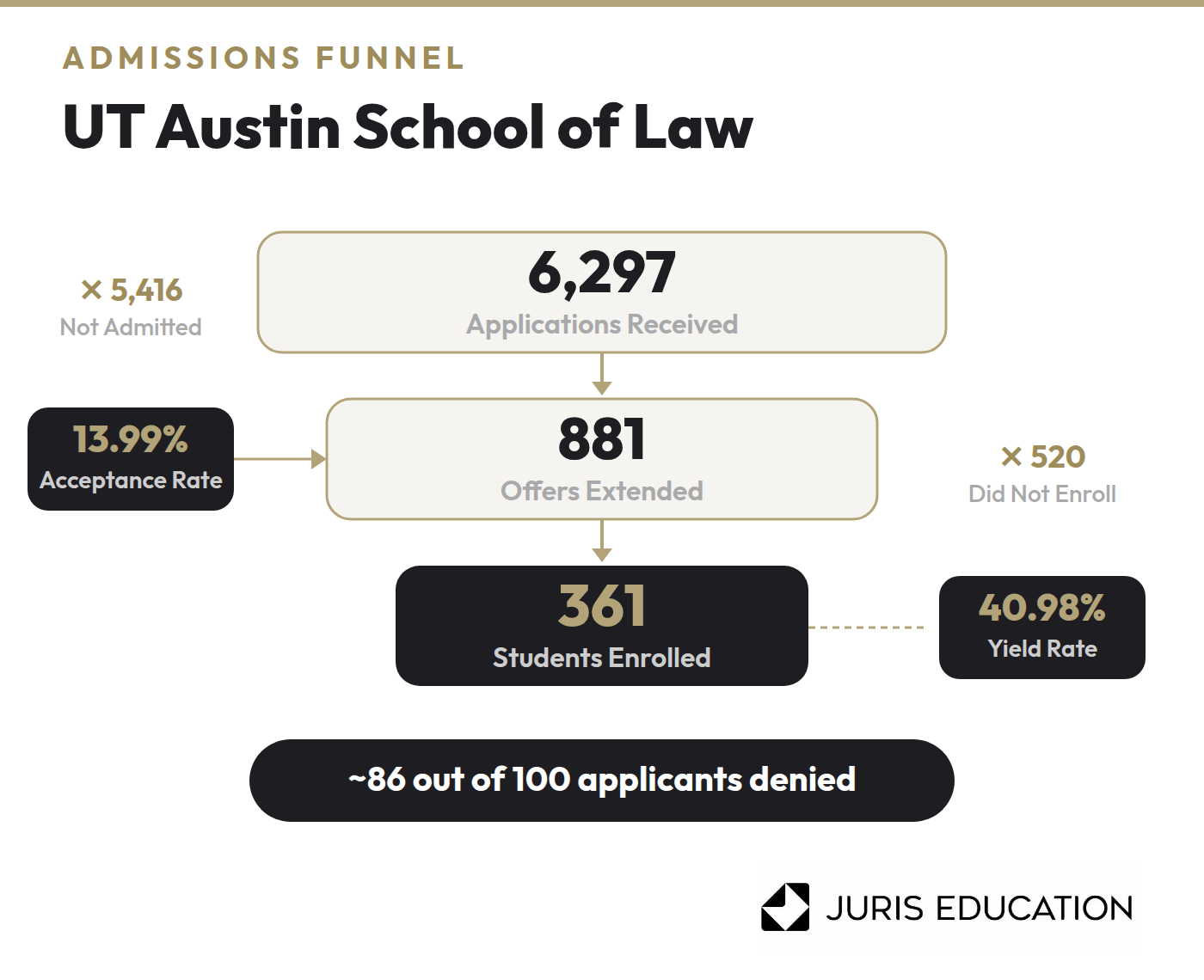
While this isn’t as low as Ivy League law schools, roughly 6 out of 7 applicants were rejected by the UT Austin School of Law over the past five admissions cycles, so it’s unlikely that you’ll get in unless you stand out.
The median LSAT score of matriculants in the 2025-2026 admissions cycle at UT Austin School of Law was 172. You don’t need a minimum score to be considered for admission.
Here’s a look at the LSAT score percentiles for matriculants in the 2025-2026 admissions cycle. Enter your score to see how competitive it is:
According to the Law School Admissions Council (LSAC), in the 2025-2026 admissions cycle, the national median LSAT score among all law school applicants was 159. That means most students at the UT Austin School of Law score 8.18% higher on the LSAT than all law school applicants in general.
In the 2025-2026 admissions cycle, UT Austin School of Law matriculants had a median GPA of 3.89. You need at least a 2.20 LSAC GPA to be considered for admission at UT Austin School of Law.
Take a look at the GPA percentiles of previous matriculants to see how competitive your GPA is:
According to the LSAC, in the 2025-2026 admissions cycle, the national median GPA among all law school applicants was 3.68. That means most students at UT Austin School of Law have a GPA 5.70% higher than most law school applicants.
UT Austin School of Law accepts the GRE, but there isn’t enough data to break it down into percentiles. In the 2025-2026 admissions cycle, only four matriculants submitted the GRE, compared with 369 matriculants who submitted the LSAT. If you have a high GRE score, you can submit it instead of the LSAT. However, stick to the LSAT; it’s the most common option at UT Austin School of Law.
Lead your application narrative with solid evidence that you’ve already supported others before anyone required you to. On UT Austin School of Law’s Public Service page, it lists "commitment to students seeking to work for the public good" as one of its distinguishing factors.
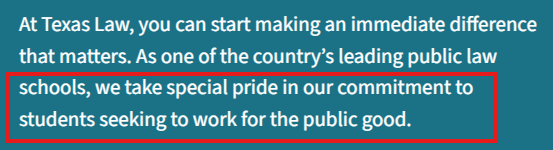
That means the school's identity runs on service at every level. The William Wayne Justice Center for Public Interest Law requires pro bono work through the Richard and Ginni Mithoff Pro Bono Program, which starts students on client-facing projects in their first semester. Around 16 clinics span everything from the Actual Innocence Clinic to the Immigration Clinic to the Environmental Clinic.
The admissions team reads thousands of applications that mention wanting to "give back." You stand out by showing you already have.
Your personal statement should trace how a specific service experience showed the limitations of good intentions without legal training and why that gap drove you toward law school.
On your resume, quantify the service with hours logged, populations served, and outcomes achieved. Readers who see that pattern will recognize a candidate who fits perfectly into the school’s culture of equal justice for all.
For more tips on crafting your application narrative, watch the video below:
Write one of your optional statements specifically around a time you saw a viewpoint different from your own and grew from the experience. Texas Law's community page features a section called "Differences without Divisions," which describes the school's culture of "rigorous debate" conducted in a "spirited but respectful way."

The school states directly that the ideal student knows "how to disagree without being disagreeable." That language suggests that the admissions committee wants students who can share a room with people they fundamentally disagree with and produce better legal thinking as a result.
Texas Law's optional statements are limited to one double-spaced page each. Use that to your advantage by focusing on a single specific moment of productive disagreement.
Describe what the other person believed, what you believed, and what changed in your reasoning. A reader evaluating your application will likely connect that story directly to the classroom culture Texas Law actively values.
Prioritize hands-on, applied experience on your resume rather than emphasizing your academic credentials. Texas Law markets itself as having "one of the best clinical programs in the country" and reinforces that claim with 16 clinics where students handle real cases for real clients.

Additionally, the JD program page states that "your legal training starts on day one." The school's experiential education infrastructure includes clinics, internships, the Mithoff Pro Bono Program, and a nationally ranked Advocacy Program. All of that suggests a preference for learning through practice over learning through theory alone.

Applicants who’ve already demonstrated that preference in their pre-law careers perfectly match the school's identity. Internships at legal aid organizations, legislative offices at the Texas State Capitol, or community mediation programs carry more weight here than a fourth year of academic research.
Frame your resume entries around what you did, who you served, and what you produced. If your strongest work experience is non-legal, show how it required you to solve real problems for real people under real constraints.
In our webinar on non-traditional applicants, Tamar Alexanian, an expert consultant at Juris Education and a graduate of the University of Michigan Law School, shares her opinion on transferable skills for law school:
"Communication skills are some of the biggest things that people develop in a workplace ... It's a huge asset that you have that, and the law school career office doesn’t have to teach you how to do those things."
Texas Law's admissions readers are looking for candidates who will hit the ground running, not students who need two years of theory before they can talk to a client.
The admissions committee invites candidates to complete a virtual interview as part of their evaluation. Not every law school offers an interview. The fact that Texas Law has one shows how much weight the committee places on qualities that only arise in conversation, such as:
Texas Law describes itself as "the best of both worlds: all the opportunities of a large school but the warm community of a small one."

Your interview is one of the best places in your application to prove you belong in that small community. Prepare by identifying the two or three experiences that best demonstrate your contributions to a group environment. Practice speaking about conflict you navigated collaboratively, and avoid rehearsed monologues about your credentials.
The interviewers are assessing whether you’ll show up on day one as someone who improves the lives of the people around you. Texas Law's community page says the school aims to cultivate "inspired learning, connection, and joy." Your interview should feel like a conversation as someone who already belongs to the school.
Take a look at the video below to learn more about law school interviews:
Build your application around the specific contribution only you can make to Texas Law's entering class. The admissions committee evaluates "any other personal characteristics or experiences that would contribute to the overall enrichment of the School of Law."
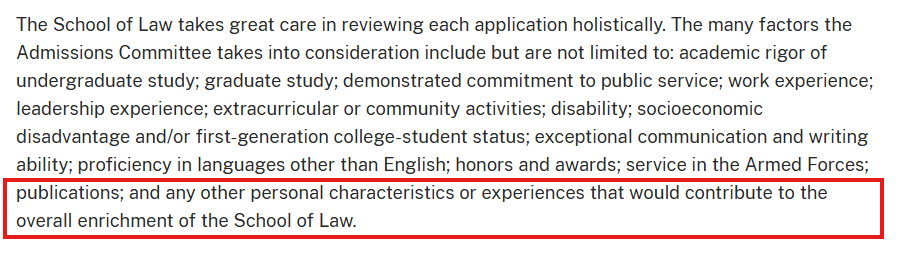
That word, enrichment, does more work than you think. It changes the ultimate question from "are you qualified?" to "what do you add?"
Your personal statement should answer "why law" through the distinctive perspective your background provides. A first-generation college graduate who grew up navigating systems without professional guidance brings something different to a Contracts classroom than a legacy applicant. An engineer who spent five years in energy infrastructure brings different questions to the Kay Bailey Hutchison Energy Center than a political science major
Identify the gap in perspective that only your life has equipped you to fill, and make that gap the spine of your application narrative.
Take a look at the video below if you’re confused about how to build a unique application narrative that sets you apart:
A competitive candidate pairs a 173+ LSAT with a 3.96+ GPA and brings real-world experience that proves they already operate like a future lawyer. Those numbers align with the 75th percentile of the most recent entering class, and hitting both puts you ahead of the majority of admitted students in the initial screening phase.
According to UT Austin School of Law's Class of 2028 profile:
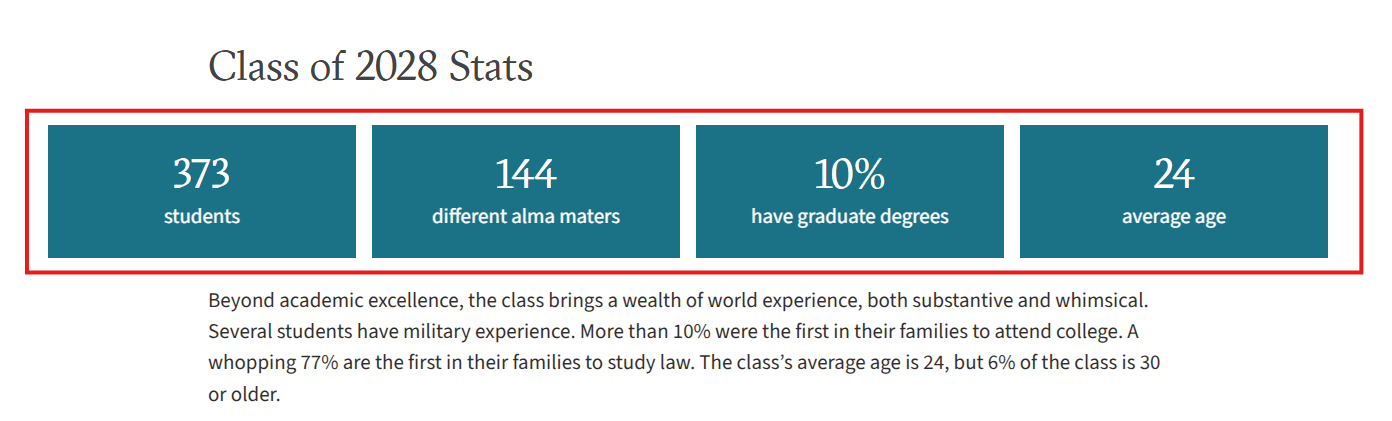
Those demographics tell you what the admissions committee actually values: Varied professional backgrounds, geographic diversity, and non-traditional paths into studying law. The entering class included a registered patent agent, a former firefighter and EMT, a high school teacher and administrator, and a Schwarzman Scholar.
Your strongest application will combine top-tier academics with a clear track record of applied, hands-on work and a personal statement that explains what gap in perspective only your background can fill at UT Austin School of Law.
Talk to an expert to improve your chances of getting into the law school. Our former admissions officers know exactly how to improve your application to ensure you’re submitting the best one possible.
Submit all materials through the LSAC and its Credential Assembly Service (CAS). Admissions officers won’t review your application until they receive all of your required items:
The application opens September 1. The Early Decision deadline is November 1 (binding), and the Regular Decision deadline is March 1.
Take a look at our video for a comprehensive law school admissions checklist:
We ranked UT Austin School of Law as the 15th best law school in the nation. Its combination of 16 in-house legal clinics and strong employment outcomes across the Texas, New York, and California markets makes it a great option for legal education.
UT Austin School of Law graduates have a first-time bar passage rate of 96.39%, exceeding the council-weighted average of 83.01% by more than 13 percentage points. The school's two-year ultimate bar admission rate is even stronger, with 98.92% of the graduating class gaining bar admission within two years of graduation.
Yes, UT Austin School of Law conducts interviews as part of the admissions process. If they like your application, the admissions committee will email you an invitation to complete a virtual interview. The interview uses a timed video-response format in which you record answers to behavioral questions and complete a short written prompt explaining your reasons for applying to Texas Law.
UT Austin School of Law offers two primary degree programs: the JD and the LLM. The JD is the standard three-year law degree and requires 86 credit hours. The LLM is a one-year program designed for students who already hold a JD or an equivalent law degree from a foreign university.
Co-Founder of Juris Education, Dartmouth College


.svg)
