Get in touch: +1 888 904 4161




If you're planning on applying to T14 law schools, there's a good chance New York University School of Law (NYU Law) is already on your list. The challenge is that most advice online focuses almost entirely on LSAT scores and GPAs, making it difficult to understand what the admissions committee is actually looking for beyond the numbers.
To better understand what successful applicants do differently, I spoke with several of our admissions experts who have guided students through the NYU Law admissions process.
I combined their insights with the latest admissions statistics and official policies to create this comprehensive guide.
If you're simply looking for the admissions requirements, click here.
New York University School of Law accepted 13.39% of applicants for its most recent entering class. According to the American Bar Association (ABA) Standard 509 Report, 10,546 students applied to NYU Law, 1,412 received offers of admission, and 452 ultimately matriculated.
Here’s a breakdown of these numbers:
This data shows that NYU Law does not significantly expand its class size, even when it receives far more applications in a given cycle. The school actually issued fewer offers of admission in 2025-2026 (1,412) than it did in 2024-2025 (1,423), even with 2,000 more applicants in the pool. The result is a sharp drop in acceptance rate from 16.67% to 13.39%, the lowest in at least five years.
This means that the admissions environment at NYU Law is tightening, not loosening. A cycle ago, roughly 1 in 6 applicants received an offer. Now it’s around 1 in 7. If you are applying in an upcoming cycle, assume the competition will be at least this intense, but likely more.
To improve your odds at NYU Law, work with an expert admissions consultant who knows what separates a complete application from a compelling one.

Getting into NYU Law is extremely difficult. With an acceptance rate of 13.39%, NYU Law turns away 86.61% of applicants each year. In other words, roughly 1 in 7 applicants gets admitted.
If you want to better gauge your chances of getting into NYU Law, try out this quiz:
NYU Law's median LSAT score for the most recent entering class was 172. The 25th percentile score for matriculants was 169, while the 75th percentile score was 174.
Add your LSAT score below to see how it compares to the 2025-2026 matriculants:
To put these numbers into perspective, a 172 LSAT score falls at approximately the 97th percentile of all LSAT test takers, meaning it scores higher than about 97% of people who take the exam. A 174 LSAT, meanwhile, is around the 98th percentile, underscoring just how competitive NYU Law's admitted students are.
Target a 174 or higher to be genuinely competitive. Although NYU Law’s median LSAT score is 172, that figure means half of enrolled students scored above it, so exceeding the median will strengthen your application.
NYU Law's median undergraduate GPA for the most recent entering class was 3.92. The 25th percentile GPA was 3.81, while the 75th percentile GPA was 3.97.
See how your GPA compares to the 2025-2026 matriculants with our tool:
For comparison, the median GPA for all students who matriculated at ABA-approved law schools in 2025 was 3.68, while the 75th percentile GPA was 3.89. NYU Law's 25th percentile GPA of 3.81 sits just 0.08 GPA points below the GPA earned by the top 25% of all law school matriculants.
In other words, even applicants at the lower end of NYU Law's incoming class have GPAs that nearly match those of the highest-performing students entering law school nationwide.
Aim for a GPA of at least 3.97 to reach the 75th percentile for recent NYU Law admits. A median GPA shows that your academic performance aligns with that of the typical admitted student, but it won’t necessarily help you stand out. NYU receives applications from many students with exceptional grades, so targeting the 75th percentile can make your academic record more competitive.
One piece of advice the experts I spoke to gave that stuck with me was this: Don't apply to be a lawyer. Apply to be a member of NYU Law's community.
This is exactly what NYU says it's looking for. According to their admissions page, NYU Law evaluates applicants based on factors including intellectual potential, leadership, character, community involvement, work experience, and their ability to contribute to the classroom.
As Tamar Alexanian, a Juris Education admissions counselor and law school professor at American University, explains in our webinar on Navigating the Law School Application:
"Top law schools are looking for candidates who can articulate how their background will add to their class profile ... making sure that you see those experiences as assets instead of weaknesses in your application."
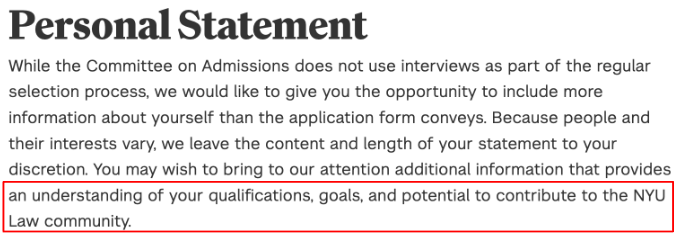
Your contribution can be anything, like a perspective, skill, or lived experience you bring to a classroom discussion, a clinic, or a study group that no other applicant brings the same way. Put this front and center in your personal statement, as NYU Law specifically asks you to mention your potential to contribute to their community there.
The admissions committee builds each class to represent a broad range of backgrounds and perspectives, not a roster of identical resumes.
Whether you're a military veteran, first-generation college student, entrepreneur, engineer, teacher, or healthcare professional, those experiences aren't side notes; they're often what separates you from applicants with similar GPAs and LSAT scores.
Don't write your personal statement around "What makes me qualified for law school?" Write it around "What perspective would my classmates lose if I weren't there?" Then use your optional essays and resume to reinforce that same perspective from a different angle.
Don't waste valuable space repeating yourself on your application. Unlike many T14 law schools, NYU Law doesn't require supplemental essays.
Instead, it gives applicants two opportunities to tell the admissions committee who they are: the personal statement and an optional Additional Information submission.
Write your personal statement first. It should answer why you're pursuing law and what experience shaped that decision. Once you know what story that essay tells, you'll see the gap it leaves, and that gap is what your Additional Information submission should fill.
Don't use this section as a landing pad for leftover accomplishments. NYU Law asks for information that shows your "qualifications, goals, and potential to contribute to the NYU Law community," and it specifically points to leadership, community involvement, adversity, or socioeconomic disadvantage. Pick one of those, not all of them.
List five different accomplishments and the committee learns nothing new about you. Walk through one specific moment, what you did in it, and what changed because of it, and the committee learns exactly how you think and act under pressure.
Keep it separate from an addendum. If you're explaining a low LSAT score or a rough semester, that belongs in an addendum, not here. This section exists to add a new dimension to your profile, not to defend one.
Before you submit anything, ask what the admissions committee learns about you here that they can't learn anywhere else in your file. If you can't answer that clearly, don't submit it.
NYU Law names work experience as an evaluation criterion directly on its own admissions page, saying the committee evaluates your work experience for "evidence of advancement, leadership, and capacity for assuming responsibility."
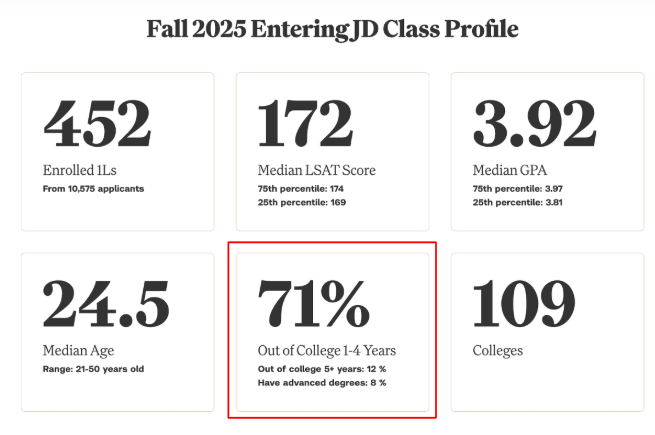
The class profile backs this up. Of NYU Law's most recent entering class, 83% worked before enrolling, 71% had one to four years of post-college experience, and another 12% had five or more years. Applying straight from undergrad isn’t impossible, but you’d be in a clear minority.
Work experience matters because it can give you what most 22-year-olds don’t have yet: a concrete story about why you want to go to law school.
Admissions committees can tell the difference between an applicant who says "I want to pursue public interest law" because it sounds good and one who says it after spending two years at a nonprofit and seeing firsthand how legal barriers affect the communities they served.
The type of work matters less than what you did with it. Consulting, teaching, government, research, advocacy, nonprofits, corporate roles, and military service all show up in NYU Law's entering classes.
Show growth and increasing responsibility, and you'll answer the exact question the committee says it's asking.
If you are a current undergrad wondering whether to apply now or wait, the data suggests waiting is not a disadvantage. For most applicants, it is a clear advantage.
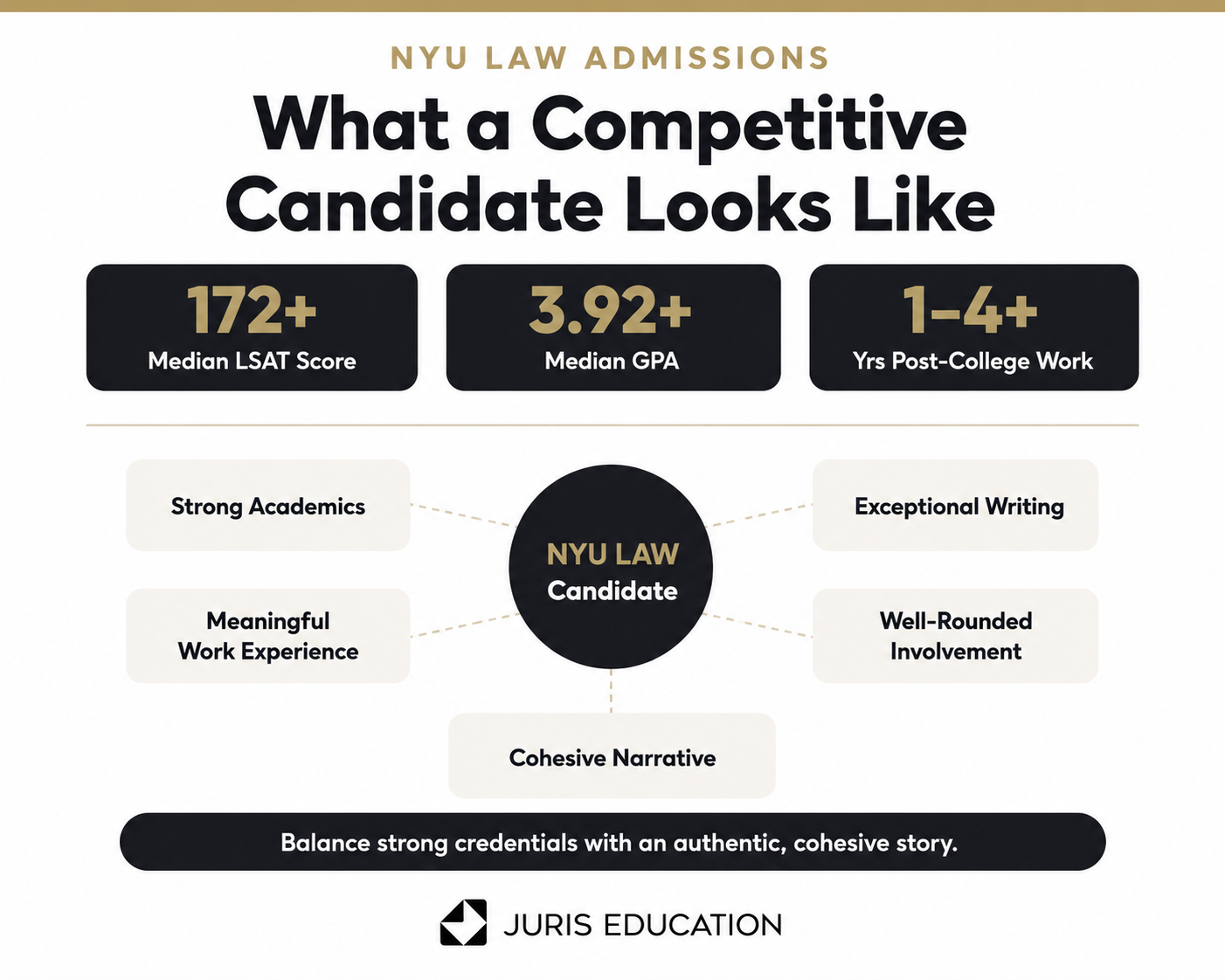
A competitive NYU Law applicant often has:
Very few applicants excel in every category. An outstanding application balances strong academic credentials with authentic experiences, thoughtful reflection, and a compelling reason you want to attend NYU Law.
NYU Law accepts applications through the Law School Admission Council (LSAC). Before submitting your application, make sure you've completed each of the following requirements.
NYU Law doesn’t require applicants to complete specific prerequisite courses before applying. Students from all academic disciplines are encouraged to apply.
Instead of focusing on a particular major, NYU Law looks for applicants who have developed strong analytical reasoning, critical thinking, research, and writing skills through a rigorous undergraduate education.
Coursework in subjects such as political science, economics, history, philosophy, English, STEM, business, or the social sciences can all provide strong preparation for law school.
NYU Law's Early Decision deadline is November 15, 2026, and the Regular Decision deadline is February 15, 2027.
Applicants interested in programmatic scholarships should submit their applications by the priority deadline of December 1, 2026, and no later than January 1, 2027; otherwise, they won’t be considered.
NYU Law ranks as the 10th best law school according to our rankings. NYU Law has consistently held its status as a T14 law school and is particularly well known for its strengths in constitutional law, tax law, international law, public interest law, and corporate law.
According to the ABA Bar Passage/Admissions Report, NYU Law’s 2025 grads had a bar passage rate of 96.69%, which is more than 10% above the national bar passage rate of 86.37%.
NYU Law offers the following programs:
Co-Founder of Juris Education, Dartmouth College


.svg)
