Our Black Friday Sale is almost here. Want to learn more?
Black Friday starts Nov 19
Starts in
00
D
00
H
00
M





I once spoke with a law school applicant who was prepared to take on nearly $300,000 in debt to attend a prestigious school. Before we discussed their chances of getting in, I asked them a different question: "What kind of lawyer do you actually want to become?"
I asked them that because their goals would determine whether their investment would be worth it or not. That kind of investment only makes sense if you’re aiming for Big Law after graduation. I put together this guide to rank the 10 most expensive law schools and explain when they're worth the price and when a more affordable option is the better choice.
The table below ranks the 10 most expensive law schools in the US by annual tuition and required fees. Required fees include mandatory charges, such as campus health-service fees, but exclude waivable health insurance, one-time fees, and loan fees.
*Note: IS = in-state resident; OOS = out-of-state resident. Tuition and costs refer to 2026-2027.
Acceptance rates are for the fall 2025 entering class, using ABA Standard 509 data.
Expensive law programs like T-14 schools and Ivy League schools are worth it only if the program’s outcome after graduation justifies the price. If your goal is to land a high-paying Big Law job, an expensive law school can be a worthwhile investment, especially if it has a strong record of placing graduates at major firms. If you’re aiming for private practice, state or local politics, or public interest, such a highly ranked law school might not be worth it.
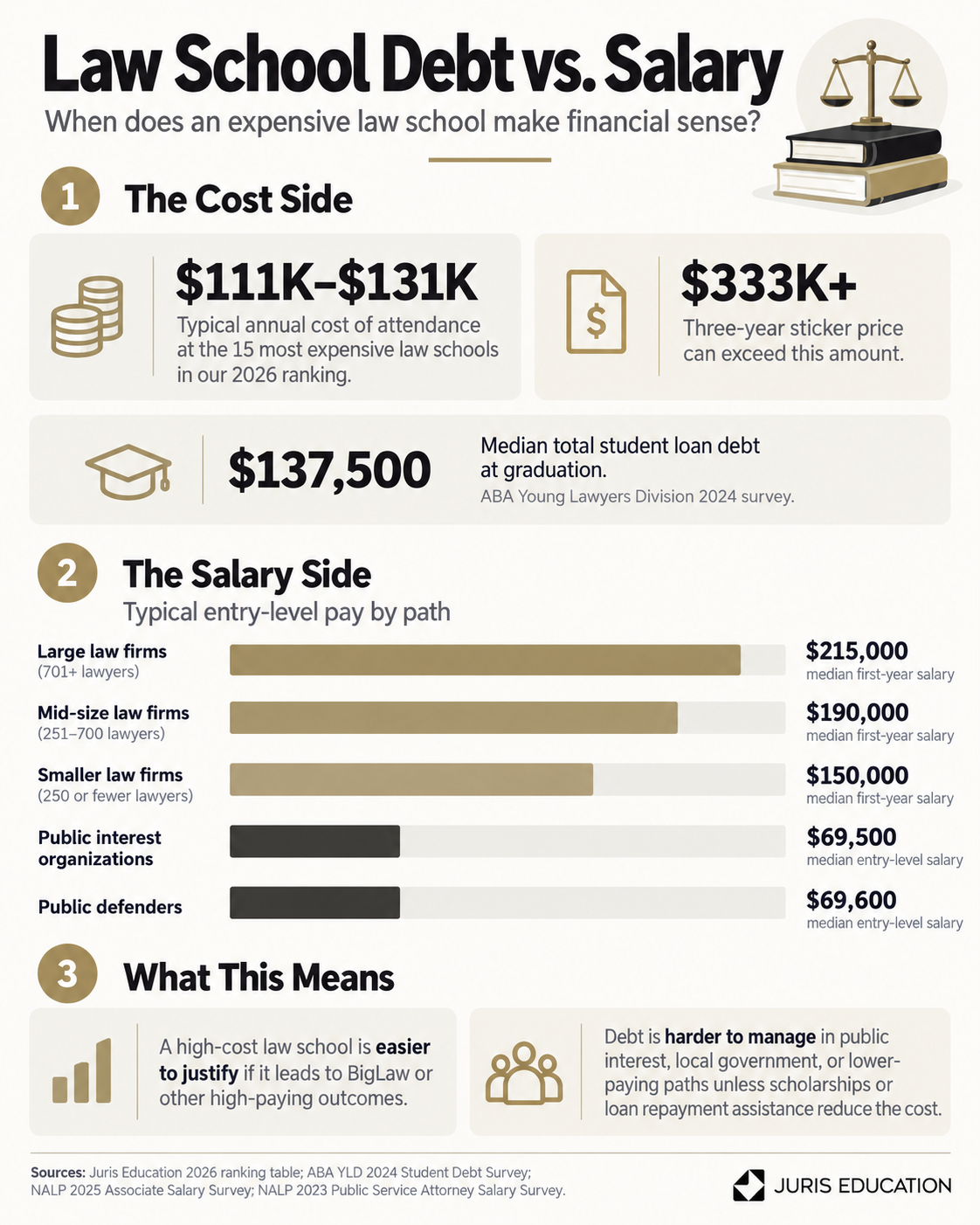
Let’s take a closer look at when an expensive school is or isn’t worth it.
When expensive law Schools are worth it:
When expensive law schools are NOT worth It:
Before you decide where to apply, you should first have a good idea of your career goals and how much debt you're comfortable taking on. If you're unsure which schools are the best fit, our team of admissions experts provides personalized help with school admissions, from building a strategic school list to maximizing your LSAT score and crafting a compelling resume and personal statement.
Law school is expensive because universities spend heavily on specialized faculty, small classes, legal clinics, and career services. Prestigious law schools also invest in facilities and resources to attract top students and professors.
The best way to reduce your law school expenses is to earn a merit-based scholarship by achieving a competitive LSAT score and GPA. You can also consider public law schools that offer lower in-state tuition, apply for other scholarships, and choose modest accommodations.
Yes, you can attend law school for free if you receive a full scholarship that covers tuition and living expenses. Some law schools offer full-tuition merit scholarships or generous need-based financial aid packages.
Co-Founder of Juris Education, Dartmouth College


