Get in touch: +1 888 904 4161




Stanford Law is one of the hardest law schools to get into in the country. Most applicants already know that, but what they don't know is why their application failed.
I've worked with students who had LSAT scores in the 175 range, near-perfect GPAs, and impressive resumes that got them into other T14 schools but not Stanford. The reason is almost always that they wrote an application that proved they were qualified for law school in general, rather than proving they belonged at Stanford Law.
The admissions committee isn't filling 400 seats; they're filling fewer than 180. At that level, every matriculant shapes the class culture, and the committee evaluates you with that in mind. If your application doesn't answer the question "What would this person add that nobody else can?" then your numbers alone won't save you. The guide below breaks down what it takes to answer that question convincingly.
If you’re just here for the requirements, click here.
In the 2025-2026 admissions cycle, Stanford Law School’s acceptance rate was 6.10%, according to the American Bar Association (ABA). The admissions committee received 5,526 applications and offered admission to 337, with only 173 students enrolled.
Here’s a look at the acceptance rate data over the past five admissions cycles at Stanford Law School:
Stanford Law's 2025-2026 cycle hit its lowest acceptance rate in five years at 6.10%. However, the school offered 337 seats, which is in line with the number it usually offers. What changed is the applicant pool; 5,526 people applied, a 29% increase from the prior year's 4,270.
For applicants, getting in is harder because demand increased, but Stanford isn't restricting class size. The school has held a fairly steady entering class between 157 and 173 for five straight years. Your competition is the other 5,500 applicants in the pool, meaning all of your application components need to stand out.
Getting into Stanford Law School is extremely difficult, especially given the increase in applications compared to the previous year. Over the last five admissions cycles, Stanford Law has averaged a 7.07% acceptance rate, meaning just about 93 in 100 students are turned away.
Get an estimate on your Stanford Law admissions odds with our free quiz:
The median LSAT score of all matriculants in the 2025-2026 admissions cycle at Stanford Law School was 173. There’s no minimum LSAT score required for admission.
Add your LSAT score to the tool below to see how it compares with the LSAT score of previous matriculants:
Here’s a look at the range of LSAT scores for the 2025-2026 matriculants:
According to the Law School Admissions Council (LSAC), in the 2025-2026 admissions cycle, the national median LSAT score among all law school applicants was 159. That means most students at Stanford Law score 8.81% higher on the LSAT than all law school applicants in general.
The median GPA of matriculants at Stanford Law School in the 2025-2026 admissions cycle was 3.96. There’s no GPA requirement for admission.
Enter your GPA into the tool below to see how it compares with previous matriculants:
The table below shows the GPA percentile ranges for Stanford Law School’s first-year class:
According to the LSAC, in the 2025-2026 admissions cycle, the national median GPA among all law school applicants was 3.68. That means most students at Stanford Law have a GPA that’s 0.24 points higher than all law school applicants.
The median GRE score of all Stanford Law School matriculants in the 2025-2026 admissions cycle was 335. There’s no minimum GRE score required for admission.
Here’s a look at the GRE percentiles for Stanford Law School’s matriculants:
Only 11 matriculants submitted GRE scores in the 2025-2026 admissions cycle, compared to 182 matriculants who submitted LSAT scores. You don’t have to submit both; submit only the GRE (and not the LSAT) if your score is higher than the median.
Write your personal statement around what you’ll add to Stanford Law School, not just why you want to attend. Stanford's personal statement prompt asks you to describe what aspects of your "life experiences, interests, and character would help you make a distinctive contribution to Stanford Law School." Stanford wants to know what you’ll bring to the school that no one else can.

Across every major page on Stanford Law's site, from the About page to the Why SLS page to the Only-at-SLS section, two words recur more than almost any others: "interdisciplinary" and "collegial."
Stanford Law School describes itself as a place where collaboration and the open exchange of ideas are "essential to life and learning."

Your personal statement needs to demonstrate both qualities. Show the committee a track record of working across disciplines or bridging separate communities, and demonstrate that you do so collaboratively rather than competitively.
In our law school application webinar, Jesse Wang, a Juris Education counselor and graduate of USC Gould School of Law, shares his insights on the personal statement.
"Make sure you craft something that is compelling and aligns with all the things that you've done before,” he says. “Not just something that you come up with out of the blue and doesn’t align with anything on your resume.”
Take a look at the video below for more personal statement tips:
Submit Stanford Law’s optional essay, which asks you to discuss a time you encountered a viewpoint that contrasted with your own and explain how you responded. It also asks whether you would do anything differently today.
These essays serve as your "Why Stanford" argument. The admissions committee doesn’t offer interviews as part of the admissions process, so your written materials carry more weight.
Stanford Law is smaller than nearly every peer institution:
Stanford tells you directly on its admissions page that the school values "the ability to communicate constructively across differences, even when the stakes are high or the differences significant."

The optional essay is where you set yourself apart by demonstrating the exact interpersonal skill that Stanford prizes most in a small, seminar-driven environment. With Faculty Discussion Seminars averaging just 11 students per section, Stanford Law School needs people who can disagree productively and respectfully.
Skipping the essay shows that you either missed the school's emphasis on constructive dialogue or chose not to engage with it.
Pick a moment where you genuinely changed your mind through engagement with an opposing view. Avoid focusing on how you changed someone’s viewpoint to agree with yours, because the prompt centers the word "responded," not "persuaded."
Show intellectual humility. Reflect specifically on what you’d change today; that self-awareness shows whether you treat disagreement as a learning opportunity or as a debate to win.
The video below shows you how to build a unique application narrative to reinforce in your optional essay:
Show the admissions committee that you approach problems by creating new solutions rather than by applying existing frameworks. Stanford Law describes itself as "driven by a passion for new ideas and a commitment to transformative solutions" and states that "experimentation, exploration, the translation of new knowledge into entrepreneurial solutions" are "in our DNA." The About page explicitly states that Stanford Law focuses on "the future, not the past."

No other top law school shapes its identity around innovation and entrepreneurship this much. The school sits very close to Silicon Valley and highlights that proximity on its Why Stanford Law page, alongside phrases like "unconventional community" and "anything-is-possible" culture.
It offers an Entrepreneurship Clinic, the Legal Design Lab (a collaboration with the d.school), CodeX (the Center for Legal Informatics), and Law & Policy Lab practicums on topics like AI governance and autonomous systems in outer space.
Your resume and personal statement should reflect a pattern of creating things, not just participating in them. Here are some ways you can demonstrate that:
Stanford Law's admissions committee reads thousands of applications from high-GPA, high-LSAT candidates who just joined impressive organizations. They’re looking for students who started, improved, or reimagined organizations.
If you need law school admissions assistance, work with an expert counselor at Juris Education. We have years of experience helping students craft compelling applications to Stanford Law School and stand out from thousands of other applicants.
A competitive Stanford Law candidate has an LSAT score of 176+, a 3.97+ GPA, extensive post-college experience, and a clear narrative about the specific value they’d add to a class of fewer than 200 people.
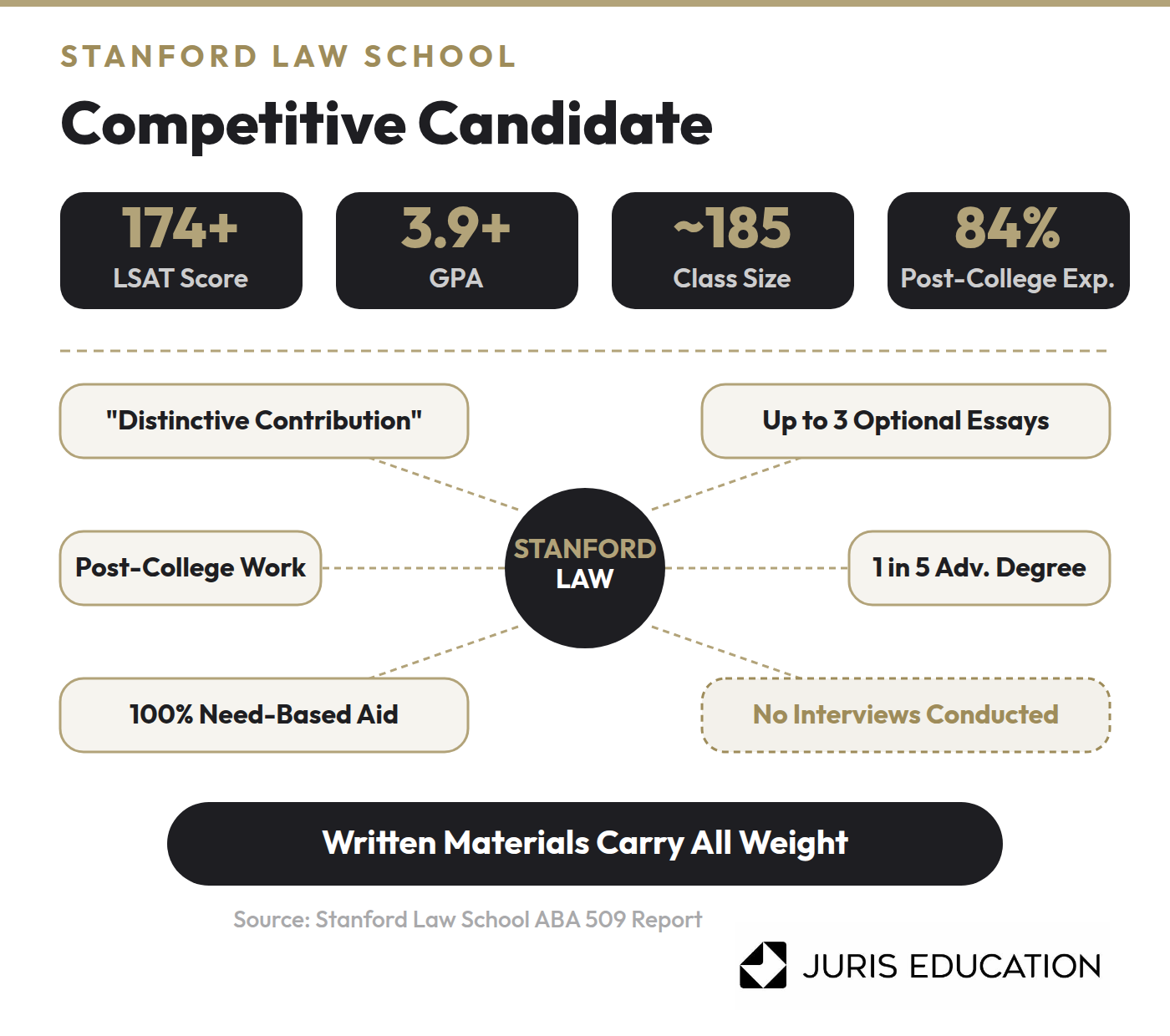
Stanford Law reports that 84% of entering students spent one or more years out of college before starting law school, and 1 in 5 arrived with an advanced degree. The admissions committee doesn’t conduct interviews, so your written materials carry all the weight of differentiating your application.
Stanford Law School gives you more opportunities to write compelling essays than any other law school:
Competitive applicants treat every optional component as required. Stanford also awards financial aid entirely on demonstrated need with no merit-based scholarships and no conditional awards tied to law school GPA.
Here’s a comprehensive list of admissions requirements for Stanford Law School:
We ranked Stanford Law School as the second-best law school in the country. It’s ranked so highly due to strong employment outcomes within 10 months of graduation and a high first-time bar passage rate.
According to the ABA, Stanford Law School's bar passage rate is 99.43% among first-time test-takers, outperforming California’s overall bar passage rate of 82.67%. Graduates pass at a rate that makes the bar exam a less serious concern, which is exactly what you want from a school charging T14 tuition.
No, Stanford Law School's admissions committee doesn’t conduct interviews as part of the admissions process. Your written application materials carry the full weight of demonstrating fit and candidacy.
Stanford Law School offers a JD program as its primary law degree, enrolling approximately 185 students per entering class. Beyond the JD, students can pursue 31 formal joint degree programs (including JD/Master's, JD/MD, and JD/PhD across more than 20 subject areas) or propose a custom joint degree of their own design, which the school describes as a "virtually limitless" option. Most JD/Master's programs can be completed in three years.
David Merson was the original author of this article. Snippets of his work may remain.
Co-Founder of Juris Education, Dartmouth College


.svg)
