Get in touch: +1 888 904 4161



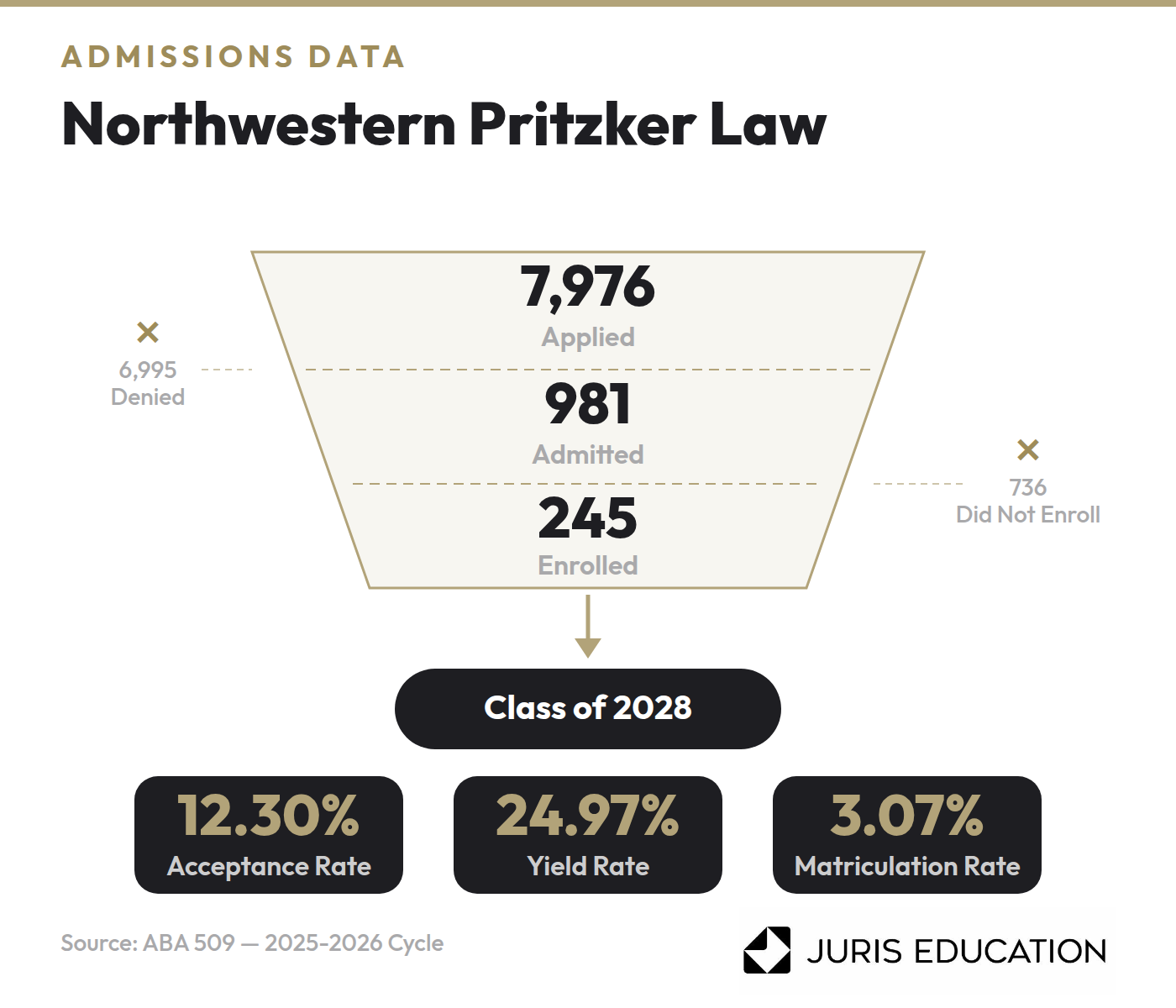
Northwestern Pritzker's acceptance rate dropped to 12.30% last cycle after applications increased by 26% in a single year. The school enrolled 245 students, almost the same number it enrolls every year regardless of how many people apply. What changed is that 1,600 more applicants showed up to compete for those same seats.
But the acceptance rate isn't what makes Northwestern Pritzker hard to get into. It's the profile of the people who actually get in. Roughly 85% of the entering class has at least one year of full-time work experience, and the average matriculant is 25 years old. Very few other T14 schools weights professional maturity as heavily as Northwestern Pritzker does, which means if you took a gap year after undergrad to gain work experience, you could be very competitive.
I've worked with applicants who thought they were competitive because they’d clear the initial applicant screening. But at a selective school like Pritzker, you need to have equally impressive non-academic components to stand out from thousands of other applicants. The guide below shows you exactly what scores to aim for, what Northwestern Pritzker's admissions committee prioritizes in competitive applicants, and how to differentiate your application from others.
If you’re just here for the requirements, click here.
The acceptance rate in the 2025-2026 admissions cycle at Northwestern Pritzker School of Law was 12.30%, according to the American Bar Association (ABA). In this admissions cycle, 7,976 students applied, and 981 were offered admission. Only 245 students matriculated from the total accepted applicants. That means the odds of getting accepted to Northwestern Pritzker School of Law are just over 1 in 10.
Here’s how Pritzker School of Law’s acceptance rate has fluctuated over the past five admissions cycles:
Getting into Northwestern Law School is very difficult. Over the last five admissions cycles, the school has averaged a 14.43%% acceptance rate, meaning fewer than 1 in 5 applicants receive an offer. As a T14 law school, Northwestern Pritzker ranks among the most selective law programs in the country.
In the 2025-2026 admissions cycle, the median LSAT score of Northwestern Pritzker matriculants was 173. There’s no minimum LSAT score required for admission.
Add your LSAT score below to see how it compares to first-year matriculants:
Here’s a look at the range of LSAT scores for the 2025-2026 matriculants:
Considering the national median LSAT score was about 159, most Northwestern Pritzker matriculants score roughly 14 points higher. If you’re currently averaging around 153 on your practice tests, you need to dedicate more time to studying. You won’t increase your score by 14 points overnight, so continue improving your weaknesses until you finally hit a 176 on your practice tests.
In the 2025-2026 admissions cycle, the median overall GPA for Northwestern Pritzker matriculants was 3.96. You don’t have to submit a minimum GPA for admission.
Add your GPA to the tool below to see how it compares with previous matriculants:
The table below shows the GPA percentile ranges for Northwestern Pritzker’s first-year class:
According to the LSAC, in the 2025-2026 admissions cycle, the national median GPA among all law school applicants was 3.68. That means competitive applicants at Northwestern Pritzker have a GPA that’s 0.32 points higher than all law school applicants.
If you have a low GPA, an upward trajectory is one of the best ways to set yourself apart on your application. Moving from a 3.50 in your freshman year to a 3.97 by graduation demonstrates exactly the kind of discipline and growth that admissions committees want to see.
The median GRE score for Northwestern Pritzker matriculants in the 2025-2026 admissions cycle was 329. There’s no minimum GRE required for admission.
Here’s a look at the GRE percentiles of Pritzker matriculants:
Only 16 matriculants submitted GRE scores, whereas 232 matriculants submitted LSAT scores. For every matriculant who submitted the GRE, about 15 matriculants submitted the LSAT. You can send both scores to the school, but you’ll have to submit the Northwestern Pritzker Law GRE Intention Form and contact the Educational Testing Service (ETS) to have your Official GRE Score Report sent to Northwestern Pritzker Law.
Northwestern Pritzker explicitly states that work experience is "such an important factor in our admissions process," shaping the entire character of the student body. Roughly 85% of entering students have had at least one year of full-time work experience.
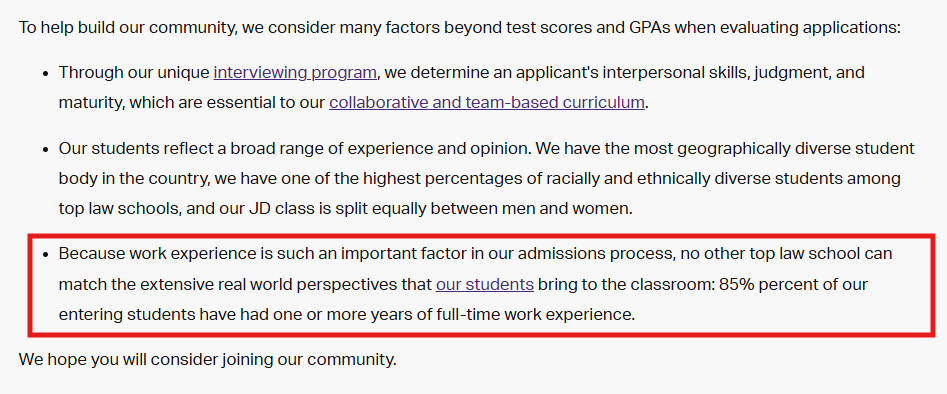
Very few T14 schools lean this heavily on professional background as an admissions factor. If you're applying straight from undergrad, you're competing against candidates who bring years of professional context to their personal statements, interviews, and classroom contributions.
In our application narrative webinar, Mika MacDonald, a Juris Education counselor and graduate of the University of Chicago School of Law, shares her insights on work experience.
"I have students that worked as a legal assistant or paralegal for a few years and then apply to law school,” she says. “They all have a great narrative, which is that they’ve investigated what it's like to be a lawyer and are still choosing to become a lawyer. They have a certain level of credibility because of that."
Even a year of work in a public service role gives you concrete evidence of the maturity and judgment Northwestern Pritzker looks for. Frame your resume around career progression and impact rather than job titles. Show what you built, solved, or led in each role so the admissions committee can see you contributing a real-world perspective from day one.
The video interview at Northwestern Pritzker is technically optional, but 95% of incoming students participate, as shown in the screenshot below.

The admissions committee uses the optional video interview to evaluate:
Think of the interview as the admissions committee’s opportunity to get to know how you speak, how you’ve learned, and whether you’re mature enough to study law. Academics only tell them so much.
In our webinar on How to Get Into the T14 Law Schools, Tamar Alexanian, a graduate of the University of Michigan Law School and expert advisor at Juris Education, highlights the purpose of the interview.
"You can only get so much from what’s on paper, and so sometimes law schools really just want to be like, what do they sound like? Are they as compelling of a person as I think that they will be?" he says.
Skipping the interview when nearly every admitted student completes it sends the wrong signal. The interview questions come from members of the admissions committee and the broader Northwestern Pritzker community and focus on competencies such as empathy, problem-solving, and resilience rather than just legal knowledge.
Prepare for the interview by practicing answers that draw on your work experience and show how you collaborate under pressure. Record yourself answering sample behavioral questions to refine your delivery before the real interview. You have 14 days from the date you receive your portal invitation, so submit your application early enough to complete the optional video interview.
Northwestern Pritzker is one of the most interdisciplinary law schools in the nation. Over 50% of the research faculty hold PhDs in addition to law degrees. Connect your interests across several disciplines, not just law.
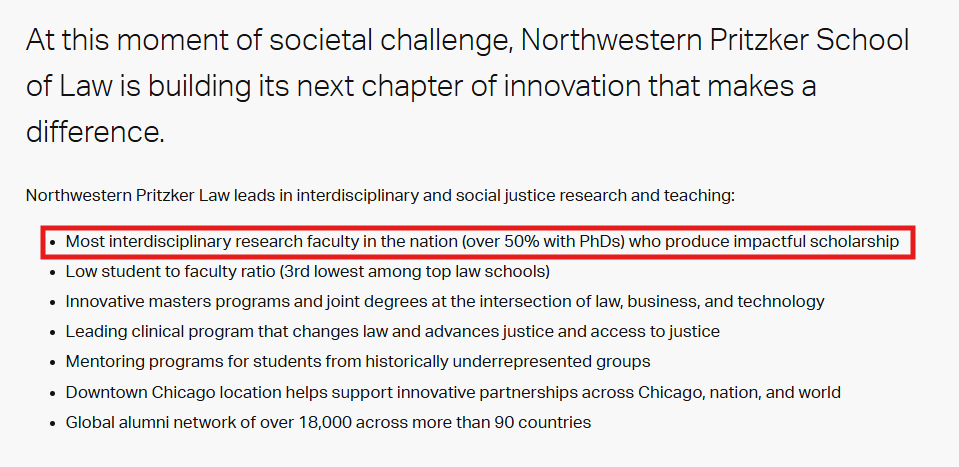
The JD-MBA with Kellogg, the Master of Science in Law for STEM professionals, and the Donald Pritzker Entrepreneurship Law Center all reflect a school that wants students who think beyond traditional legal disciplines.
Your personal statement should highlight moments where you combined two fields or applied thinking from one domain to solve a problem in another. For example, if you worked in healthcare and want to study health law, don't just describe your career pivot. Demonstrate how your clinical experience showed a gap that legal training could help you address.
In a webinar on Perfecting Your Personal Statement, Tamar Alexanian offers valuable advice on how to differentiate your writing from that of other applicants.
"You don't want to go on and on making a list of, ‘I'm a leader, I'm good at this, I'm good at that,’” he says. “You want your story to demonstrate that for your reader. Provide examples as much as you can, provide stories as much as you can. Anything that kind of helps things jump off the page."
Make the connection between your non-law background and the specific interdisciplinary resources at Northwestern Pritzker explicit so the admissions committee sees a student who will thrive in their environment.
For more tips on tailoring your personal statement, watch the video below:
In your personal statement or optional essays, write about Northwestern Pritzker's commitment to justice and access. The Bluhm Legal Clinic houses more than 20 clinics within 12 centers and represents one of the most comprehensive clinical programs in the country.
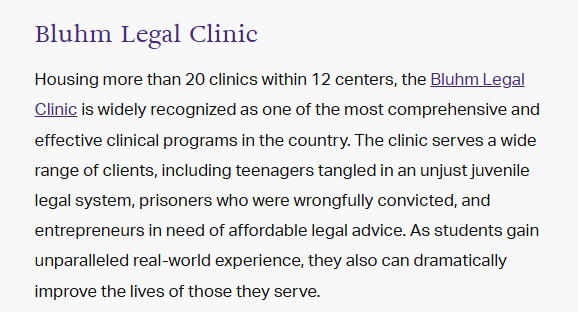
The Center on Wrongful Convictions, the Center for International Human Rights, and the Children and Family Justice Center envelop the core of Northwestern Pritzker’s identity.
The school's “About” page leads with "innovation that makes a difference" and explicitly names social justice research and teaching as a pillar of its mission.
If public interest or social impact motivates your legal career, name the specific clinic or center where you want to contribute and explain what you'd bring to that work in your personal statement, essays, or interview. A candidate who writes about wanting to challenge wrongful convictions and references the clinic's track record signals far more alignment than someone who mentions "public interest" generically.
Take a look at the video below to learn how to craft your application narrative.
Northwestern Pritzker’s optional essays aren’t optional. Northwestern Pritzker's admissions policy lists a long set of factors the admissions committee evaluates, and "concern for others" and "unique experiences and perspectives that will enrich our learning community" appear alongside traditional metrics like academic accomplishments.
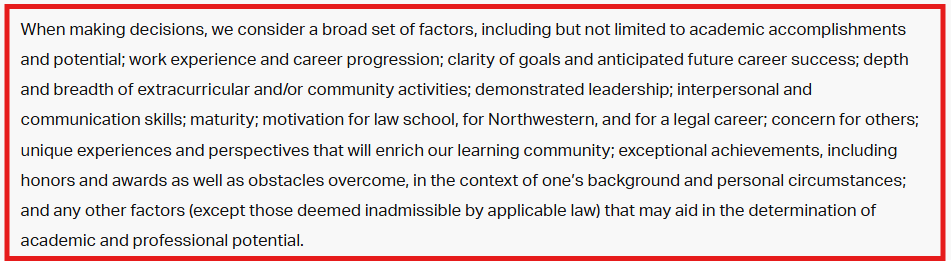
One of the best pieces of advice to get into Northwestern Pritzker is to demonstrate these non-negotiable qualities in your application.
Northwestern Pritzker also describes itself as collaborative rather than competitive, with a team-based curriculum that starts in the required first-year Communication and Legal Reasoning course.
Optional essays give you an opportunity to demonstrate qualities the personal statement can't fully cover. Use them to explain:
Every optional essay you leave blank is a missed opportunity to show the admissions committee you've done your research and you understand what makes Pritzker's culture different from other T14 schools. Keep each response focused on one clear idea rather than trying to cover everything.
A competitive Northwestern Pritzker applicant scores at or above the 75th percentile LSAT of 175 and has a GPA at or above 4.00. Those numbers put you in the top quarter of the enrolled class and give you the strongest statistical footing heading into application review.
However, numbers alone won't get you accepted. Northwestern Pritzker's class profile page emphasizes that 85% of the entering class has at least one year of post-undergraduate work experience, and few other top law schools match the real-world perspectives its students bring to the classroom.
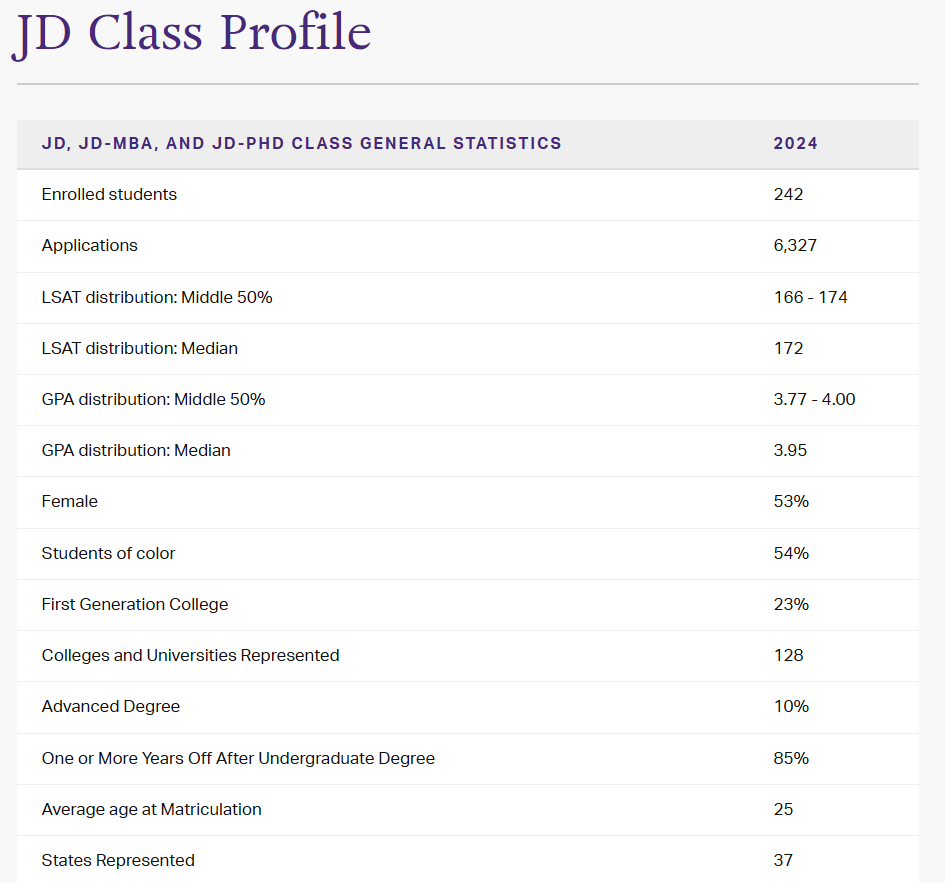
The average matriculant is 25 years old, indicating that most admitted students have worked full-time for two or more years before enrolling. If you're applying as a K-JD candidate straight out of undergrad, you need to understand that you're entering a pool where professional maturity is the norm rather than the exception. Admissions officers look for evidence of maturity throughout all elements of your application.
Strong internships, research positions, or leadership in campus organizations can help offset the lack of full-time employment, but you'll need to work harder in your personal statement to demonstrate the maturity and interpersonal skills that work experience naturally provides.
The most recent entering class drew from 128 different undergraduate institutions and 37 states, making Northwestern Pritzker one of the most geographically diverse law schools in the T14. Your application should reflect the specific perspective you'd bring to a diverse student body, rather than sounding like a generic high-achieving applicant.
Northwestern Pritzker lists several requirements that you need to submit electronically through LSAC by the February 15 deadline. Here's everything you need to compile:
Stay on top of each requirement with Juris Education’s law school admissions consulting services. Our consultants have years of experience helping applicants build a competitive profile for schools like Northwestern Pritzker School of Law
Northwestern Pritzker currently ranks 14th on our list of the best law schools in the United States. The school's clinical training program ranks particularly high, reflecting its investment in the Bluhm Legal Clinic and hands-on learning.
Northwestern Pritzker's first-time bar passage rate for 2025 graduates is 98.83%. The two-year ultimate bar passage rate for 2023 graduates is 98.12%. In the highest-volume jurisdictions, Northwestern Pritzker graduates passed at rates of 80.00% in California, 83.55% in Washington, D.C., 93.63% in Illinois, 94.44% in New York, and 95.45% in all eight remaining jurisdictions combined.
Northwestern Pritzker uses an asynchronous online video interview hosted on the Kira platform. You'll watch pre-recorded questions from admissions committee members and other members of the Northwestern community and then receive 30 seconds to prepare and 60 seconds to record your response to each question. The system allows unlimited practice sessions before you begin, but once you start the formal interview, you get one take per question. Expect around six questions covering competencies such as empathy, resilience, teamwork, and problem-solving. The entire process takes roughly 30-45 minutes.
Northwestern Pritzker offers seven primary JD degree programs, three master's in laws (LLM) programs, and a Master of Science in Law (MSL) degree. JD students can also concentrate in one of several areas, including Business Enterprise, Civil Litigation and Dispute Resolution, Environmental Law, International Law, Law and Social Policy, or Technology, Innovation, and Entrepreneurship.
David Merson was the original author of this article. Snippets of his work may remain.
Co-Founder of Juris Education, Dartmouth College


.svg)
