Get in touch: +1 888 904 4161




Many students consider work experience an essential part of their application, and they’re right. What they don’t know much about is just how much work experience you really need on your application to impress admissions officers.
Some students work three to four hours a week in a legal position and think they have everything they need, but that’s missing a critical component. You need thousands of hours of work experience to stand out in the application process, which roughly translates to one year of full-time work.
Even more important is recalling exactly what you did in each role and how you grew from it. Below, I’ll give you strategies to help you find the best work experience for your law school application to impress each admissions officer that reads your file.
The best types of work experience for law school show that you’ve handled real responsibilities and have foundational skills you’ll actually use as a future attorney.
There isn’t a single “perfect” job for law school. Admissions officers look for experience that shows maturity, reliability, and skills that translate well to legal training. Legal roles are helpful because the connection is obvious, but teaching, nonprofit work, customer service, leadership roles, and research positions can be just as persuasive if you explain them well.
Below are the most common work experiences that look impressive on your law school application:
You don’t need a job in a law office for your experience to matter. Many strong candidates have never held a legal role. What they do have is a set of responsibilities they can connect to the skills law schools care about.
A mix of legal and non-legal experience can benefit your overall application. This lets you present a balanced application that includes direct legal experience showing your passion for studying law and transferable skills that will benefit you as a future lawyer.
One type of experience isn’t necessarily better than the other. Some applicants get into law school with only legal experience, while others get in with no legal experience. The key is how you frame your experience on your application.
Even though you don’t need legal experience to get into law school, it does help you confirm that you’ve seen the pressures of the field and still want to pursue it as a career. It shows you’re dedicated to the profession, and admissions like to see your passion.
On the flip side, some law schools admit applicants with no legal experience because they highlight transferable skills on their resumes, such as communication, leadership, or problem-solving.
Ideally, you should aim to have a mix of both types of work experience to show that you’re not just excited about studying law, but you believe you’ll thrive in it.
However, aim for deep involvement in your work experiences rather than a long list of short activities. It’s much better to show that you worked as a paralegal for two years and a retail assistant for one year than to have five activities that only lasted for three months each.
We recommend 1,000 to 2,000+ hours of combined work experience before applying to law school. One full-time year of work translates to roughly 2,000 hours, and one part-time year translates to roughly 1,000 hours.
But I wanted to put these numbers into context, so I talked with several of our top admissions consultants. The common thread I’ve seen is to treat 1,000 hours of work experience as the absolute minimum for your law school requirements. Aiming for 1,000 hours shows you've had enough time in a role to learn something, make mistakes, and grow from them.
However, 2,000+ hours is a much better target. This lets you get specific in your writing and interview responses about decisions you made, people you helped, and problems you solved. Without specificity, your work experience just looks like hours logged instead of actual skills you learned.
Here's how we recommend you divide those hours across legal and non-legal roles:
An important thing to note is that these hour recommendations should span your entire undergraduate career and any gap years you take before law school. Many students take a gap year to gain more work experience before applying to law school. However, students who’ve taken a gap year of three or more years should have deeper work experience on their resumes since they’ve had more time to work.
In our law school application webinar, Mika MacDonald, an expert consultant at Juris Education and a University of Chicago Law School graduate, shares her insights on work experience.
"I had one student who volunteered at a prison once a week for teaching ... every week he went down there for four hours for three years, which was basically his whole college career. That's a level of commitment to public service that admissions officers will really like to see."
Also keep in mind that these numbers are a starting point, not the end product. Admissions committees at every law school care far more about what you did during those hours than how many you logged.
Your academic record shows whether you can handle coursework. Your jobs and internships show how you cope with people, pressure, and imperfect situations.
It helps your application in at least three ways:
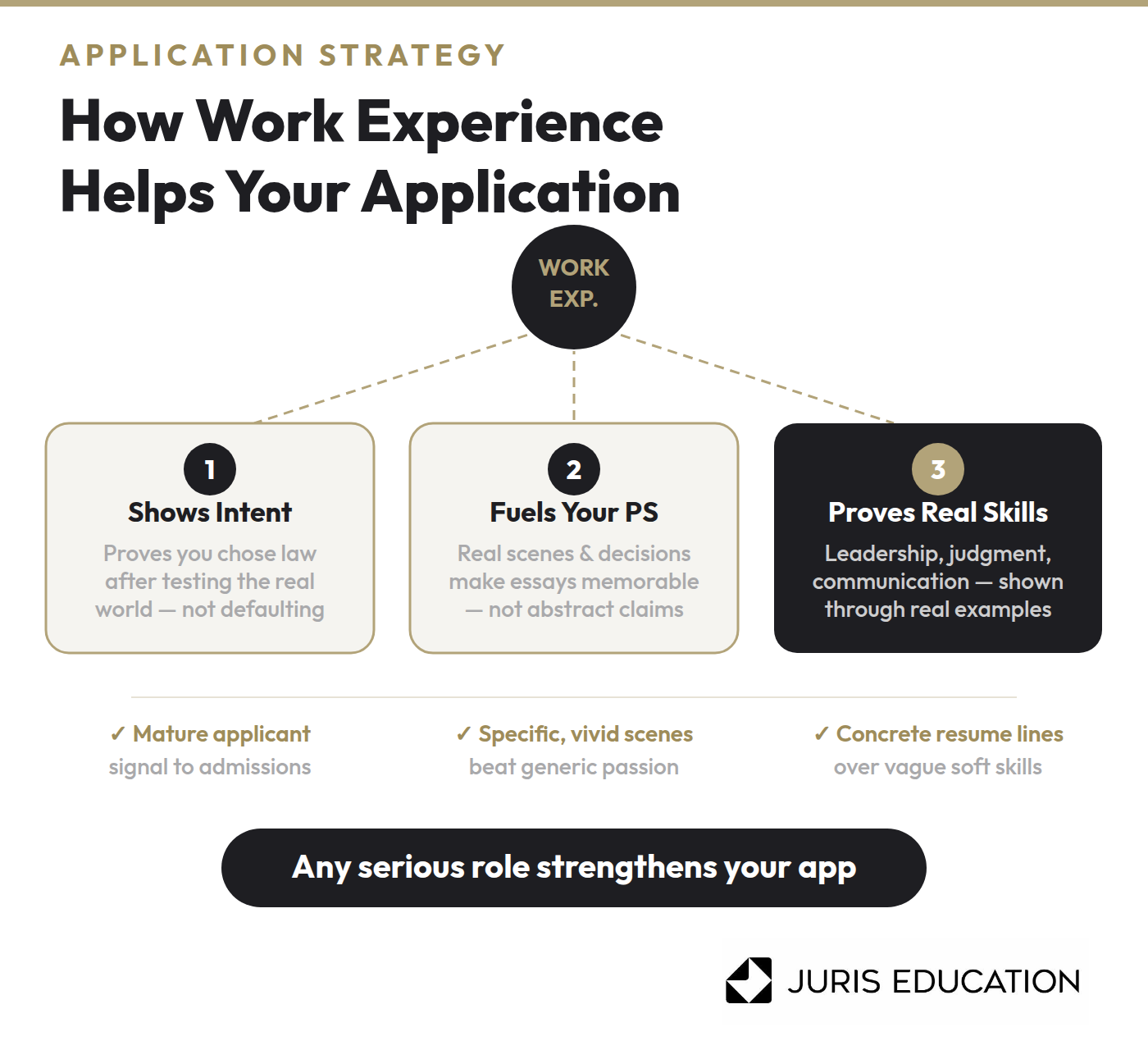
In our T-14 law school webinar, Tamar Alexanian, a University of Michigan Law School graduate and expert advisor at Juris Education, shares her advice on the benefits of work experience.
"Law schools actually love to see when people take some time off ... law school is a professional school, so they’re hoping to not have to babysit you in any sort of way. They’re hoping that you come to them with some critical thinking, writing, and professional skills that’s required."
If you don’t have much work experience, you can take a gap year to get some. Work experience is one of the best ways to showcase the skills admissions committees are looking for.
When admissions officers read your resume and essays, they’re constantly asking: “Can this person handle the demands of law school and legal work?” Certain skills come up repeatedly.
As a lawyer, you’ll be talking to laypeople about complex ideas and have to break them down into digestible concepts. Teaching jobs, tutoring jobs, reception jobs, and customer service jobs can help you improve your communication skills, as that’s the primary function of the job. When highlighting these jobs on your resume, focus on how you navigated difficult conversations, handled miscommunications, and helped confused students.
Law school has a fast turnaround time on almost every assignment. You’re required to spend long hours at specific times of the year, and situations don’t always go as you planned. Jobs like a summer camp counselor, lifeguard, retail worker, restaurant staff, or legal support roles can all show that you’re able to stay calm despite the chaos around you.
Focus on times when everything was really busy, there was an emergency, or when nothing seemed to go right. Admissions officers want to know how you still showed up despite these stressful times.
You don’t necessarily need to have managed a team to show leadership. You can demonstrate it by taking charge of a project in your club, running a student organization, supervising a shift, or volunteering to coordinate a project at a small startup. Focus on times when you trained someone else, led meetings, or were the go-to person people relied on.
As a lawyer, you’ll be responsible for representing clients at vulnerable points in their lives. You need to show that you’re willing to support clients through conflict, loss, or stressful changes. This can arise with experience in shelters, crisis hotlines, legal aid groups, youth programs, or other community organizations that support vulnerable populations.
Problem-solving is one of the most common skills you’ll deal with as a lawyer. Thankfully, most jobs require some level of problem-solving, so it’s easy to show on your resume. However, you should be deliberate about what you did when something wasn’t working. Talk about how you identified the issue, how you navigated through the solution, and what the results were after you solved the issue.
In law, you’re required to analyze hundreds of documents with extreme attention to detail. You’re representing other clients, so you can’t miss any word or punctuation. You can easily describe attention to detail in most jobs, but it’s especially important in data entry, proofreading, lab work, bookkeeping, and other roles where small mistakes can have big consequences.
Law school requires you to read extensively, then use what you’ve learned to formulate your own arguments. Research assistant roles are the best fit to demonstrate this skill, but they’re not the only ones. Lesson planning, program design, investigative reporting, or camp and tutoring positions that require you to create your own materials all involve gathering information, evaluating sources, and tailoring content to a particular group.
If you’re unsure how to frame your experience, work with a counselor at Juris Education. Our admissions experts understand the law school admissions process and can help you identify which jobs to apply for and how to present them effectively on your application.
You can include law-related internships on your resume as work experience. They’re fairly competitive and can fill up very early. However, if you secure one, you’ll be in a strong position in the application process, as internships can be a strong way to show that you have hands-on experience working in legal firms.
Here’s how to find and secure law internship positions.
You don’t need a lifelong specialty in mind, but it helps to know whether you’re more drawn to criminal work, corporate work, public interest, government, or something else. That core direction will push you toward particular offices and organizations.
Start by asking your course professors who teach in specific areas of law. For example, if you built a working relationship with your environmental law professor, ask them about their favorite aspects of the specialty. Get to know how they were drawn to that specific specialty and see how that compares with your passion for it.
Your school will likely have a career center, which is the perfect place to start looking for work experience. Counselors will help you find internship databases and employer contacts you might not be able to locate on your own. Before you apply, your counselor can help you edit your resume, write a tailored cover letter, and find alumni you can speak with.
You can also attend your career center’s fairs and networking events, where firms, government offices, and nonprofits in the community seek students. This is a great opportunity to network with industry professionals. Show up with your resume, a few meaningful questions, and interest in each program.
Many people automatically go to BigLaw firms for meaningful work experience. This can be a good option, but spots often fill up very quickly, leaving you with limited choices.
While a BigLaw intern position can look great on your resume, so can working for a local firm. Admissions officers care far more about how you present the skills you learned during your work experience than the size of the firm you interned at.
You can also learn more hands-on work at smaller firms, prosecutors’ offices, public defenders, legal aid organizations, and municipal agencies. In those settings, you’ll likely have to sit in on client meetings, help organize case files, listen to court hearings, and see how attorneys manage their daily schedule.
Note exactly who you contacted and what they need from you. All you need is a simple spreadsheet listing the organization’s name, key deadlines, required documents, your application status, and any saved conversation notes. This helps you keep track of all the opportunities you can potentially secure.
Once you finally start as an intern, keep a journal and record all your experiences. Write down what you learned, what you observed, and who you engaged with. That way, you’ll be able to bring yourself right back into the moment when writing about it in your personal statement or resume.
High school students can find opportunities through government programs, bar association initiatives, court‑sponsored internships, and university‑run summer law institutes. Some law internship programs pay an hourly wage or stipend, particularly those run by government agencies or bar associations. High school law interns might assist with basic research and administrative work, observe hearings, shadow attorneys, participate in mock trials, attend workshops, and meet legal professionals.
Yes, a gap year can improve your admission chances if you use it intentionally. Working full‑time, pursuing meaningful service or research, or taking on significant responsibilities gives you more to talk about in your application and can clarify why you’re pursuing law. A loosely planned gap year with little to show for it doesn’t add much.
Yes, non-legal work experience can help you get into law school. The key is how you frame it. Explain what you learned, how you changed, and how those lessons map onto law school and legal practice. Admissions officers care far more about that story than about whether your job title included the word “legal.”
Co-Founder of Juris Education, Dartmouth College


.svg)
