Get in touch: +1 888 904 4161




I talk to students every cycle who spent their summers working retail jobs or taking unrelated electives when they could’ve been sitting in a simulated 1L classroom learning the Socratic method from actual law professors or participating in mock trails. Students who attend strong pre-law summer programs learn expert LSAT strategies, how to write a strong personal statement reviewed by admissions professionals, and how to build faculty relationships that turn into recommendation letters.
What surprised me most when I looked at pre-law programs across the country is how many of the best ones are completely free. Fully funded programs at top law schools accept a small number of students each year, cover housing and meals, and provide post-program mentorship that lasts through your entire application cycle. Most applicants never apply because they don't know these programs exist.
The lists below cover the best options for both undergraduates and high school students so you can find the right program before the deadlines pass you by.
Here are the 15 best pre-law summer programs for undergrads planning to apply to law school:
We also looked at every pre-law summer program in the U.S. and compiled a list of the 15 best for high school students:
We reviewed hundreds of pre-law summer programs nationwide and selected the top 15 that offer both undergraduates and high school students an excellent introduction to law school. Every program on this list earned its spot based on the following criteria:
Discover the perfect summer programs by talking to our pre-law specialists. With years of admissions experience, they know expert strategies for finding the right pre-law summer program and how to highlight it on your law school application.
Pre-law summer programs give you a realistic preview of law school while building the exact skills admissions committees look for. You should take a pre-law summer program if you want to see whether legal work actually fits your thinking style before you invest three years and six figures in a JD. Reading about law school and sitting in a simulated Socratic classroom are completely different experiences, and the students who discover that gap early save themselves a costly wrong turn.
Here are all the benefits of enrolling in a pre-law summer program.
Many programs put you directly in a Socratic-style classroom, where professors will call on you to analyze cases, defend positions, and think on your feet. Experiencing it early helps you decide whether this learning style fits you, as you’ll be experiencing it quite a bit in law school.
Good pre-law summer programs offer courses (e.g., Torts, Criminal Law, Contracts, Legal Writing) taught by law school faculty. You’ll read and brief cases, take timed essay exams, and receive debriefs that usually reflect your first year in law school. That realistic look helps you assess your readiness and refine your study plan before you apply or matriculate to a real law school.
You’ll practice close reading of opinions, identifying holdings, extracting rules, and applying them to new facts, which all form the core of legal reasoning. Programs often emphasize rule synthesis and structured analysis, which translates directly to stronger exam answers and writing samples.
Legal writing modules train you to craft clear, persuasive arguments and cite authority correctly. Many programs add oral advocacy or moot-style exercises, so you can learn how to present arguments and respond to difficult questions, which will help you in your interview.
In our pre-law student webinar, Ebehiremhen Izoku, a Juris Education admissions expert and graduate of Stanford Law School, shares her insights on how pre-law summer programs can benefit your writing.
"Maybe you could talk about it in your personal statement. For example, if you learned at pre-law camp that you definitely want to go to law school, that's something that you can incorporate into your personal statement.”
Expect to learn case briefing, outlining, note-taking, and time management, plus guidance on forming effective study groups. These habits separate successful 1Ls from the rest, and practicing them early builds academic resilience.
You also get a better sense of what to major in before applying to law school. Strong programs connect you with law school faculty, admissions staff, and alumni networks that can support you long after the program ends.
Pre-law summers encourage varied, meaningful experiences (research, advocacy, policy work) that make your application more distinctive and coherent. Admissions committees favor applicants who show breadth plus depth, and a structured summer program helps you build both.
Programs that let you take first-year courses early or complete intensive prep help you enter 1L with a stronger foundation and more confidence. That head start can translate into better grades, earlier involvement in clinics, and more bandwidth for pro bono and experiential learning later.
You’ll join a supportive cohort and gain access to staff who are “just an email away” for guidance. For underrepresented and first-gen students, this community piece is often transformative, pairing skill-building with sustained mentorship.
Apply to a pre-law summer program as early as possible, ideally three to six months before the program starts. Most application deadlines for summer programs fall between January and April, but several programs use rolling admissions and fill their spots well before the posted deadline.
If you’re a pre-law student and need more advice on what to do, take a look at the webinar below.
To choose the right pre-law summer program for you, follow these steps.
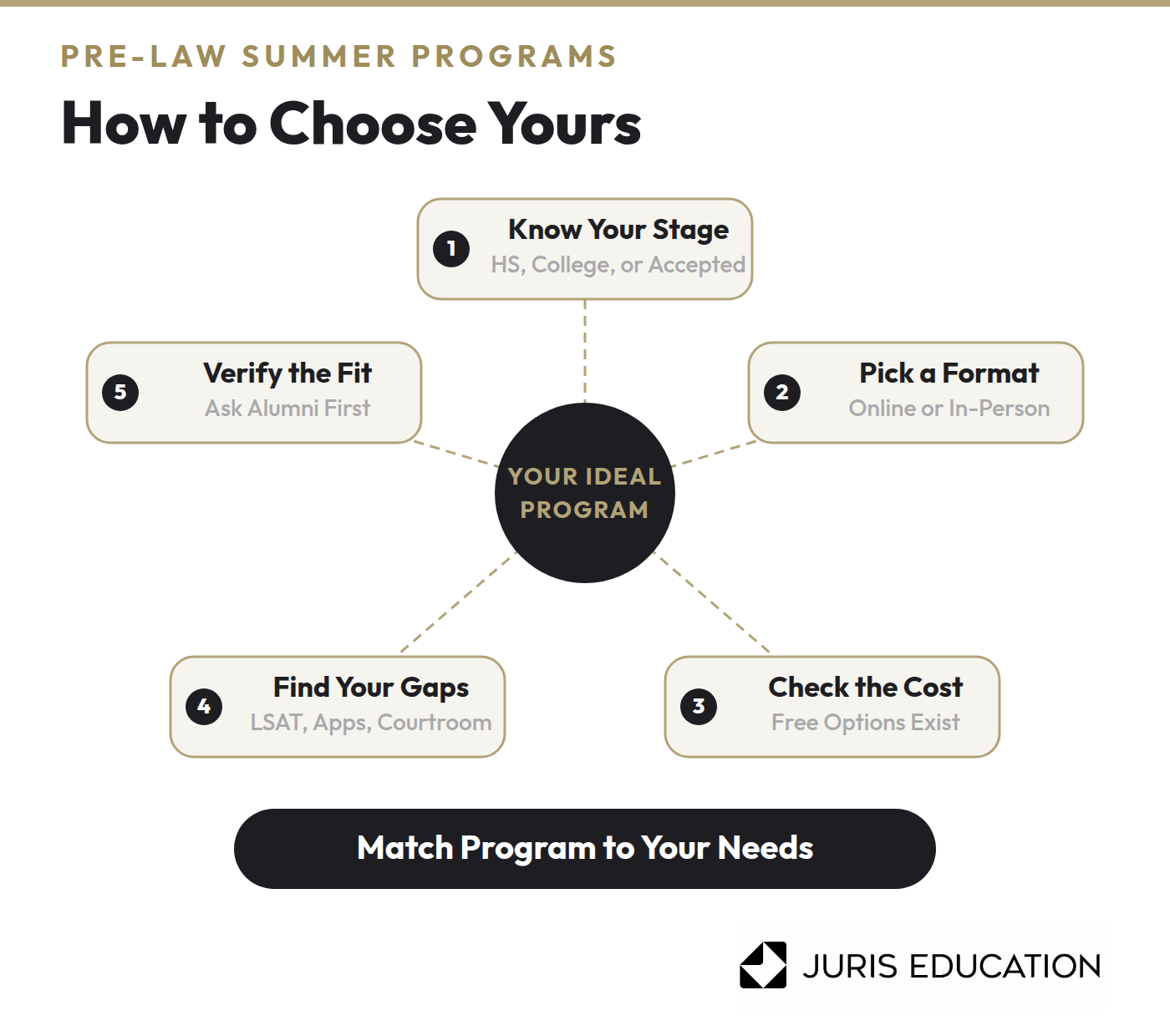
Your grade level determines which programs you can even apply to, and how close you are to your law school applications should drive which ones will improve your skills and knowledge.
Typically, high school students benefit most from programs that build foundational skills such as legal reasoning, oral advocacy, and case analysis. If you’re early in your high school education, you likely won’t be applying to law school anytime soon, so your primary goal should be to gain exposure and develop your skills. Programs like mock trial academies and pre-college law courses let you test your interest before committing to a law program.
College students within one to two years of applying to law school should consider programs that directly strengthen their law school applications. Look for programs offering LSAT preparation, personal statement mentorship, and simulated 1L coursework.
In our law school application timeline webinar, Christina Aldime, a JD-MBA graduate of Northwestern Pritzker School of Law and an expert consultant at Juris Education, shares her experience working in a pre-law summer program.
"I did a pipeline program, and I was able to work with a firm the summer before my law school experience. I got to see what working at a law firm looks like with no stress because I hadn't started law school, so I had no idea what the process was like.”
Students already accepted to law school or applying in the current cycle should prioritize 1L preparation programs like CLEO's Pre-Law Summer Institute, which simulates an entire first-year curriculum before orientation.
To get a better idea of where you are in the law school application timeline, take a look at the video below.
Online programs usually provide flexibility, but in-person programs can be more difficult to attend, especially if you’re commuting. Consider which format best fits your needs and learning style.
If you’ve never experienced the Socratic method, cold calls, or what it’s like to brief cases under a tight deadline, an in-person residential program will likely teach you more of these fundamental skills. Law school doesn’t allow you to pause a lecture and come back to it tomorrow, so an online program might not help you understand the day-to-day schedule of being a law student.
Online programs work best for students who already know they want to pursue law and need to build specific knowledge, like constitutional law fundamentals or legal writing mechanics, on a flexible schedule. Some asynchronous law courses let you learn about a subject comprehensively without having to relocate for your entire summer.
Commuter programs are the middle ground. At these programs, you usually attend in-person Saturday sessions, so you don’t have to worry about it affecting your summer job or internship schedule.
Several of the strongest pre-law summer programs in the country cost nothing to attend. Know what's available before you assume you need to spend thousands of dollars:
Paid programs aren’t automatically better. A $9,000 residential program and a free one can both provide you with strong LSAT prep, faculty mentorship, and courtroom exposure. The difference usually comes down to how prepared the faculty is to help you learn and grow your skills.
Pre-law summer programs are worth the cost when they build skills or connections you can’t get on your own, and several of the strongest programs in the country charge nothing at all. FSU's Weidner program, BU's SPLA, USC Gould's ASCEND, and TRIALS all cover tuition, housing, and meals for accepted students. Paid programs ranging from $2,000 to $10,000 can provide similar value, but compare what you’re actually getting against the free alternatives before you commit.
If cost is a factor, apply to the fully-funded programs first. Many are specifically designed for first-generation college students and applicants from lower-income backgrounds, so the application process should account for financial need.
The best program for you fills a specific gap in your law school preparation.
If you’ve never stepped into a courtroom, look for programs that include court visits, trial observation, or mock trial competitions. Stanford's Intensive Law & Trial and Rhodes College's Mock Trial Academy both focus their curriculum around courtroom simulation.
If your LSAT score is your primary weakness, look for programs that offer dedicated test prep. TRIALS has one of the most intensive LSAT preparation curricula in the country.
If you need help building your actual law school application, programs like KHOP and POP focus specifically on the admissions process, including your personal statement, resume, school selection strategy, and financial planning.
If you want to explore a specific area of law before committing to the field itself, look at programs that offer specialized tracks. For example, Penn Carey's Pre-College Academy lets you explore environmental law, human rights, and immigration law during your third week. Georgetown's online program offers courses in international law alongside its general law offerings.
Before you apply, reach out to program alumni or current coordinators and ask about anything you can’t find on their website.
For example, you could ask about the student-to-instructor ratio during each session. A program that highlights a "small group learning setting" might mean only 12 students per breakout room, or it might mean 40 students watching a lecture together. The difference matters when you’re seeking feedback on your advocacy or a draft personal statement.
Also, ask about what happens after the program finishes. The strongest programs have alumni networks, offer continued mentorship, or connect graduates with law school admissions contacts. TRIALS provides a full year of post-summer support. CLEO graduates become lifelong "CLEO Associates" with access to a professional network.
Ask recent participants whether the program changed something specific about their law school preparation. Look for specific answers like, “I was able to increase my LSAT score by 6 points in two months,” as that usually indicates they learned a lot from the experience.
In a pre-law summer program, you read and brief cases, participate in Socratic method discussions, attend lectures from law professors and practicing attorneys, and build core legal skills like oral advocacy and legal writing. Most programs also include courtroom visits, mock trial simulations, or guest panels with judges and working lawyers.
Yes, pre-law summer programs are usually very competitive, especially the fully funded residential programs at top law schools. USC Gould's ASCEND accepted 35 students from roughly 800 applicants in 2026, and TRIALS selects around 20 participants each year from thousands of applications nationwide. Open-enrollment programs like Georgetown's online courses and Wake Forest's self-paced offerings accept most students who meet the baseline eligibility requirements, so selectivity varies widely depending on the program you target.
David Merson was the original author of this article. Snippets of his work may remain.
Co-Founder of Juris Education, Dartmouth College


.svg)
