Get in touch: +1 888 904 4161




In the 2025-2026 admissions cycle, Penn Carey Law was the most selective it’s been in the past five years, and application volume increased 25% in a single year. Most applicants see the low acceptance rate and assume they need a higher LSAT score. That's part of it, but it misses what makes it different from every other top law school.
Penn Carey focuses on cross-disciplinary education. You can earn a JD and an MBA from Wharton in three years. You can take graduate courses at the medical school or the engineering school for law school credit. Most students pursue some form of dual degree or certificate.
The admissions committee looks for applicants who’ll actually use the cross-disciplinary infrastructure. I've worked with students who had LSAT scores in the 175 range and got waitlisted because their applications read like they could have been sent to any T14 school. And I've worked with students below the median who got in because every component of their applications connected to a specific program.
The guide below covers what scores you need, what the admissions committee prioritizes, and how to build an application that shows Penn Carey you understand what makes their school different from every other school on your list.
If you’re just here for the requirements, click here.
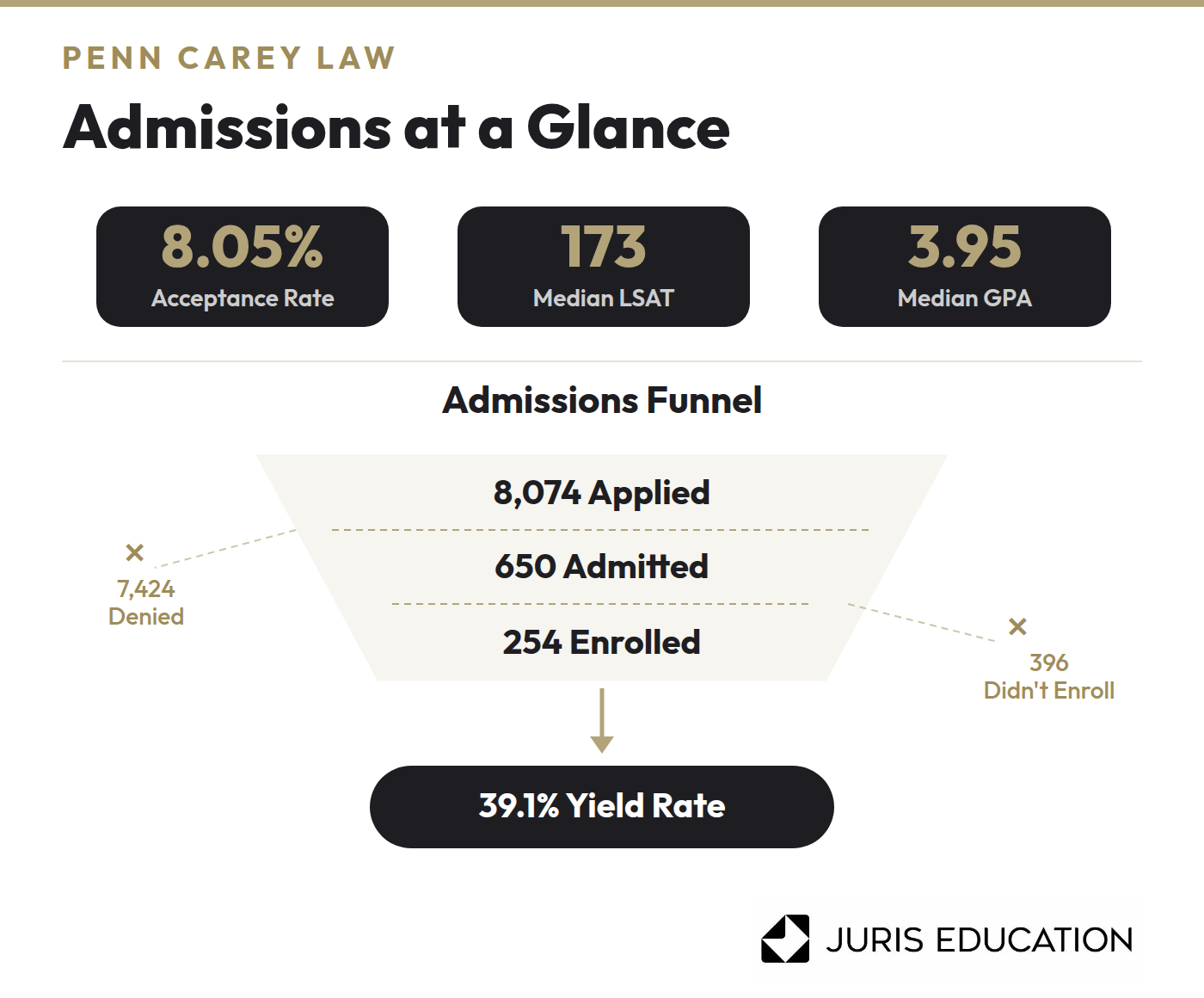
In the 2025-2026 admissions cycle, University of Pennsylvania Carey Law School had an acceptance rate of 8.05%, according to the American Bar Association (ABA). In this admissions cycle, Penn Carey Law had 8,074 applications and offered admission to 650 students. Only 254 students matriculated from the total applicant pool.
The table below shows how admissions data have fluctuated at Penn Carey Law across five cycles:
Penn Carey Law is one of the hardest law schools in the country to get into. Over the last five admissions cycles, Penn Carey Law has averaged an acceptance rate of only 9.40%. That means every component of your application needs to stand out to have a realistic shot at admission.
Take our interactive quiz below to find out how likely you are to get into Penn Carey Law:
In the 2025-2026 admissions cycle, Penn Cary Law matriculants had a median LSAT score of 173. There is no minimum LSAT score required for admission.
See how your LSAT score compares to those of Penn Carey Law’s previous matriculants using the tool below:
Here are the LSAT score ranges for Penn Carey Law’s 2025-2026 matriculants:
According to the Law School Admissions Council (LSAC), in the 2025-2026 admissions cycle, the national median LSAT score among all law school applicants was 159. That means Penn Carey Law’s median LSAT score is 8.81% higher than the median for all law school applicants.
Penn Carey Law’s median GPA for the 2025-2026 admissions cycle was 3.95. There is no minimum GPA required for admission.
Enter your GPA into the tool below to see how it compares to previous matriculants:
The table below shows the GPA percentile ranges for Penn Carey Law’s first-year class:
According to the LSAC, in the 2025-2026 admissions cycle, the national median GPA among all law school applicants was 3.68. That means Penn Carey Law’s median GPA is 0.27 points higher than the national median.
Penn Carey Law doesn't publish a median GRE score. Only five matriculated applicants submitted GRE scores, which is too small for the school to report any percentiles. Penn Carey does accept the GRE (and GMAT) in lieu of the LSAT, but the vast majority of applicants still submit LSAT scores.
Penn Carey Law's optional essays allow you to provide the admissions committee with additional relevant information beyond what’s included in your personal statement. One prompt in particular is the school's "Why Penn" essay, and skipping it is a missed opportunity.
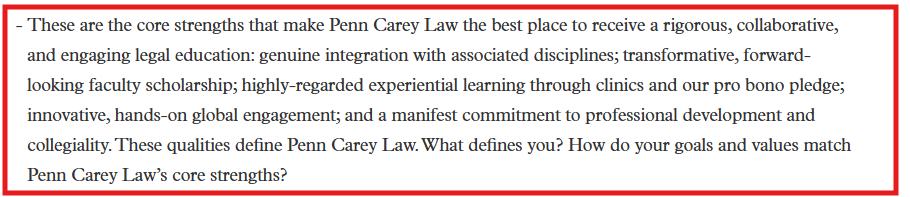
The prompt lists five core strengths that define Penn Carey Law:
It then asks two pointed questions:
The keyword in that last question is "match." The admissions committee isn’t asking you to praise Penn Carey Law. They want you to draw a direct line between your own defining traits and the school's institutional identity.
For example, if you spent three years doing cross-sector consulting work that combined healthcare policy with regulatory strategy, connect that experience to Penn Carey's interdisciplinary integration with Wharton and the School of Medicine.
Each optional essay should be limited to one page, double-spaced. That means each sentence has to be precise. Lead with your defining quality in the first sentence and spend the rest of the page connecting it to Penn Carey's infrastructure.
Take a look at the video below to learn how to build your application narrative and apply it to your optional essays:
Penn Carey Law offers over 40 certificates and joint/dual degrees. Cross-disciplinary education is Penn Carey’s core academic identity, and the admissions committee seeks applicants who’ll actively use a cross-disciplinary approach to advance their education.
JD students can receive law school credit for up to four pre-approved graduate-level courses at other Penn schools. Certificates of study are open to all law students who complete the requirements, with no separate admissions process. That means you can earn a Wharton Certificate in Business Economics and Public Policy, a certificate in Global Health alongside the Perelman School of Medicine, or a JD/MSE with the School of Engineering and Applied Science, all within three years and without additional tuition for most courses.
Most applicants fail to highlight Penn Carey Law’s cross-disciplinary approach in their supplemental essays. Name the specific certificate or joint degree you plan to pursue, and explain how it aligns with your career trajectory.
For example, if you spent two years in healthcare consulting and plan to practice health law, explain how the certificate in Health Policy offers the perfect pathway for you that no other T14 school can match.
Penn Carey Law doesn’t conduct interviews as part of the first-year JD application process. That means your letters of recommendation are the best way to show who you are beyond your academics.
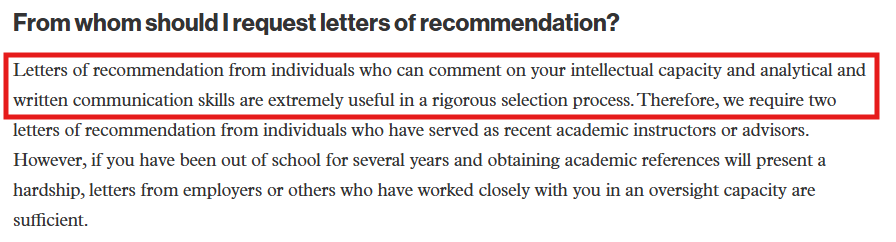
Letters of recommendation from individuals who can comment on your intellectual capacity and analytical and written communication skills are "extremely useful in a rigorous selection process." Notice the specificity of that language. Penn Carey Law wants recommenders who can evaluate how you think and how you communicate that thinking in writing.
Penn Carey Law's admissions committee evaluates leadership, community service, and extracurricular activities as separate factors in its review. Your resume already covers these categories. Your letters should speak to who you are and how you learn.
Choose a professor who graded your writing closely and can describe how your analytical approach evolved over a semester. Pick a supervisor who watched you collaborate on a complex project and can give a specific moment where your contribution changed the team's direction for the better.
In our law school application webinar, Tamar Alexanian, a Juris Education consultant and University of Michigan Law School graduate, shares her insight on letters of recommendation.
“The school won't review your application until all of your letters of recommendation are in, so I generally tell students to tell recommenders that recommendation letters are due sooner than they're actually due,” she says.
Penn Carey Law accepts up to four letters of recommendation, though only two are required. If you have a third or fourth recommender who can address a dimension of your candidacy that nothing else in your file covers, submit the additional letter. But only if it adds new information.
Watch the video below for more tips on securing impactful letters of recommendation for law school:
All Penn Carey Law students must perform at least 70 hours of pro bono legal service while enrolled, and most complete far more than that minimum. The school calls this a "vibrant and holistic shared vision of public service" and houses it within the Toll Public Interest Center, one of the most prominent public interest programs at any T14 school.
The 70-hour requirement shows a culture that assumes every student will engage in public service. The admissions committee scrutinizes each applicant’s resume to determine whether the applicant will eventually thrive in that environment.
According to Penn Carey Law, admissions officers look for:
“Numerous factors in the admissions process, including the student’s academic record, course selection and grade trends, standardized test score, letters of recommendation, leadership, community service, extracurricular activities, professional and life experiences, and the applicant’s examples of written expression.”
The keyword here is community service. If your application lacks community service experience, you’re working against one of Penn Carey's core institutional values.
Show depth of commitment rather than a list of short-term activities. Quantify your hours and your impact where possible.
The admissions committee knows exactly what 70 hours of pro bono work looks like, so they’ll immediately gauge whether your history of community service shows someone who will thrive on that commitment or struggle with it.
A competitive Penn Carey Law applicant has a 173 LSAT score, 3.95 GPA, and cross-disciplinary experience that aligns with Penn Carey Law's offerings.
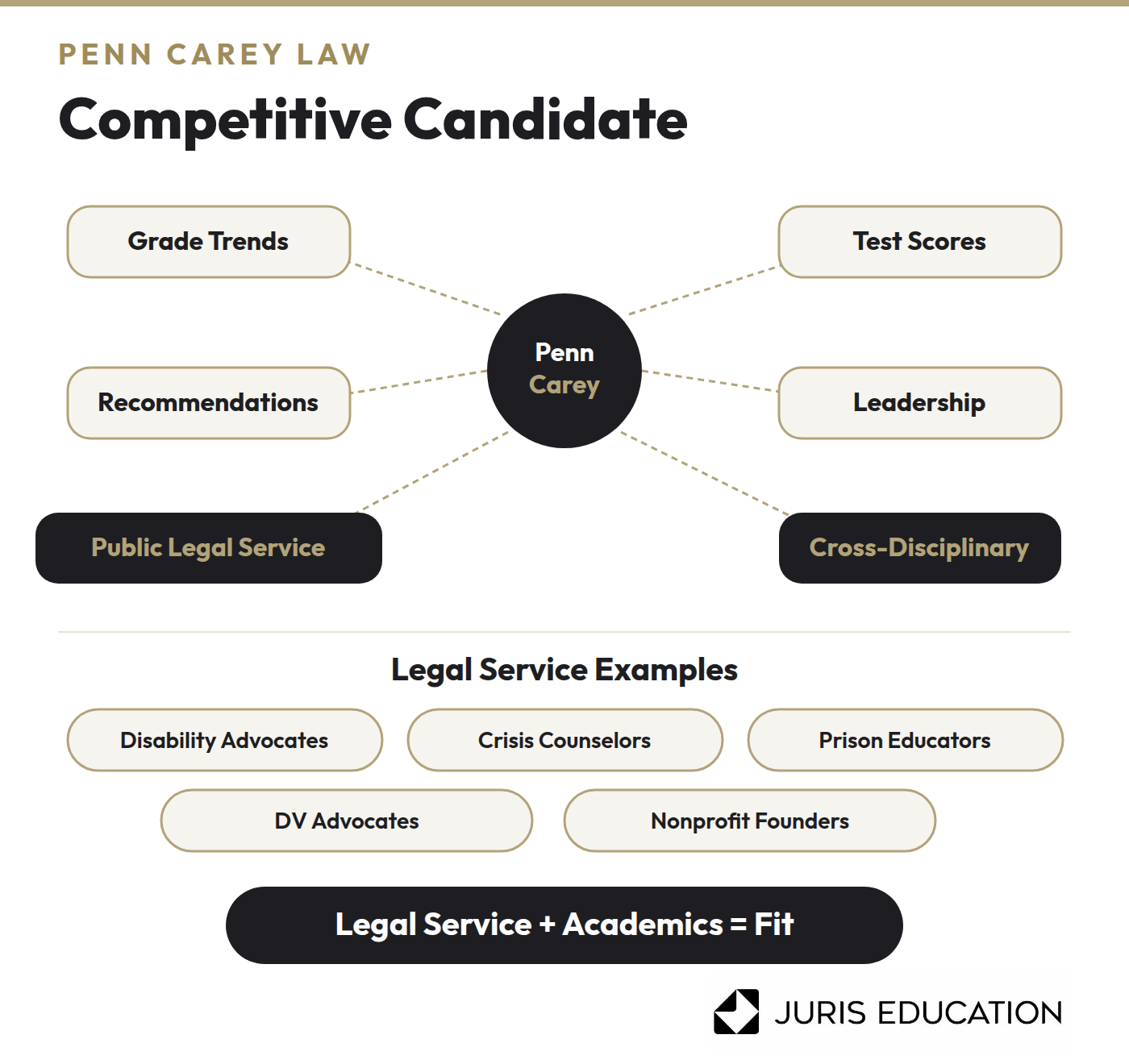
The admissions committee considers:
Penn Carey also accepts the GRE and GMAT, one of the few T14 schools to offer that flexibility, though the vast majority of enrolled students submit LSAT scores.
The Class of 2028 represents 110 undergraduate colleges and universities, 66 different undergraduate majors, and 31 U.S. states plus the District of Columbia. Around 26% of the class are STEM undergraduates, highlighting Penn Carey's commitment to educating future lawyers who can operate across business, healthcare, and technology.
Members of the class include community service workers, such as:
That means a competitive Penn Carey applicant must also have meaningful public service work to even be considered for admission.
Below is a list of all the application requirements you need to have ready before you submit your Penn Carey application:
Penn Carey Law ranks fifth on our list of the best law schools in the U.S. It’s a selective institution where over 77% of students pursue dual degrees integrating law with business and other fields, resulting in strong employment outcomes across the board.
Penn Carey Law graduates posted a first-time bar passage rate of 94.42% in 2025. Compared to the Council-weighted average bar passage rate of 84.56%, Penn Carey Law students achieved a bar passage rate 9.86 percentage points higher.
Penn Carey Law doesn’t interview applicants as part of the standard first-year JD admissions process. Your written application carries the most weight in the admissions process. Spend your time refining your personal statement and optional essays because those written components are the primary window into who you are beyond your numbers.
Penn Carey Law's flagship program is the three-year Juris Doctor (JD), but the school's real differentiator is how much you can build around that degree. Graduate programs include the Master of Laws (LLM), Master of Comparative Laws (LLCM), Doctor of Juridical Science (SJD), and Master in Law (ML). Joint degree options include the accelerated three-year JD/MBA with Wharton, as well as JD/MSE and JD/MCIT programs with Penn Engineering. If you already know you want to pair law with another field, Penn Carey builds that into the DNA of the JD experience rather than treating it as an afterthought.
David Merson was the original author of this article. Snippets of his work may remain.
Co-Founder of Juris Education, Dartmouth College


.svg)
