Get in touch: +1 888 904 4161




Berkeley Law provides matriculants with the academic depth and employment outcomes of an elite program while also having a specific mission to serve every segment of society. That attracts a specific kind of applicant, and the admissions committee knows exactly how to spot the ones who are being authentic.
I've seen applicants get into Berkeley Law with strong LSAT scores and high GPAs. But I’ve also seen applicants with strong public interest backgrounds gain admission over candidates with higher GPAs and test scores due to their compelling application narratives. The difference often comes down to how you connect your experiences to what the school actually values.
The guide below covers which scores make you competitive, how to differentiate your narrative, and what Berkeley Law admissions officers are really looking for in competitive candidates.
If you’re just here for the requirements, click here.
In the 2025-2026 admissions cycle, the acceptance rate at the University of California, Berkeley School of Law was 14.84%. In this admissions cycle, Berkeley Law received 6,562 applications and offered 974 applicants a seat, resulting in 348 matriculants.
Here’s a look at how Berkeley Law’s acceptance rate has changed over the past five admissions cycles:
Berkeley Law's applications dropped from nearly 8,000 in 2021-2022 to around 6,500 today, a decline of roughly 18%. That shrinking pool is the primary driver behind the slight increase in acceptance rate you see in 2024-2025 (17.30%). The school's enrolled class has remained remarkably consistent at around 320-350 students.
Berkeley Law dropped its acceptance rate back to 14.84% even as the applicant pool remained relatively consistent with the prior year. That means the school extended fewer offers while still enrolling a larger class of 348. Your application needs to make a clear case for why Berkeley Law specifically fits your goals.
It’s difficult to get into the UC Berkeley School of Law. In the last five admissions cycles, the school has averaged an acceptance rate of around 14.64%. That means roughly 1 in 7 applicants typically receive an offer of admission.
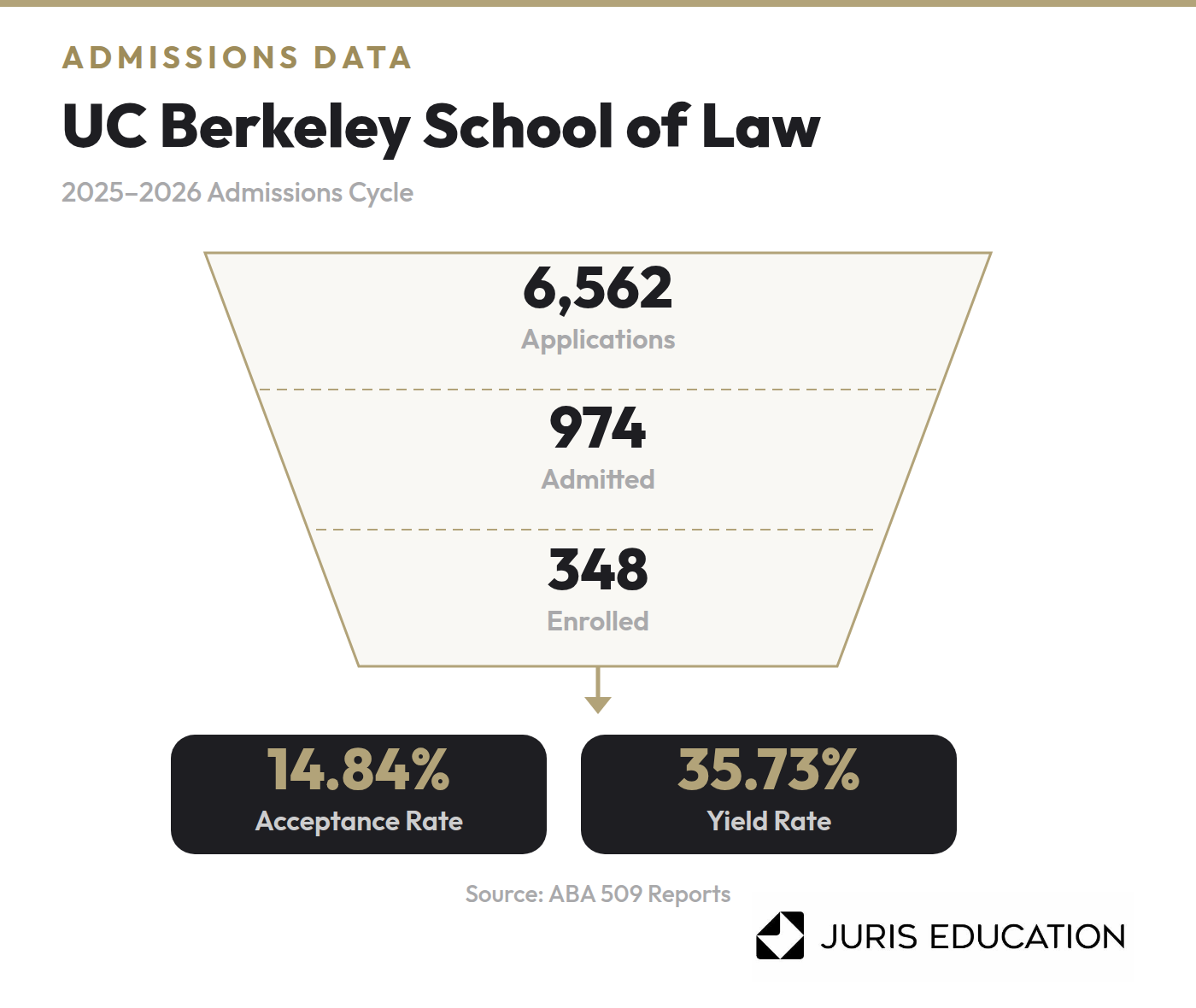
In Berkeley Law’s most competitive cycle, the acceptance rate dropped to 12.47% in 2022-2023. Three admissions cycles later, the acceptance rate has increased slightly to 14.84%, with more than 90 additional seats offered. That means it’s a bit easier to gain admission than it was a couple of years ago, but you still need a compelling application to stand out.
Take our free quiz to estimate your admissions odds at Berkeley Law:
Berkeley Law matriculants had a median LSAT score of 170 in the 2025-2026 admissions cycle. No minimum LSAT score is required for admission.
Enter your LSAT score into the tool below to see how it compares against Berkeley Law's most recent entering class:
Here's how LSAT scores broke down among the 2025-2026 entering class:
The Law School Admissions Council (LSAC) reports a national median LSAT of 159 for all law school applicants in the 2025-2026 cycle. Berkeley Law's median of 170 is 6.92% above the national figure, meaning most students here score well above the general applicant pool.
Berkeley Law matriculants had a median GPA of 3.92 in the 2025-2026 admissions cycle. No GPA requirement exists for admission.
Enter your GPA into the tool below to see where you fall relative to Berkeley Law's most recent entering class:
The table below shows GPA percentile ranges for Berkeley Law's first-year class:
The LSAC national median GPA for all law school applicants in the 2025-2026 cycle is 3.68. Berkeley Law's median GPA of 3.92 is 0.24 points above the national benchmark, reflecting the caliber of undergraduate performance the admissions committee expects.
Only six matriculants submitted GRE scores in the 2025-2026 admissions cycle, which is too small a sample to report percentile data. Berkeley Law accepts the GRE, but the overwhelming majority of matriculants submit LSAT scores. Focus your test preparation on the LSAT unless you already hold a strong GRE score.
Use integrity, vision, and creativity as a framework for your personal statement. Berkeley Law's Faculty Admissions Policy names them as the exact traits the school wants to see in its graduates.
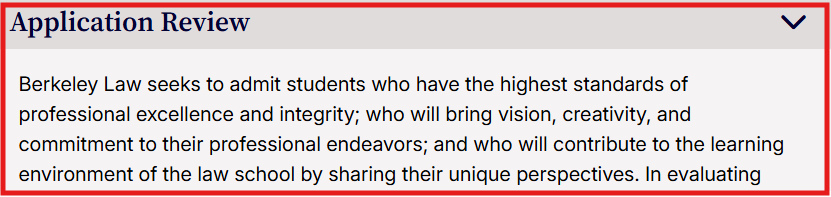
The admissions page reinforces the same language by asking applicants to explain how they’ll use their law degree "with integrity, vision, creativity, and/or to innovate." When a school repeats the same phrase across its official policy documents and application prompts, that repetition should be your blueprint.
In our law school application webinar, Jonathan Rodriguez, a Juris Education counselor and Georgetown University Law Center graduate, shares his insights on building a unique personal statement.
"Inside of every lawyer is a struggling novelist,” he says. “You want to showcase your writing ability and that they're going to still have to train you in the legal knowledge ... but they also will be looking at this to see your ability as a writer and how you put words together to tell a compelling narrative."
Berkeley Law wants to see that you can identify a legal problem (vision), approach it in an unconventional way (creativity), and do so with ethical grounding (integrity).
Structure your narrative so each of these qualities appears naturally through a specific experience or accomplishment. If you organized a community mediation program for tenants facing eviction, your vision was to identify the gap in access to legal services. The creativity was building the program. The integrity was doing it pro bono.
Take a look at the video below to learn how to craft your application narrative:
Berkeley Law's admissions page states that while the optional video interview won’t affect your application's completeness, the school "highly encourages" submission.
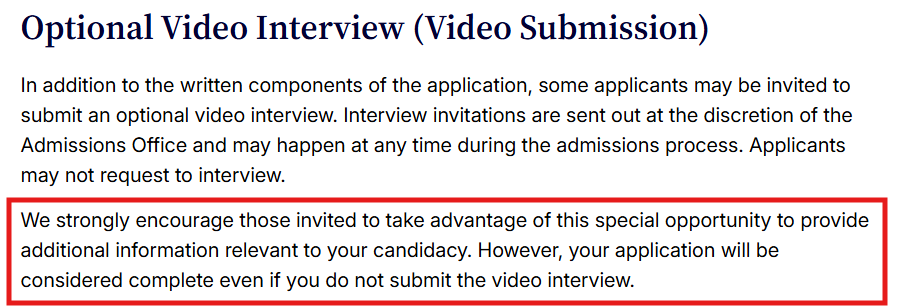
One of the two video prompts asks about what draws you to Berkeley Law, while the other is a randomized situational question. Together, they tell the admissions committee how you think and communicate.
Berkeley Law's admissions philosophy centers on evaluating "human beings and not simply numbers."
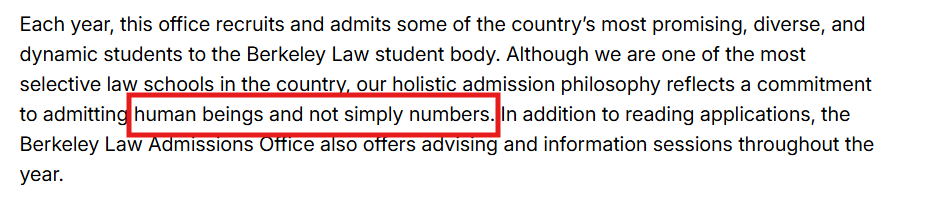
An optional video is how they operationalize that philosophy for candidates they want to learn more about. You get four minutes per question. Treat the first question as a spoken version of a "Why Berkeley" essay.
Reference a specific center or clinic, a faculty member's research area, or one of the school's top-ranked programs in Intellectual Property, Environmental Law, or Social Justice and explain how you’ll make the most of these opportunities when you matriculate.
For the situational question, stick to a firm structure. State your approach, walk through your reasoning, and conclude. Skipping the video when invited leaves a significant gap that your written materials alone can’t fill.
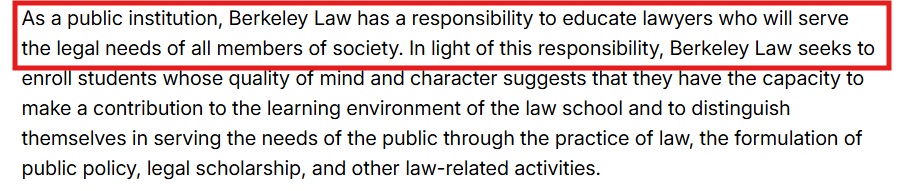
Anchor at least one element of your application to Berkeley Law's identity as a public institution with a stated responsibility to the public good. The Faculty Admissions Policy says that Berkeley Law educates lawyers who will "serve the legal needs of all members of society."
The JD program page echoes that its graduates have "served all segments of society and who have become leaders in many fields of law." The personal statement prompts ask how you see yourself contributing to or advancing the public good.
The phrase "all segments of society" appears frequently across Berkeley's website. It suggests that the school frames public service orientation as a core institutional identity.
On your resume, highlight pro bono work and community engagement alongside professional experience. In your personal statement, draw a direct line between your lived experience and the populations you intend to serve.
Submit your application well before the February regular decision deadline. Berkeley operates on a rolling admissions basis. They review the applications as they come in. Applying early means your application reaches admissions reviewers sooner.
In our law school webinar, Tamar Alexanian, a Juris Education advisor and graduate of the University of Michigan Law School, shares her advice on applying to law school early.
"I am a big believer that September 1 (opening day) is your best day to get your application materials in,” she says. “It means there are the largest number of seats available. You want to be at the front of the line with the most seats. That is the best time to apply. The next best time is September 2, and then September 3."
The December 15 deadline for the Berkeley Law Opportunity Scholarship (BLOS) and the Public Interest Scholars program provides a good entry point for applicants with strong public-interest profiles. Applying by that earlier deadline accomplishes two things:
BLOS candidates and Public Interest Scholars must also complete the LSAT or GRE by November 30. Planning around that timeline forces you to have all application materials ready to go weeks before other applicants.
To get the full picture of the law school application timeline, watch the video below:
A competitive Berkeley Law applicant has an LSAT score of 171 or higher and a GPA of 3.93 or higher. Those are above the medians for the 2025-2026 entering class, and surpassing both puts you in a strong position academically. Applicants who score at the 75th percentile can feel confident that their numbers will pass the application screening phase.
What separates a competitive applicant from a qualified one is a clear connection to Berkeley Law's institutional priorities. The school's Faculty Admissions Policy centers on integrity, vision, and creativity, and the application prompts ask you directly how you plan to use your law degree to advance the public good.
A competitive applicant who organized free legal clinics for undocumented workers demonstrates all three traits through a single experience:
Include that specificity in every component of your application. In your personal statement, anchor your narrative to one of Berkeley's 35+ Student-Initiated Legal Services Projects. Name the exact SLP you want to join and explain what your pre-law experience would bring to it.
In the optional Kira video interview, reference a faculty member's research area or one of Berkeley's top-ranked programs in Intellectual Property, Environmental Law, or Social Justice. Generic interest in public service won't differentiate you at a school where 22% of recent graduates entered public interest careers and 20% secured judicial clerkships.
Here are all the requirements to get into Berkeley Law:
Take a look at the video below for a comprehensive overview of all law school application requirements:
Berkeley Law ranks 12th on our list of the best law schools in the United States. It’s very hard to get into, but it's worthwhile given its 99% employment rate.
Berkeley Law graduates posted a first-time bar passage rate of 94.79% in 2025. Compared to the Council-weighted average bar passage rate of 83.61%, Berkeley Law graduates achieved a bar passage rate 11.18 percentage points higher.
Berkeley Law doesn’t require an interview, but the admissions office recommends that applicants complete an optional Kira video interview. Your written application still carries the most weight, so spend your time refining your personal statement and optional essays before worrying about the video component.
Berkeley Law's flagship program is the three-year JD. Graduate programs include the Master of Laws (LLM) in both traditional and executive tracks, the Doctor of Juridical Science (JSD), and the PhD in Jurisprudence and Social Policy (JSP). Concurrent degree options pair the JD with graduate programs across UC Berkeley's campus, and combined degree agreements extend to the Fletcher School at Tufts (MALD) and the Harvard Kennedy School (MPP).
David Merson was the original author of this article. Snippets of his work may remain.
Co-Founder of Juris Education, Dartmouth College


.svg)
