Get in touch: +1 888 904 4161




UCLA Law dropped to a 12.05% acceptance rate last cycle — its most competitive in five years. But the acceptance rate isn't what makes it difficult to get into. It's the specificity that the admissions committee wants to see.
I've worked with applicants who wrote personal statements about wanting to practice public interest law and didn’t get in, then watched applicants with lower numbers get in because they connected their experience to a specific program, referenced the Achievement Fellowship, or explained why practicing in Los Angeles was the logical next step in their career trajectory.
UCLA Law uses the phrase "distinctive contribution" in its application prompt, and the committee evaluates most application components with that in mind. An application that could be sent to any T14 school tells them nothing about why you belong at UCLA Law specifically.
The guide below covers what scores make you competitive, what the admissions policy shows about its priorities, and how to write an application that proves you chose this school over any other law school.
If you’re just here for the requirements, click here.
In the 2025-2026 admissions cycle, 8,623 students applied to the UCLA School of Law, and 1,039 were offered admission, resulting in a 12.05% acceptance rate. Only 322 students eventually matriculated, 717 fewer than the number of applicants offered admission.
Here’s a look at how the UCLA School of Law’s acceptance rate has fluctuated over the last five admissions cycles:
It’s very difficult to get into the UCLA School of Law, evidenced by its 12.05% acceptance rate. Over the last five admissions cycles, the school has averaged only a 15.18% acceptance rate. The last admissions cycle was the most competitive it’s been in the last five years. More people applied, while offers of acceptance remained fairly similar to previous years, meaning competition continues to intensify.
Get an estimate on your admissions odds with our free quiz:
The median LSAT score of UCLA School of Law matriculants was 171. You don’t need a minimum LSAT score to gain admission to the UCLA School of Law, but you should have a competitive one to stand out.
To put that score into perspective for you, the national median LSAT score of all law school applicants in the U.S. is 159, according to Law School Admission Council (LSAC) data. The UCLA School of Law’s median LSAT score is a staggering 12 points higher than the national median, so standing out is very difficult.
See how your LSAT score compares with matriculants in the 2025-2026 admissions cycle:
A 3.95 GPA is a great way to show that you’re ready for law school, as this aligns with the 50th percentile of UCLA matriculants in the 2025-2026 admissions cycle. The UCLA School of Law doesn’t require a minimum GPA, but you should still submit a GPA that's competitive.
Use the tool below to see how your GPA compares with previous matriculants:
Compared with the national median GPA of 3.68, the UCLA School of Law clearly values competitive students. The UCLA School of Law’s median GPA is 0.27 points higher than the national average, so it’s imperative to clear the screening phase.
In the 2025-2026 admissions cycle, only one matriculant submitted the GRE, so there isn’t sufficient data to fully support percentile calculations. Historically, the median GRE score has hovered around 328, but fewer and fewer students are submitting GRE scores.
You can submit the GRE over the LSAT, but considering that 327 matriculants submitted the LSAT last cycle compared to only one matriculant who submitted the GRE, it’s fair to say that you should submit the LSAT instead. Only submit the GRE if you have a 25th percentile LSAT score or lower and a GRE score that’s 330 or above.
Tailor your personal statement to the exact language UCLA School of Law uses in its application instructions. UCLA doesn’t ask for a generic statement. The prompt asks you to discuss your ability to succeed in law school and the practice of law, along with any "attributes, experiences, or interests that would enable you to make a distinctive contribution to UCLA Law or the legal profession."
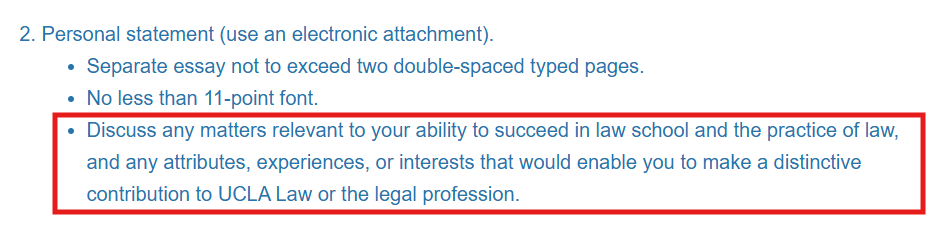
That phrase appears repeatedly throughout the UCLA School of Law's admissions policy and application materials. The admissions committee evaluates your essay against those words specifically.
That means your personal statement should answer the "why law" and "why law now" questions that every strong personal statement addresses while also addressing what makes your background and perspective different from the rest of the applicant pool.
The UCLA School of Law's admissions policy further clarifies what "distinctive contribution" means to them on the admissions policy page:

Choose one or two of those evaluation factors and show them in action through a specific story from your life. For example, an applicant who spent two years organizing tenants in a multilingual housing complex has a concrete "distinctive contribution" narrative that directly aligns with the UCLA School of Law's values.
UCLA Law places what it calls "special emphasis on socioeconomic disadvantage" in its admissions evaluation. Few T14 law schools state this priority so explicitly in their official admissions policy.

That means if you grew up in poverty or navigated financial hardship to reach your undergraduate degree, the UCLA School of Law is telling you that your story matters. The school backs this up through its Achievement Fellowship Program, a full-tuition scholarship specifically for applicants who have "overcome significant obstacles in life, such as socio-economic disadvantage, disability, being the first in their family to attend college, attending under-resourced schools, or other major hardships."
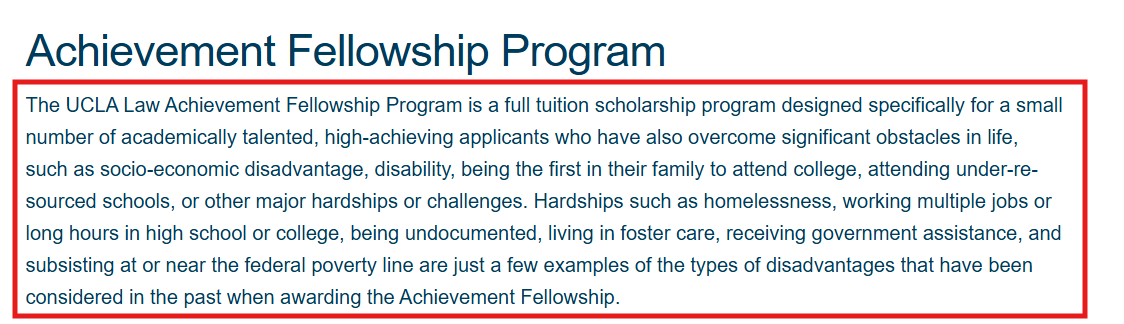
The program requires a separate one-page essay that describes the obstacles you overcame and why you’re a strong candidate.
In our law school application webinar, Mika MacDonald, an expert advisor at Juris Education and graduate of the University of Chicago Law School, shared her insights on socioeconomic status.
"People entering law school tend to be very well privileged, and law schools are aware of that,” she says. “They especially look for diversity, so they’re not just filling a class of privileged students."
If any part of your background involves financial hardship, first-generation status, homelessness, or working through school to support your family, write that Achievement Fellowship essay. It’s also a great opportunity to highlight your socioeconomic background in your personal statement or supplemental essays to tell a cohesive story.
Learn how to tell your unique story by crafting your application narrative with the webinar below:
If you have public interest experience, submit the Epstein Program application alongside your LSAC application. The Epstein Program is one of UCLA Law's highest-profile institutional assets, and it has its own separate admissions committee that reviews candidates in tandem with the main admissions office.
Applicants with strong public interest backgrounds who apply to the Epstein Program get two opportunities to stand out: The Epstein committee reads your file, and the general admissions committee reads it independently.
UCLA's Epstein admissions criteria show that they value demonstrated commitment to public-interest work through pre-law employment (not just volunteer hours) as well as "leadership, persistence, initiative, and resilience."
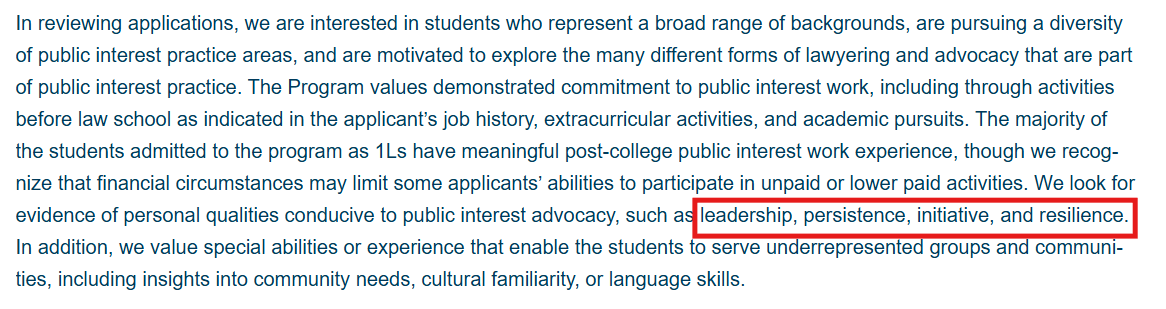
A candidate who spent two years at a legal aid organization or worked as a community organizer before law school fits the exact profile the program describes. Your Epstein application includes two short-answer questions in addition to the standard personal statement, so you get more space to make a specific case for why you want to study law and why you want to study it now.
The UCLA School of Law describes its Los Angeles location as "in the heart of the world's most global city" across multiple pages of its website. The school treats LA not as a geographic detail but as a core part of its educational model.

Its experiential program, with over 50 course offerings, explicitly relies on LA's courts, nonprofits, government agencies, and the entertainment industry as training grounds for students.
When you write any supplemental materials or frame your career goals on your resume, connect your ambitions to the specific legal landscape LA provides. An applicant interested in entertainment law who writes about wanting to practice at a firm without mentioning LA or the Ziffren Institute misses a key component of the application at the UCLA School of Law.
Name the center or clinic that aligns with your goals in your supplemental essay. Show UCLA you chose them because of what LA makes possible at their school and nowhere else.
UCLA Law requires exactly two letters of recommendation, meaning each letter has to do significant work to help validate your other application materials. The admissions page states that "at least one letter should be from someone familiar with the applicant's academic work."
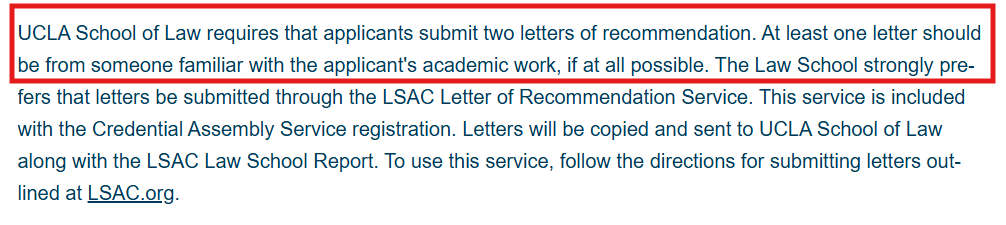
Choose your academic recommender carefully because UCLA Law's admissions policy weighs "the rigor of the undergraduate educational program undertaken" and "scholarly achievements such as graduate study, awards and publications."
A professor who can speak to your analytical ability and intellectual curiosity in a seminar setting validates that outstanding intellectual ability.
Your second letter should come from a supervisor who can document a different aspect of UCLA Law's evaluation criteria, such as career achievement, community service, or leadership.
UCLA Law's class profile shows that over 20% of the most recent incoming class founded or led a student organization. The admissions committee is looking for evidence that you have already exercised the "civic responsibility" their policy mentions as a central purpose of the school.

A letter from a nonprofit executive director or a workplace supervisor who watched you lead a team gives the committee confirmation of that leadership capacity.
Take a look at the video below for a comprehensive overview of letters of recommendation for law school:
A standout applicant at UCLA Law needs an LSAT score at or above 171 (the median) and an undergraduate GPA near 3.95. If your numbers fall below that, you need an exceptionally compelling narrative and profile to offset the difference.
The UCLA School of Law also weighs work experience, career achievement, community service, leadership potential, language ability, and socioeconomic disadvantage alongside your GPA and test scores.
According to the Class of 2028 profile, UCLA Law wants applicants who’ve done something meaningful before law school. The average age of the incoming class is 25, and 12% of the class is 28 or older. Over 20% of enrolled students founded or served as president of a student organization during undergrad.

The class includes military veterans, professional actors, entrepreneurs, opera singers, and students who interned at the White House, the FBI, the CIA, and both chambers of Congress. Students came from 109 different undergraduate institutions across 31 states and four countries. UCLA Law is looking for evidence that you've tested your interests and developed a perspective worth bringing into a law school classroom.

Use your personal statement to connect the narrative thread between what you've done and why law school is the logical next step. Your recommenders should speak to your critical thinking, writing, and analytical abilities, as UCLA's admissions policy specifically calls out these skills.
About 11% of the entering class majored in engineering, science, technology, or math, and 19% are first-generation college students. If you bring a non-traditional academic background or a perspective shaped by economic hardship, UCLA Law will see that favorably.
Every component of the UCLA Law application goes through LSAC's electronic application system, so start by registering for the Credential Assembly Service (CAS) before you do anything else. Here’s a list of the requirements you need to submit:
UCLA Law explicitly prohibits the use of any AI tools in completing the application. The admissions committee reviews every file holistically, and the majority of applicants will receive a decision by the end of April.
The video below also provides you with a comprehensive law school admissions checklist.
The UCLA School of Law ranks #13 on our list of the top law schools in the United States. The school consistently ranks as the top-ranked law school in Southern California and among the strongest on the West Coast.
UCLA Law’s first-time bar passage rate is 96.65% across all jurisdictions, outperforming the council-weighted average of 83.13% by more than 13 percentage points. Broken down by jurisdiction, 269 of 280 UCLA graduates who sat for the California bar passed on their first attempt for a 96.07% pass rate, while the statewide average for council-accredited law schools sat at 82.67%.
No, UCLA Law doesn’t offer interviews as part of the standard admissions process. Your academic and written application materials carry the full weight of the evaluation. The admissions committee may request an interview on a case-by-case basis, but that’s the exception.
UCLA Law offers four degree programs: a Juris Doctor (J.D.), a Master of Laws (LL.M.), a Master of Legal Studies (M.L.S.) for working professionals seeking legal knowledge without practicing law, and a Doctor of Juridical Science (S.J.D.) for those pursuing academic careers in legal scholarship.
Co-Founder of Juris Education, Dartmouth College


.svg)
