Get in touch: +1 888 904 4161



Choosing a law school in Florida isn’t as simple as picking the highest-ranked option. The state has many major legal markets, including Miami, Tampa, Orlando, and Tallahassee, and different schools can give students very different access to those markets.
The challenge is figuring out which schools offer the strongest combination of career opportunities, practical experience, and connections for where and how you actually want to practice.
I worked with several of our experts who have experience getting students into Florida law schools to narrow down the strongest schools in the state and talk through what actually matters when choosing between them.
While there are nine fully ABA-accredited law schools in Florida and one provisionally ABA-accredited law school, Jacksonville University College of Law, we’ve compiled our top five picks below. I’ve also included some of the most useful tips that came up in our conversations.
Here are the five best law schools in Florida, along with their rankings and important admissions data.
All admissions data is based of the most recent ABA Standard 509 and Bar Passage reports:
Take a look at our guide to learn more about our picks for the top law schools in every U.S. state.
I looked through every ABA-accredited law school in Florida and carefully chose the top five based on four key factors:
Most law schools place graduates within their region. According to the National Association for Legal Placement (NALP), nearly two-thirds of the employed Class of 2025 graduates worked in the same state where they attended law school.
The University of Florida Levin College of Law has the widest statewide reach, but Florida State University College of Law dominates Tallahassee and state government hiring.
Florida International University College of Law (FIU) and the University of Miami School of Law feed straight into the Miami-Dade corridor, and Stetson University College of Law is anchored in Tampa Bay.
If you already know you want to practice in South Florida, attending a highly ranked school in Tallahassee won’t give you the same connections or recruiting relationships that a school like FIU would. You should choose the school with a strong network and resources in the city that you plan to work in post-graduation.
If you’ve already spent some time clerking or interning in a particular part of Florida, those connections can also give you an advantage when you’re applying to law school and are worth considering when you’re choosing which law school to apply to and attend.
As Mika MacDonald, a University of Chicago Law School graduate and Juris Education admissions expert, explains in our webinar on How to Build a Unique Application Narrative:
"The best 'Why X School' essay in the world is if you're going to a regional school and you say 'I want to live and work in this region and I grew up here, my family's here, and my support network's here.' They think you're more likely to be successful."
Admissions committees at regional schools value applicants with local ties because those students are more likely to stay, succeed, and add to the school's alumni network in that specific market.
Florida's bar exam is notoriously difficult; not every school prepares graduates equally. The 2025 statewide first-time pass rate was 75.65%, and a school with a bar passage rate well below the state average should be a yellow flag, since it means the school’s curriculum might not effectively translate to licensure or success post-graduation.
In our Pre-Law 101 webinar, Jesse Wang, a JD/MBA graduate from USC Gould School of Law and counselor at Juris Education, advises applicants to:
“Focus on what is concrete: bar passage rates and employment outcomes. If those rates are really on the lower end, that kind of should be like a yellow or even a red flag."
Pull each school's ABA 509 disclosure and look at two numbers: the first-time bar passage rate and the percentage of graduates in full-time, long-term, bar-passage-required employment within 10 months. Those two figures will reveal more about a school's value than any ranking.
The employment rate in particular tells you how many graduates actually get the job they went to law school for, not just any job. Here’s an example of how to read these reports the right way:
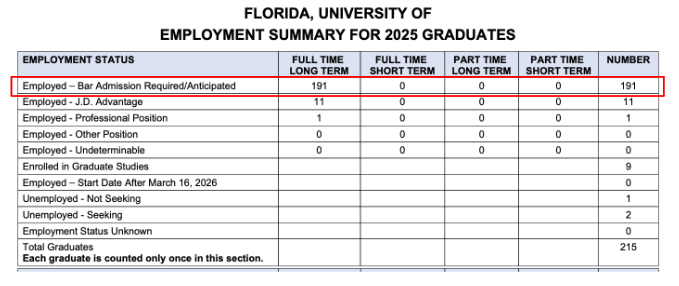
The University of Florida Law's 2025 employment summary shows 191 of 215 graduates in full-time, long-term, bar-passage-required jobs, a rate of 88.8%. That's a strong percentage and a green flag. Anything above 80% signals a school whose degree consistently converts into real legal jobs.
If the number is below 70%, you should reconsider that school and dig into what the rest of the class is doing: Are they underemployed, still job searching, or working outside the law entirely?
One factor that the experts on my team constantly remind students to consider is the debt they’ll be in once they graduate. Don’t just think about the three years of your JD; think about what financial position those three years will leave you in once you begin your career.
Florida's tuition spread is one of the widest in the country. The smartest framework for Florida specifically is that if you’re admitted to UF or FSU with in-state tuition, you’re getting a top-35 national education at a public-school price, which is one of the best value propositions in legal education anywhere.
Non-resident tuition changes that math fast. Out-of-state students at UF and FSU pay much more than residents, closing much of the price gap that makes those schools such a good deal for Floridians. Take a look at this comparison table to see just how large the gap is:
Keep in mind that these are just tuition costs. The total cost of attending these schools will be significantly higher.
If you're comparing a top Florida law school as a non-resident against a mid-tier law school offering you a full or near-full scholarship, the scholarship should win unless there are significant benefits for you to attend the higher-ranked school.
You lose the in-state discount that made the top school affordable, so you're comparing full non-resident tuition at a top-35 school against zero debt at a school ranked lower.
Unless the top school's employment data clearly justifies that debt, take the money. MacDonald reinforces the point:
"Debt is dangerous; debt locks you into places. Think ahead about what it's going to be like after you graduate, and think about whether it's a sustainable level of debt."
If you need more admissions support, our experts provide personalized application help at every stage of the process to ensure you build the strongest possible profile.
Yes, several Florida law schools accept the GRE instead of the LSAT for law school admissions. Florida State University College of Law, the University of Florida Levin College of Law, and Florida International University College of Law all accept the GRE.
Florida State University also runs a Seminole Scholars program that admits FSU undergraduates based on ACT or SAT scores at or above the 85th percentile, without the need to write the LSAT or GRE. The University of Florida Levin College of Law (UF) has a similar Gator Scholars option for UF undergraduates. But both programs have strict GPA thresholds and limited seats.
Co-Founder of Juris Education, Dartmouth College


.svg)
