Get in touch: +1 888 904 4161




Getting into Washington and Lee Law School is becoming more and more selective each year, with its acceptance rate dropping to its lowest point in the last five years. As admission to W&L Law gets more competitive, strong numbers alone won’t tell the admissions committee why you belong in the program.
One mistake I see applicants make is submitting an application that could just as easily go to 10 other law schools. They meet the LSAT and GPA medians of the schools on their list, but don’t go the extra mile to answer why they belong at this particular school. W&L gives applicants several clues about what it values, and knowing how to use those clues in your application can help you build a much more tailored application.
Your W&L Law application should show not only that you can handle the rigors of law school, but also that your experiences, goals, and approach to working with others align with the type of student this program wants in its community.
In this guide, I’ll break down how to get accepted into W&L Law, including the scores that make you competitive, what to emphasize if you fall below the medians, and how to use your experiences and written materials to build a stronger application.
Washington and Lee Law School accepted 22.73% of applicants in the 2025–2026 admissions cycle. A total of 2,341 candidates applied, the school extended 532 offers, and 128 students matriculated.
I took a look at W&L Law’s ABA reports from the last five years and noticed a few trends. There was a 33.85% increase in the number of applications in the most recent admission cycle and the one before, jumping from 1,749 to 2,341, which was a record high. Despite the surge in applicants, W&L Law accepted the fewest candidates in five years, rejecting 77.27% of applicants.
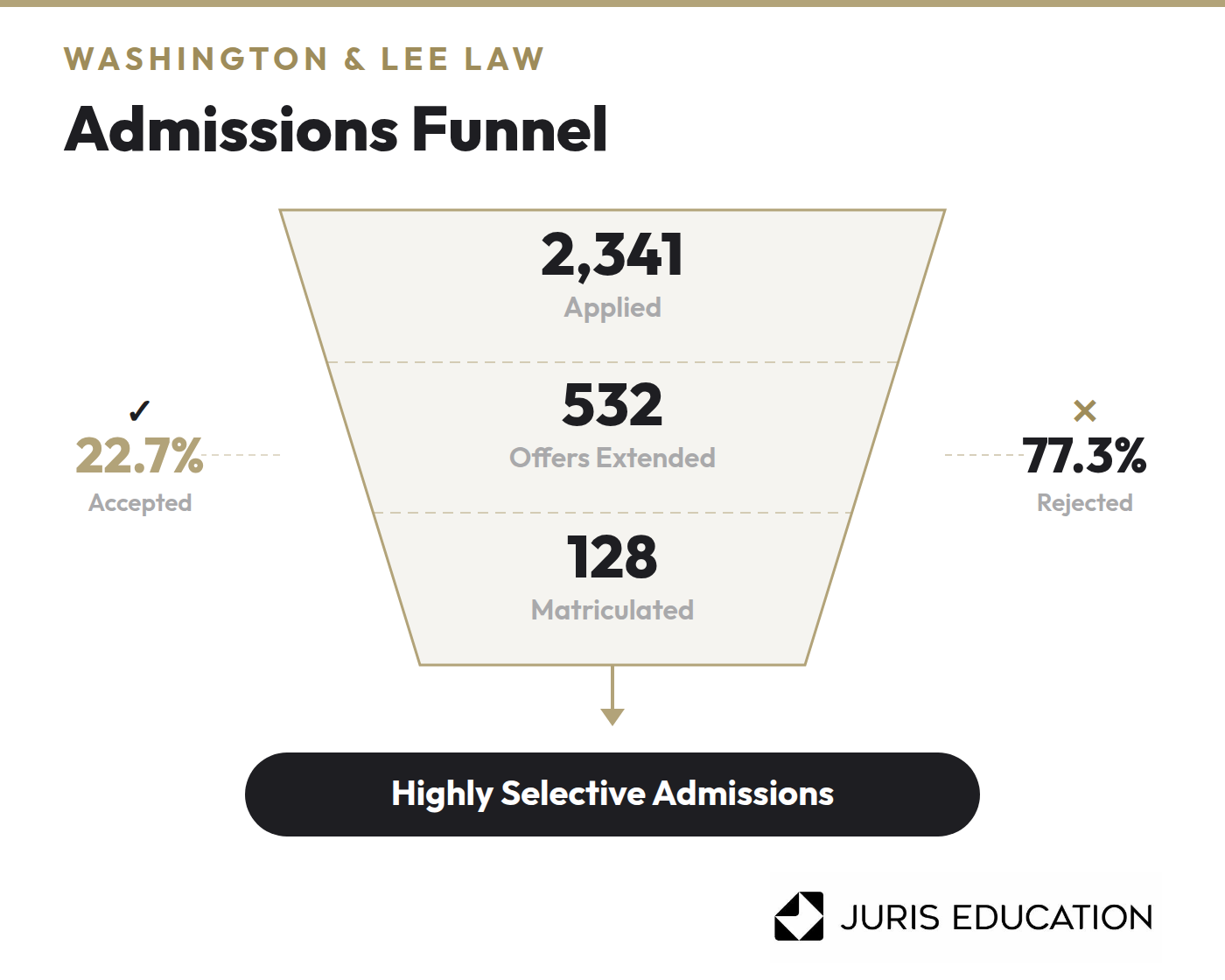
With a 22.73% acceptance rate, W&L Law rejects roughly 8 out of 10 applicants, making it a difficult law school to get into.
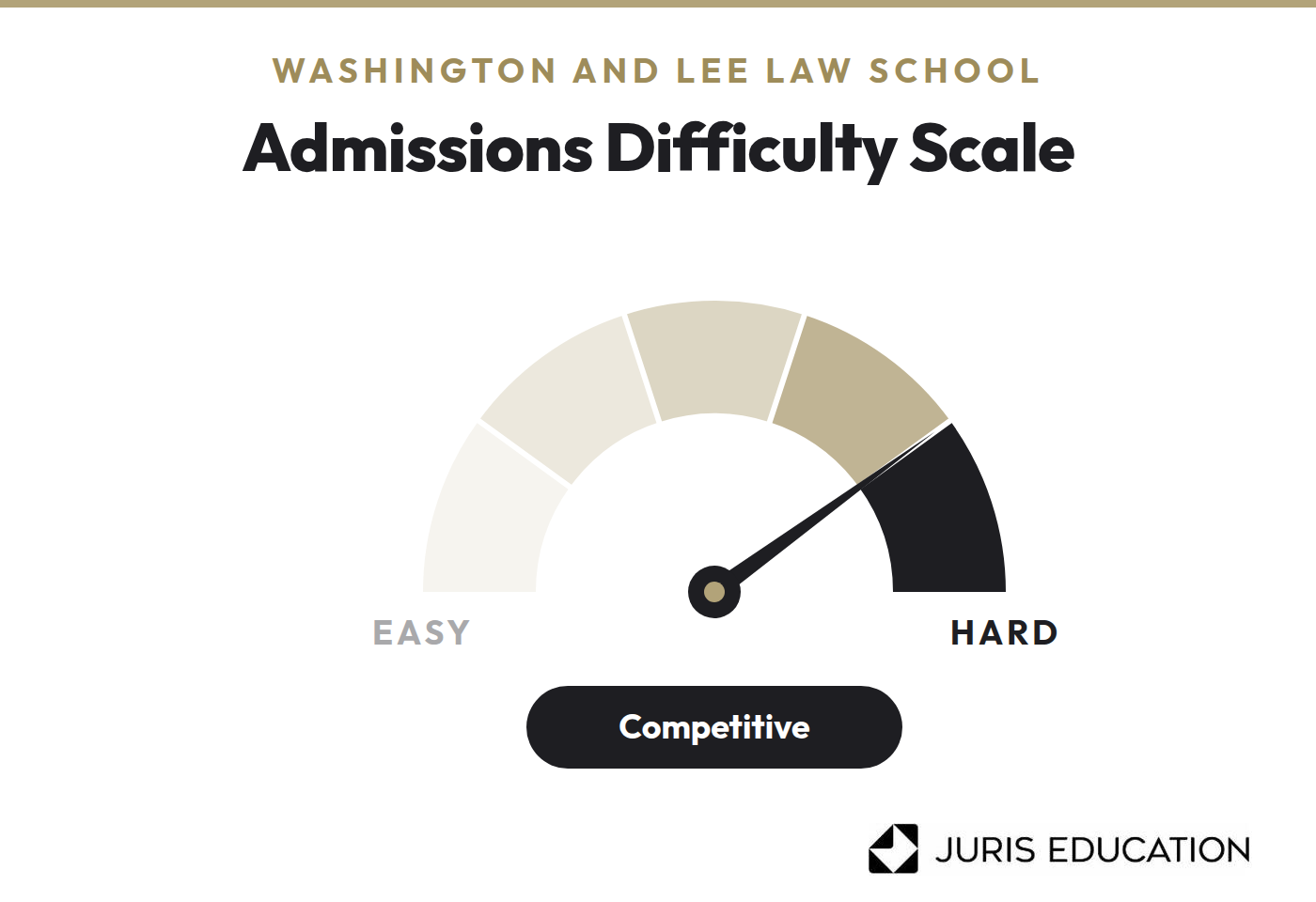
The school’s medians are a 167 LSAT and 3.75 GPA, so you should aim to meet or exceed both benchmarks. If you fall below one or both of these medians, the rest of your application needs to give the admissions committee stronger evidence that you can succeed in law school.
For example, law-related internships, jobs, or substantial post-graduate experience in business, government, or public policy can strengthen your application by demonstrating analytical thinking, writing, leadership, and professional judgment. A strong personal statement, compelling recommendations, and a clear record of academic or professional growth can also offset weaker numbers.
Washington and Lee Law School reported a median LSAT score of 167 for the 2025–2026 admissions cycle. You don't need a minimum score to be considered for admission.
Use the tool below to see how your score compares with previous matriculants in the 2025-2026 admissions cycle:
Washington and Lee Law School reported a median GPA of 3.75 for the 2025–2026 admissions cycle. You don't need a minimum GPA to be considered for admission, but a competitive GPA helps you stand out.
Use the tool below to see how your score compares with previous matriculants in the 2025-2026 admissions cycle:
Washington and Lee Law School doesn’t publish GRE percentile scores of its admitted students. In the most recent admission cycle, every single first-year student submitted LSAT scores. In 2024, 3 of the 125 matriculants submitted a GRE score, but the law school didn’t publish student percentile scores.
Despite the low number of admitted students with GRE scores, the school has stated it gives the same consideration to both admissions exams: “W&L Law does not prefer one test to the other, and either will be given equal consideration as part of a holistic review of the application.”
W&L Law's admissions committee published some notably candid and comprehensive guidelines for every part of your application. Read them carefully before you start your application, and again before you submit it, to make sure you've applied its advice.
The W&L Law admissions committee wants to know something “memorable about you that they wouldn’t discover otherwise.” In other words, avoid writing a personal statement that’s just a summary of your resume. W&L Law suggests topics like a losing season, a musical ambition, or the best advice you ever received. Stories like these reveal a lot about how you think, what you value, and what you would bring to a classroom discussion.
A line that stood out to me on this advice page is W&L Law’s warning against writing a personal statement that requires “the necessity of a decoder ring.” It's clear the committee wants authenticity expressed in plain English, but there’s another clue here, too: They have a sense of humor. In fact, the entire page is witty and conversational. So, don’t be afraid to let your personality come through in your writing; this is a great way to stand out.
Remember that admissions committees read thousands of applications on top of their legal and academic responsibilities, so aim to make your personal statement engaging and enjoyable to read. An admissions counselor once told me their favorite personal statements either teach them something new or tell a story about a time the applicant was out of their comfort zone. The key is to think of a memorable experience you’ve lived through and relate it to how it makes you a good candidate for law school.
Once you finish your draft, set it aside for a day or two before rereading it. If it doesn't sound like your authentic voice, start over. As the W&L admissions committee puts it: “You're embarking on a career where your ability to write persuasively will be your stock in trade. Consider this your first assignment.”
If you need help writing your personal statement, watch our webinar with law school admissions experts Tamar Alexanian, a University of Michigan Law School graduate, and Ebehiremhen “Ebehi” Izoku, a Stanford Law School graduate. They share insider guidance for choosing a strong story and writing a memorable statement.
The admissions committee puts it succinctly: “If your personal statement didn't wow us, your optional essay can save the day.”
W&L Law gives you two very different optional essays: one on your life experience and another on an ethical dilemma. If you have two genuinely different stories that reveal new sides of you, submitting both can strengthen your application. But if you only have one strong story, choose the prompt that speaks to you most and give that response your full attention.
Let’s compare the two prompts:
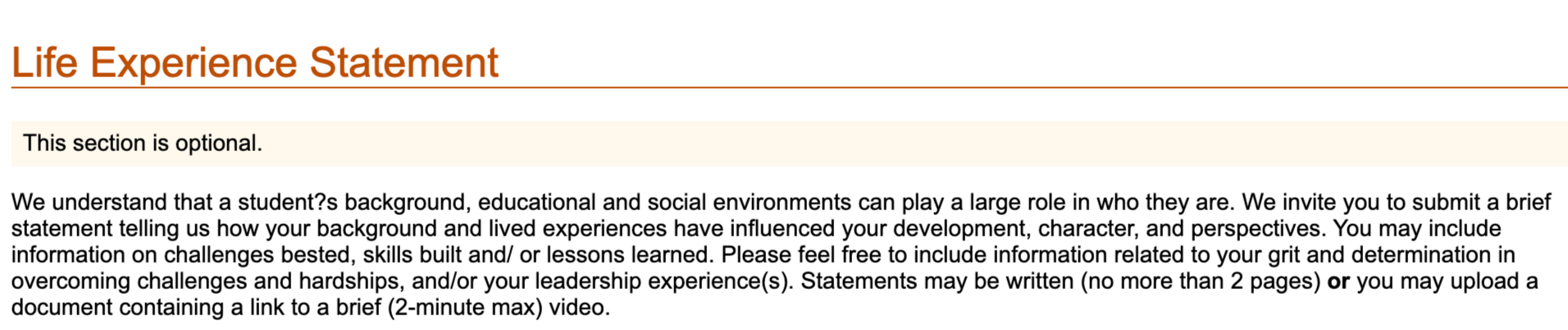
The life experience prompt asks you to talk about a challenge that shaped you. Writing about how you responded in a difficult situation reveals a lot about your judgment, reasoning, and values. Moreover, the meaningful takeaway from this experience reveals the unique perspective you would bring to the classroom. Use this as a chance to demonstrate how your critical thinking in that situation helped you grow into a great candidate for W&L Law.
The prompt also allows you to submit a video explanation. This is a great chance to show your oral advocacy skills.

The ethical dilemma prompt asks you to "showcase the sensibility you'll bring to your studies," as the W&L Law admissions committee puts it. This prompt ties directly to legal education and how you would approach a dilemma you will likely encounter as a lawyer. The committee specifically wants you to answer the following questions:
This is your chance to put your reasoning skills on display and prove you can think like a good lawyer. Set aside heated opinions or personal biases and show you can weigh competing interests carefully, logically, and fairly.
W&L Law requires one letter of recommendation but accepts up to four. However, this is about quality over quantity. I don’t recommend submitting the maximum number of letters from people who don’t know you well enough to speak in detail about your character. Remember, reviewers have limited time with each application, so submitting four generic letters will actually hurt your application.
Instead, choose two or three recommenders who have seen you apply your abilities in challenging situations. Choose people who know you from separate parts of your life, such as an academic professor, an employment supervisor, or a volunteer coordinator. If you've been out of school for years, the admissions committee says a recommender who knows you well matters more than one who taught you in a classroom.
When asking for these letters, give your recommenders plenty of time to write you a strong letter. Asking them two weeks before the deadline will likely result in a weak letter.
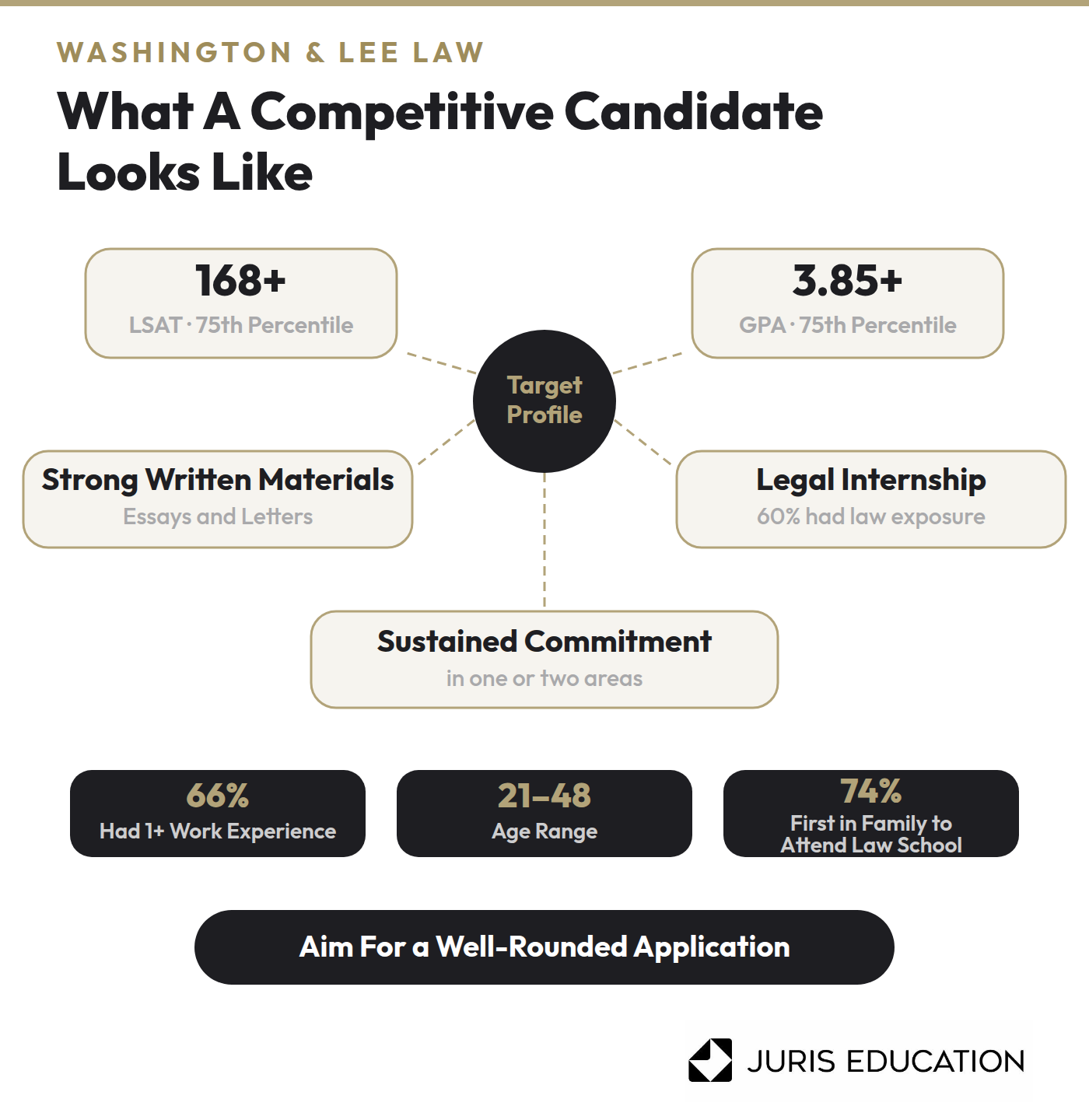
A competitive Washington and Lee Law School applicant should aim for an LSAT score of 168+ and a GPA of 3.85+. Hitting both benchmarks gives you a strong foundation, but your application still needs to show meaningful experience and sustained involvement outside the classroom.
Beyond your numbers, aim to demonstrate real-world experience, exposure to legal or analytical work, and long-term commitment to one or two meaningful activities. W&L’s recent entering-class data supports this profile: 66% of students had at least one year of post-graduate experience, while 60% had completed a legal internship or other law-related work.
Rather than trying to collect as many activities as possible, focus on experiences where you can show depth, increasing responsibility, leadership, or measurable impact.
If you want help with getting into law school, work with our expert admissions counselors to maximize your chances of admission. Our expert counselors graduated from the top law schools in the country and work with you one-on-one to ensure your application stands out from the thousands of candidates.
Washington and Lee University School of Law ranks #41 in our 2026 ranking of the best law schools in the U.S.
Washington and Lee Law School’s bar passage rate is 93.46% nationally for the Class of 2025, according to the ABA bar passage disclosure.
Washington and Lee Law School’s regular decision deadline is July 1, while its binding early decision deadline is December 1. The school reviews regular decision applications on a rolling basis and recommends applying by its March 1 priority deadline.
Washington and Lee Law School doesn’t list an admissions interview as a required part of the JD. application. For waitlisted applicants, the admissions office conducts optional 30-minute interviews by phone or Zoom.
Washington and Lee Law School offers a full-time, three-year J.D. program, along with exchange and visiting student opportunities. As part of its curriculum, the school requires students to complete 18 experiential credits, including representing actual clients in a real practice setting, legal clinics, and externship programs.
Co-Founder of Juris Education, Dartmouth College


