Get in touch: +1 888 904 4161




If you're researching Duke Law School, you've probably already looked up its acceptance rate, median LSAT, and GPA. Those numbers matter, but as I put this guide together, I found myself coming back to a different question: what actually separates thousands of applicants with the same numbers?
To find the answer, I spoke with my team of admissions experts with firsthand insights into the Duke Law admissions process. Some have served on Duke Law's admissions committee, while others have helped dozens of students earn admission there.
I combined their insights with Duke Law's latest admissions data to explain not just how competitive the school is, but also what successful applicants do differently once their numbers are already competitive.
If you’re just here for the requirements, click here.
Duke Law School accepted 12.88% of applicants for the Class of 2028. According to the American Bar Association (ABA) Standard 509 Disclosure, 6,240 students submitted applications to Duke Law; only 804 received offers of admission, and 227 ultimately enrolled.
Here’s a closer look at Duke Law’s acceptance rates over the past five years:
Duke Law has maintained a five-year average acceptance rate of approximately 12.49%, reinforcing its position as a consistently selective law school.
During this period, Duke Law received an average of 6,269 applications per year and extended roughly 785 admission offers. From those admitted, the school ultimately enrolls a class of about 220-230 students each cycle.
Overall, while year-to-year acceptance rates fluctuate between 10.51% and 14.45%, the broader trend shows a stable, highly selective admissions process with consistently high demand.

It is very challenging to get into Duke Law School. A 12.88% acceptance rate means Duke Law admits fewer than 1 in 8 applicants. The average acceptance rate across all T14 law schools is 11.52%, which places Duke Law slightly above that average but still firmly among the most selective law programs in the country.
Duke Law's median LSAT for the Class of 2028 was 171. The 25th percentile score for matriculants was 169, while the 75th percentile was 172.
For context, all of the students who matriculated at ABA-approved law schools in 2025 had a median LSAT of 159, with a 75th percentile score of 166. That means even Duke Law's 25th percentile LSAT of 169 exceeds the score earned by the top quarter of law school matriculants nationwide.
Target a 172 or higher to be genuinely competitive. While a 171 places you at the median of Duke's entering class, a 172 moves you into the top quarter of admitted students, where your LSAT becomes a meaningful strength rather than simply meeting expectations.
Duke Law's median undergraduate GPA for the Class of 2028 was 3.91, with the 25th percentile at 3.83 and the 75th percentile at 3.96.
For comparison, students entering ABA-approved law schools in 2025 had a median GPA of 3.68, while the national 75th percentile GPA was 3.89. In other words, Duke Law's median GPA exceeds the GPA earned by the top quarter of students entering law school nationwide.
Aim for a 3.96 or higher if you're looking to maximize your competitiveness. A GPA at Duke's median shows your academic performance aligns with the typical admitted student, while a GPA at the 75th percentile makes your academic record a clear asset during admissions.
Duke Law technically accepts the GRE, but in practice, almost no one uses it. Only 4 out of 227 students in the entire Class of 2028 submitted GRE scores. Duke Law does not publish percentile data for those scores in its ABA 509 disclosures because the sample is too small to be statistically meaningful.

Getting into Duke Law requires more than strong numbers; it requires a cohesive, school-specific application. Here are the four most effective tips to get into Duke Law School, grounded in what the school's admissions process actually rewards.
Duke Law offers two binding ED rounds:
ED signals a genuine commitment, and Duke Law's admissions team notices that signal. Mark Saunders, a Duke Law graduate and admissions counselor at Juris Education, confirms that Duke Law makes admissions decisions more quickly than most T14 schools.
In a webinar on building a unique application narrative, he noted that Duke Law School has a process where they reach out to certain people and guarantee an admission decision within two weeks in early September.
That speed works in your favor if you apply early. Duke Law uses a rolling admissions process, reviewing applications as they are received and sending decisions when they’ve been made. Very late applicants face a significant disadvantage due to the number of offers already made as the deadline approaches.
Getting your application completed by early fall puts you in front of admissions before the bulk of the applicant pool arrives.
Duke Law expects your personal statement to be introspective, mature, and anchored in real experiences. The biggest mistake applicants make is listing qualities instead of proving them through a story.
As Saunders explains:
"It's one thing to say I'm a very organized person; I'm an analytical thinker. But it's a whole other animal to come up with a narrative and show how different challenges and experiences show that you have these qualities instead of just telling them."
Claiming "I am resilient" without evidence gives them nothing to remember you by. But a story about the semester you worked two jobs with a full course load and still organized a legal aid clinic fundraiser proves resilience without ever using the word.
When you build the narrative correctly, the reader reaches the conclusion about your character on their own, and that conclusion is far more convincing than an unsupported claim ever could be.
Your statement also needs a clear arc. Jesse Wang, a USC Law graduate and admissions coach at Juris Education, describes the ideal personal statement as:
"A central nexus that connects your past, your present, and your future."
Open with a specific moment, build tension through a real challenge you faced, then resolve toward your decision to pursue law. The resolution is where most applicants lose momentum by ending with vague aspirations like "I want to make a difference."
Instead, tie the specific lesson from your challenge to what you want to accomplish as an attorney and why legal training is the necessary next step.
Duke Law wants to see a candidate who thinks critically, leads with purpose, and fits the school's collaborative, practice-ready culture.
Every reader on the admissions committee is asking one question: does this person's story hang together, or does it feel like four separate applicants wrote four separate documents? Make every component answer that question the same way.
Don't repeat your personal statement across your other materials. Use the short-answer essay to show a different dimension of who you are. Use the optional "Why Duke Law" essay to connect your goals to specific programs, clinics, or faculty at Duke. Each piece should reveal something new while reinforcing the same core theme.
Saunders puts it plainly:
"The biggest difference between the personal statement and the resume is that the resume is a rundown of all the things you've done, whereas the personal statement dives deep into one particular experience. You're not trying to regurgitate that."
Treat your recommenders the same way. If your personal statement shows resilience through a personal challenge, brief your recommender to speak to something else entirely: your analytical thinking in a seminar, your leadership on a group project, your growth across semesters.
For the Class of 2028, 85% of students had at least one year of post-college work experience. With that large a majority, work experience is closer to the norm than the exception at Duke Law. If you took a gap year or several years between college and law school, do not downplay that time. Lean into it.
Feature what you learned and accomplished prominently in your personal statement, resume, and any relevant optional essays.
If you do not have post-college work experience, that does not disqualify you. About 30%-40% of a typical incoming class at Duke Law consists of people who have just graduated from college, so post-college work experience isn’t required. But if you have it, make sure your application reflects it.
For comprehensive law school admissions guidance, and to ensure you submit the most competitive Duke Law application, book a consultation with one of our expert counselors.
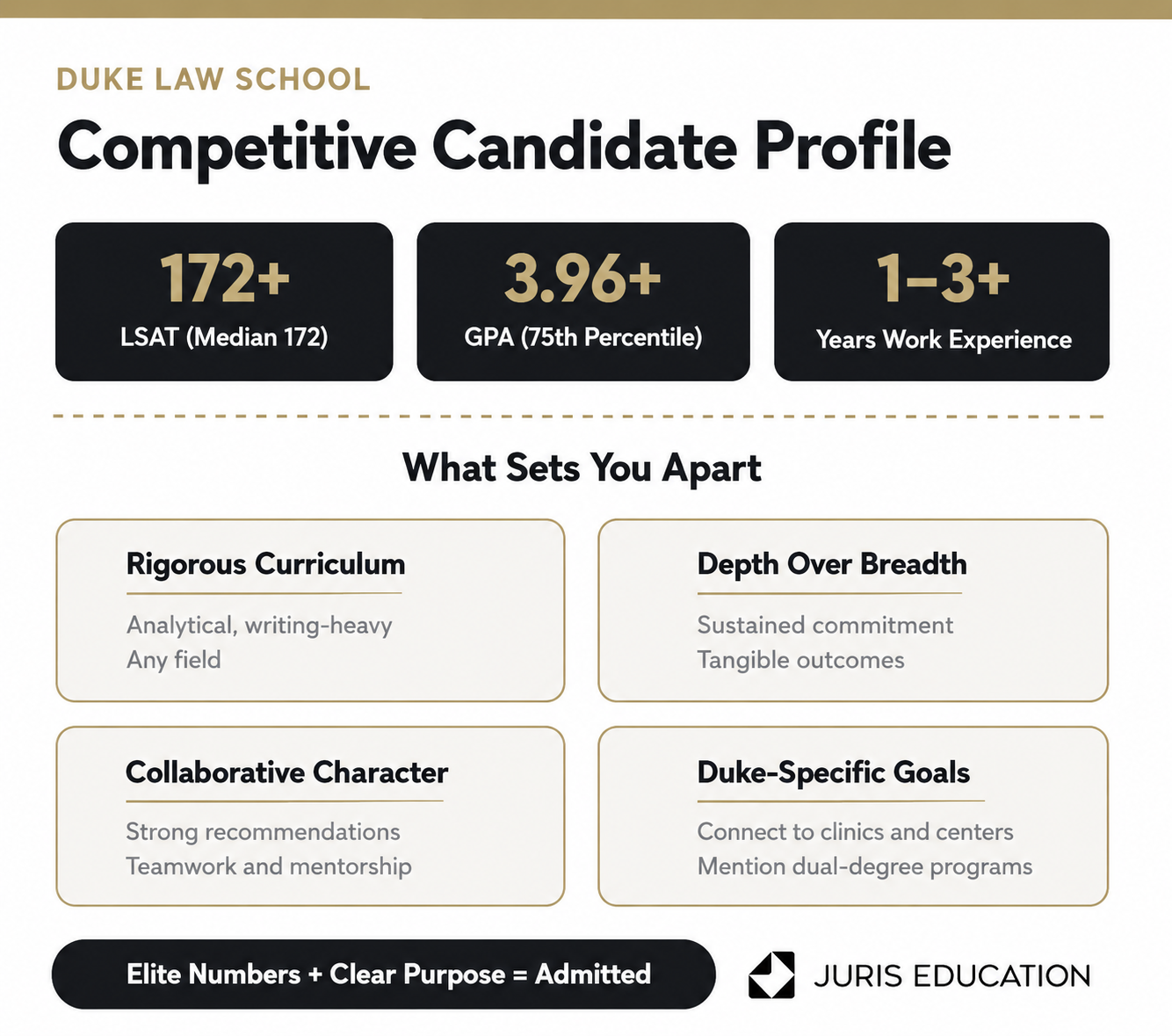
A competitive Duke Law applicant combines elite academic credentials with clear purpose and meaningful professional experience. Here’s what that looks like in concrete terms:
Duke Law processes applications through the Law School Admission Council (LSAC) Electronic Application. Every component below must be submitted through that system:
In terms of deadlines, Duke Law uses rolling admissions and offers two binding Early Decision rounds plus a regular decision deadline:
Duke Law ranks as the 8th best law school according to our rankings. Duke Law is a permanent member of the "T-14."
Duke Law does not conduct traditional admissions interviews. The school evaluates all applications based on written materials alone: your personal statement, short-answer essays, optional essays, letters of recommendation, transcript, and resume. Some candidates may receive an optional invitation to visit campus, but this is not a formal evaluation component.
Duke Law offers the following degree programs:
Co-Founder of Juris Education, Dartmouth College


.svg)
