Get in touch: +1 888 904 4161




Cardozo School of Law’s acceptance rate is at its lowest in years, down to 29.56%. The number of applicants and enrollment rate are also at record highs, which makes the pattern here clear: More and more students want to attend Cardozo Law, and the school is getting more selective.
If you’d like to become one of Cardozo Law's successful graduates, this guide will go over everything you need to know about how to get into this law school, including application tips, deadlines, and more.
If you’re just here for the requirements, click here.
In the most recent admissions cycle, Cardozo School of Law's acceptance rate was 29.56%. A total of 3,833 students applied, 1,133 offers were extended, and 319 students matriculated.
I took a look at Cardozo Law’s admission reports since 2019 and noticed a few trends. During the 2025 admissions cycle, Cardozo Law received the most applications in the last seven years. Even with that record volume of applicants, the admissions committee extended the fewest offer letters since 2019, driving the acceptance rate to its lowest point. Interestingly, as Cardozo Law grew more selective, it also posted its highest enrollment rate in seven years: 28.16% of accepted students enrolled in 2025, up from 24.19% in 2019.
Here’s a look at Cardozo Law’s admissions statistics from the past seven cycles:

At a 29.56% acceptance rate, roughly 7 out of 10 applicants get rejected. This makes Cardozo School of Law moderately difficult to get into. If you want to maximize your chances of acceptance into this law school, work with an education consultant from Juris to optimize your application. Our expert consultants work with you one-on-one to ensure your application stands out from the thousands of candidates.
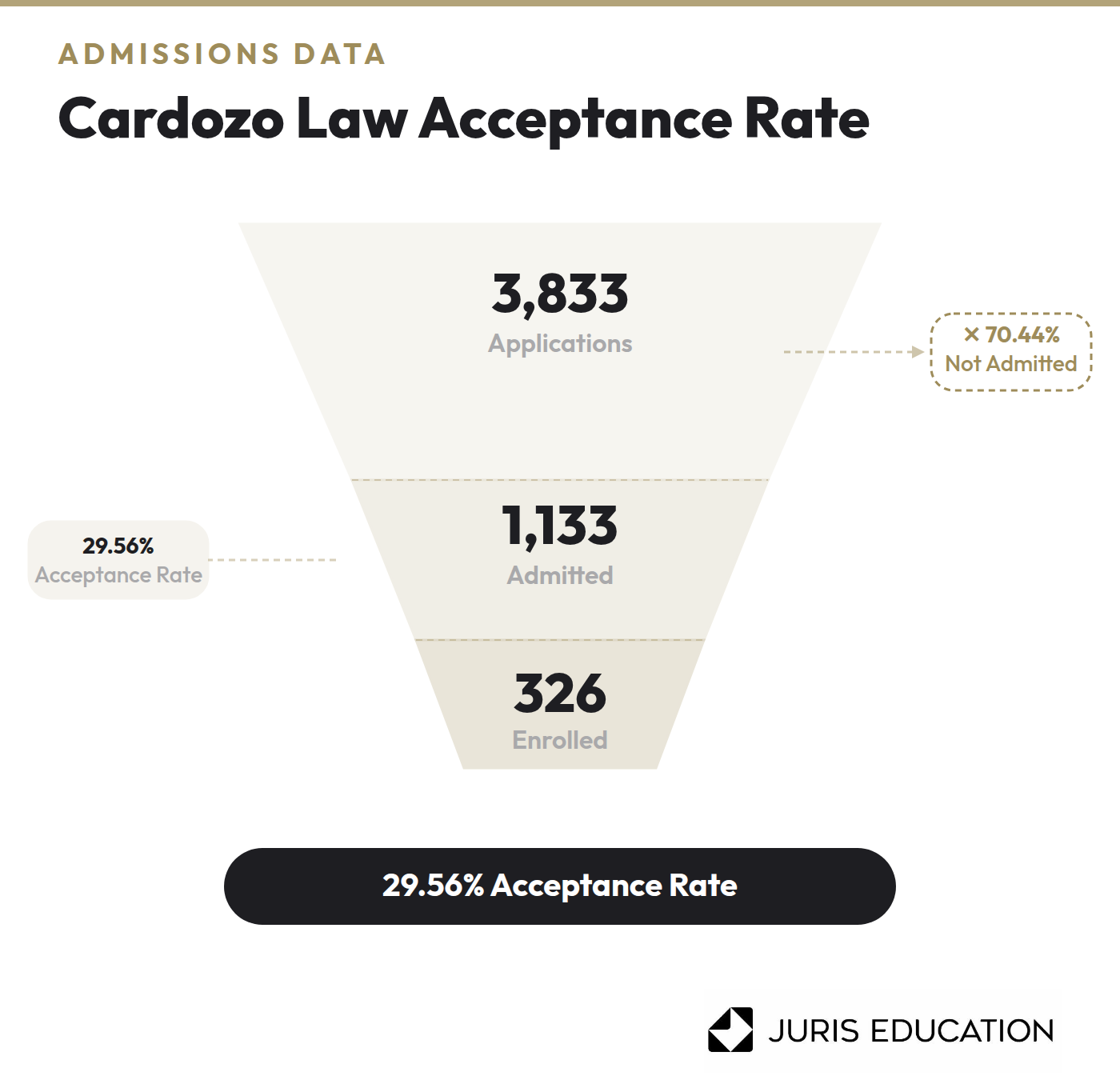
Over the last five years, Cardozo Law has averaged a 33.88% acceptance rate, with each year getting more selective. You need an application that speaks directly to Cardozo Law, with specific reasons why its program fits the legal career you want to build.
In the 2025-2026 admissions cycle, Cardozo School of Law's median LSAT score was 165. You don't need a minimum score to be considered for admission, but you do need a competitive score to stand out.
Use the tool below to see how your score compares with previous matriculants in the 2025-2026 admissions cycle:
The national median LSAT score among all law school applicants was 159 in the 2025-2026 admissions cycle, according to the Law School Admission Council (LSAC). That means most students at Cardozo Law scored 3.77% higher on the LSAT than all law school applicants.
Cardozo School of Law's median GPA of all matriculants in the 2025-2026 admissions cycle was 3.78. There's no minimum GPA to be considered for admission.
Enter your GPA into the tool below to assess its competitiveness compared with the most recent matriculating class:
In the same admissions cycle, the national median GPA among all law school applicants was 3.68, according to the LSAC. That means most students at Cardozo Law have a GPA 2.72% higher than the national median.
According to its ABA disclosures, Cardozo Law School accepts the GRE for law school admission but does not publish percentile scores. Cardozo Law enrolled four GRE students in 2022, six in 2023, five in 2024, and four in 2025. That averages 4.75 per year, so about five students.
As a general rule, law schools prefer LSAT scores over GRE scores. I always recommend our students take the LSAT over the GRE.
Treat the optional statement as a mandatory essay to show admission committees you’re going the extra mile in your application. Your personal statement needs to answer "Why law?" and close with "Why Cardozo Law?” On the other hand, the optional statement then answers a different question. It needs to answer "Why should Cardozo Law choose me?"
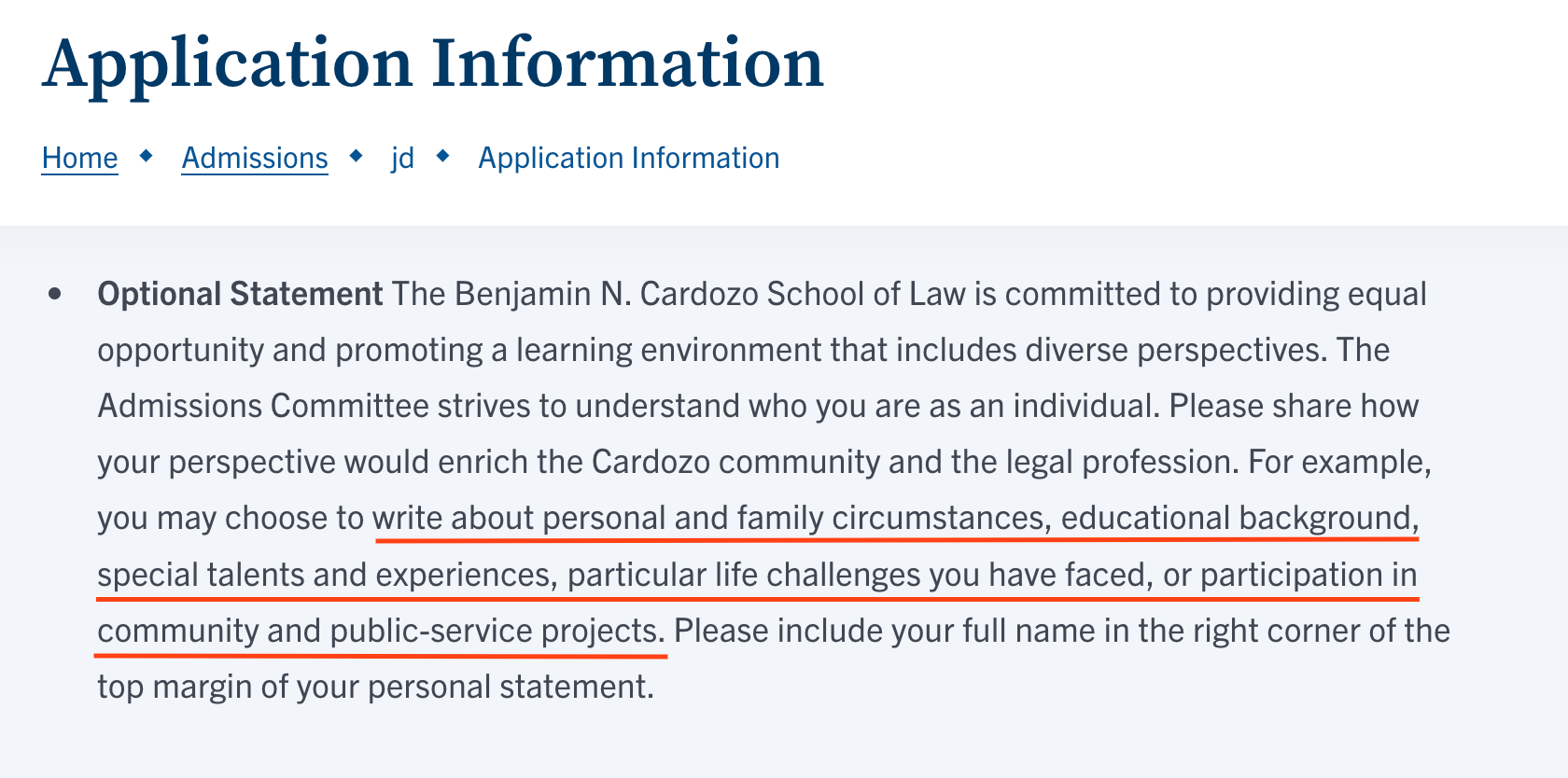
The Cardozo Law admissions committee encourages applicants to use the optional statement to explain who they are as individuals. The prompt lists examples worth writing about: personal and family circumstances, educational backgrounds, special talents and experiences, life challenges, and participation in community and public service projects.
Pick the topic that speaks most to you, and describe what unique quality you’d bring to the classroom. Admissions committees seek diverse backgrounds when choosing an incoming class. Lean into an experience or circumstance that sets you apart.
If you were the first in your family to attend college, explain how that shaped the way you approach institutions and leadership. If you worked for a nonprofit in your community, describe one campaign and what it taught you about how the law helps or fails the people it serves. If you worked in film production before applying, connect that background to the legal questions you ran into on set, the kind of work Cardozo Law’s Filmmakers Legal Clinic handles for real clients.
Remember that the optional statement should include new information, different from your personal statement, like a different responsibility, community, or skill; it’s meant to add a new dimension to your application. Something I tell students is that a weak optional statement repeats the personal statement in different words, and this repetition wastes the space where the committee asked to hear a new story.
During the orientation speech for the Class of 2025, Cardozo Law Associate Dean Val Myteberi stated:
“Innovation, ambition, activism, and leadership. These are words written on our Fifth Avenue windows because they are what we believe you bring to your studies here.”
Cardozo Law describes itself through these four pillars:
Use this language to show the committee you understand what the school values and how you align with those values. You don't need to name all four. Pick one or two pillars your record actually supports, and let the experience you write about serve as evidence of it.
For example, if you started a small business or entrepreneurial project, that shows you’re both innovative and ambitious. Use either your personal or optional statement to write about this experience and how it makes you a good fit for Cardozo Law. If your story ties in with one of its in-house or field clinics, I recommend closing your personal or optional statement with that association.
Your personal and optional statements should tell different stories; however, they should work together cohesively and be connected by a common thread: your application narrative.
If you want to make sure your personal and optional statements are doing their respective jobs while working together, I recommend watching our How To Build A Unique Application Narrative That Sets You Apart webinar below:
Taking a gap year to gain relevant experience can make your application more compelling if you spend that time strategically, whether that means an internship, graduate study, a legal role, or building something of your own.
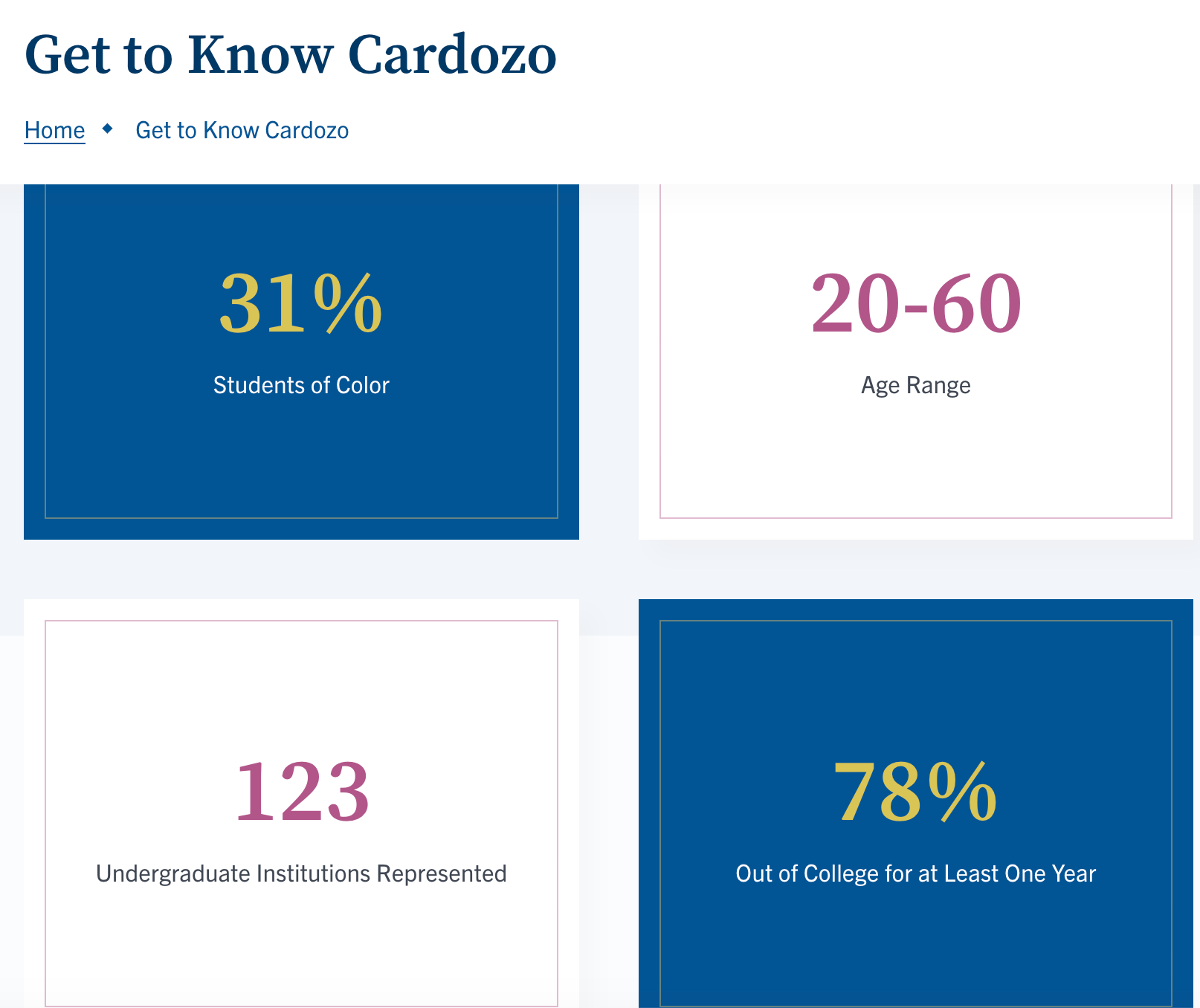
Cardozo Law's 2025 incoming class profile shows that 78% of the class was out of college for at least one year, and ages ranged from 20 to 60. A class selected this way tells you the admissions committee values what applicants bring back from the world outside a classroom, and that arriving straight from undergrad isn’t the standard at Cardozo Law.
The strongest gap years demonstrate that you gained experience based on the pillars from the previous tip. A role at a nonprofit or advocacy organization gives you an activism story with real clients and outcomes. A role at a startup, or building your own project, speaks to innovation and shows committees you can handle the rigor of law school after time away from the classroom.
When writing about your gap year in your application materials, always quantify what you did on your resume, including number of caseloads, clients served, or results delivered. Turn the most meaningful experience into an anecdote in your optional statement. Ask the supervisor who watched you do the work for a letter of recommendation, since a recent professional letter carries more weight than a three-year-old academic one.
When our students ask whether a gap year will hurt their chances, I tell every student the same thing: Admissions committees don't penalize gap years. They penalize gap years they can't make sense of, and reward the ones that show growth as a potential lawyer.
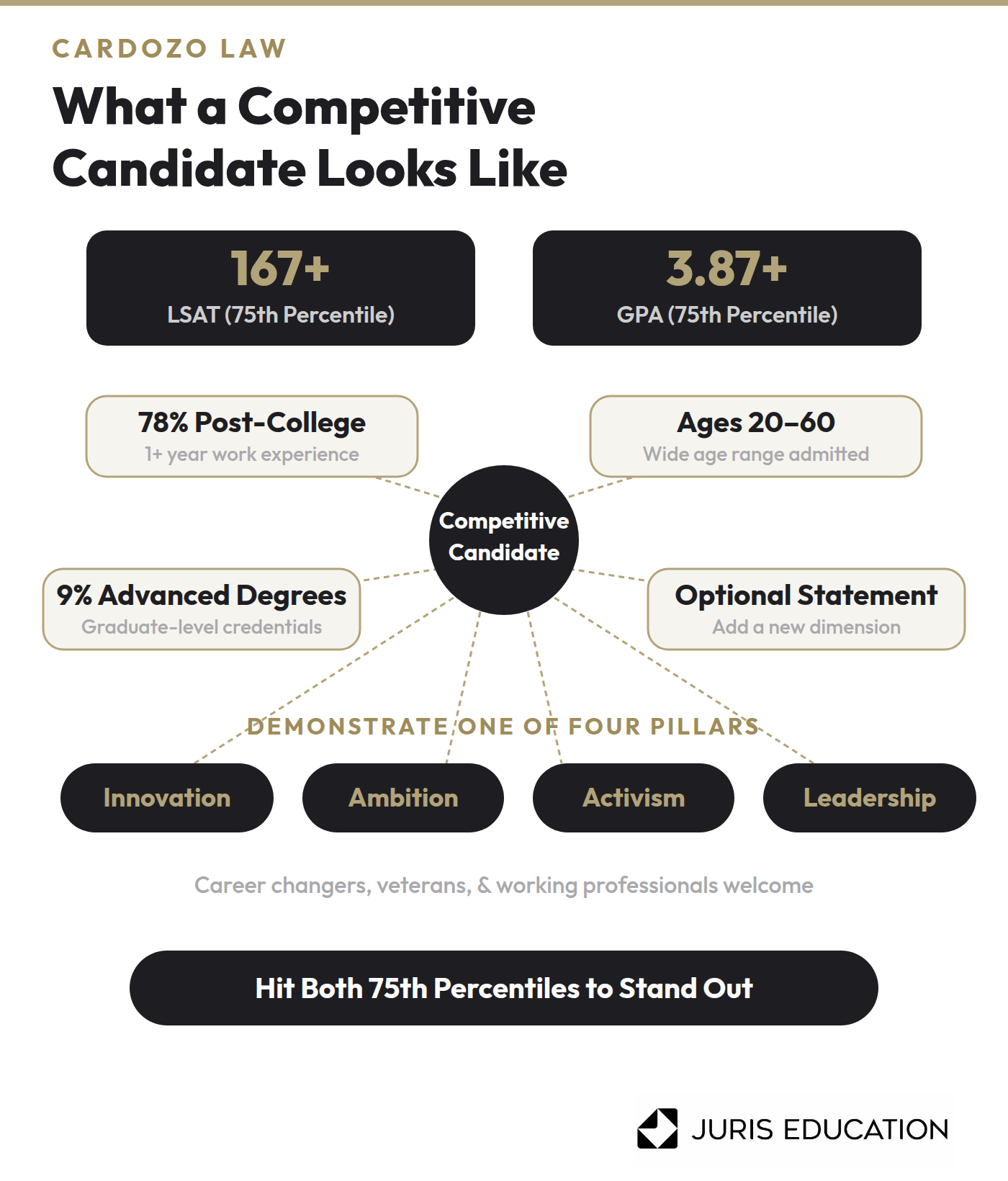
A competitive candidate at Cardozo School of Law has a 167+ LSAT score, a 3.87+ GPA, and experience in at least two of the school's four pillars in their resume or essays. Those numbers align with the 75th percentile of the most recent entering class, and hitting both puts you ahead of the majority of admitted students in the initial screening phase.
According to Cardozo Law's 2025 incoming class profile:
These statistics show that Cardozo Law admissions officers look for applicants who bring professional and life experience into the classroom. The wide age range tells you the committee reads applications from career changers, veterans, and working professionals alongside recent graduates, and values the perspective each one of them brings.
Submit all application materials through the LSAC and its Credential Assembly Service (CAS). Cardozo Law School uses a rolling admissions process and won’t review your application until it receives all required materials.
Here’s everything you need to submit:
Watch the video below for a comprehensive law school application checklist:
Cardozo School of Law is ranked 61st in the nation, according to our ranking.
Cardozo Law's first-time bar passage rate is 87.83% for the class of 2025, based on the most recent ABA bar passage data.
Cardozo Law doesn’t schedule evaluative interviews as part of its admissions process, and applicants cannot request them. In limited circumstances, the admissions committee may invite a candidate to interview, but this is the exception. Since there's no interview to lean on, your written materials carry the full weight of your application.
Cardozo Law offers its JD program with two entry terms, the traditional Fall start and a May/Summer start that spreads the first year across three semesters. Beyond the JD, the school offers four LLM programs, two online degrees, and a JSD:
Dual-degree options include a four-year JD/MBA with Yeshiva University's Sy Syms School of Business, which students apply to after their 1L year, and a JD/LLM international dual degree with the Sorbonne in Paris.
Co-Founder of Juris Education, Dartmouth College


.svg)
